
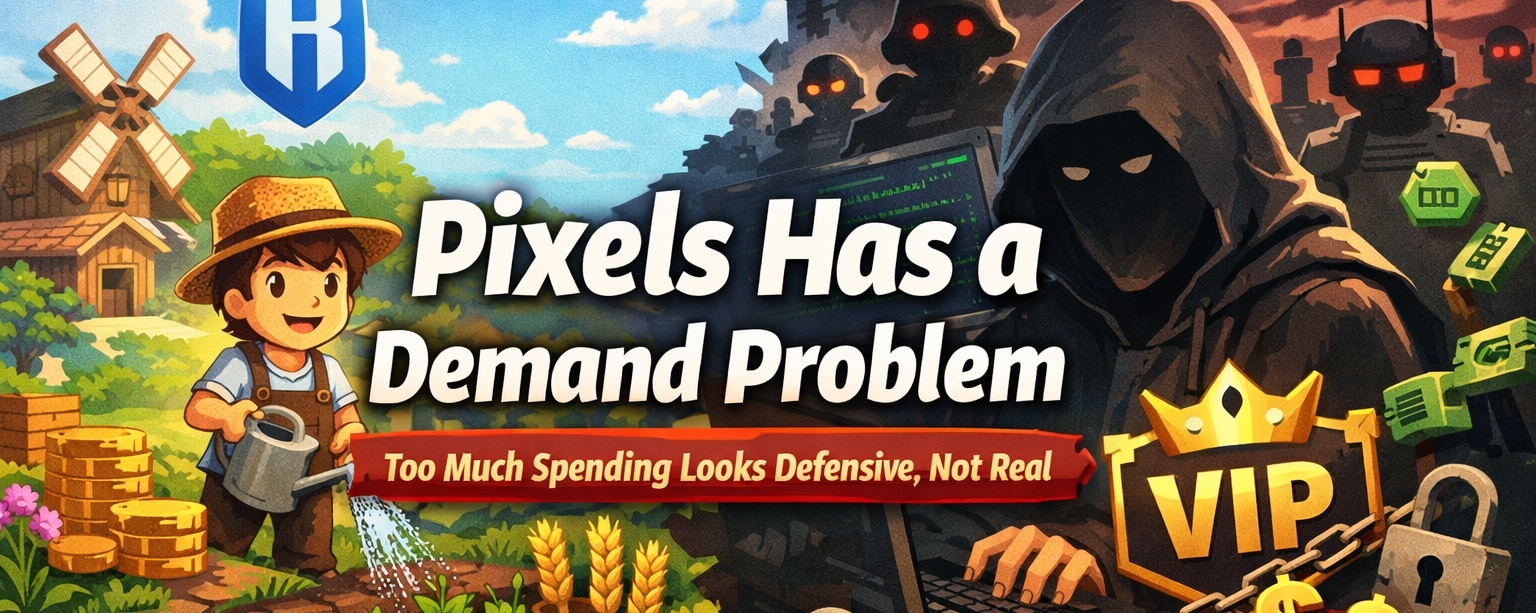

The way I see it, the most useful way to understand Pixels is not by looking at growth alone, but by looking at defensive demand. What I mean by that is simple: if players are spending not because they enjoy the game more, or because they want to express themselves, but because they are trying to avoid friction, bots, or restricted access, then something is off. On the surface, the economy may look active. Underneath, it is much weaker than it appears.
That matters right now because the Web3 gaming market is no longer at a stage where user numbers and token activity are enough on their own. The real question has changed. Are players spending because they genuinely want to, or because the system quietly pushes them in that direction? In a game like Pixels, which depends so much on social play, open markets, and player-driven activity, that distinction matters more than the headline metrics.
What stands out to me in Pixels is the way its economy is layered. There is a soft currency serving one function, and a premium currency serving another. On paper, that makes sense. One supports the everyday gameplay loop, while the other is tied to upgrades, higher-value items, or premium behavior. There is nothing inherently wrong with that setup. My concern is not the structure itself. It is what that structure can turn into once real player behavior starts shaping it.
To me, a premium layer is healthy only when it is selling things like expression, speed, or optional status. The problem starts when it begins to make participation feel cleaner or easier in a way that matters. At that point, the paid route is no longer just the nicer route. It becomes the less frustrating one. And once that happens, spending starts to mean something different. It is no longer a clean sign of preference. It can become a sign that players are paying to work around the system.
That is why I do not see VIP-style utility as just another monetization feature. If paying gives players smoother trading, more room to operate, or some distance from an environment shaped by abuse or exploitation, then the ecosystem starts dividing people in a subtle but important way. Free players may not be blocked outright, but they can still end up stuck in a rougher version of the same system. For me, that is the point where optional monetization starts turning into defensive monetization.
The incentives get messy from there. The team wants activity. The token needs demand. The market wants to see signs of a live economy. But on-chain, spending always looks healthy at first glance. A dashboard cannot tell the difference between someone paying out of excitement and someone paying because the unpaid experience feels worse. That is what makes defensive demand so risky. It can make a weak product signal look like a strong economic one. And once a team starts reading that signal the wrong way, it can begin optimizing for the wrong things.
This issue shows up especially clearly in autonomous or decentralized systems because enforcement is never complete. Open wallets, tradable assets, public markets, and composability all make these systems more open and more dynamic, but they also make them easier to exploit. A centralized game can hide a lot of this behind moderation and direct control. A decentralized game often ends up pushing some of those costs back into the product itself. That is why I think Pixels should be read not just as a game economy, but as a coordination system under pressure.
If I had to name one metric that actually matters here, it would be the Defensive Demand Ratio. In other words: out of all premium or VIP-linked spending, how much comes from real desire, identity, creativity, or convenience, and how much comes from trying to avoid friction? If that ratio is too high, then the project may still look healthy in the short term while quietly damaging trust and long-term retention. That is the kind of weakness markets usually notice only after the damage is already done.
My more contrarian view is that the next major failure in Web3 games may not come from inflation alone, but from friction monetization dressed up as demand. In a game like Pixels, that risk becomes even more serious as the ecosystem grows and starts behaving more like a platform. If paid utility becomes the main way to get a cleaner experience across the system, then monetization stops being a sign of product strength and starts becoming a sign that core coordination problems were never really solved.
For me, the real test is very straightforward. If Pixels is genuinely healthy, then premium demand should still hold up even after anti-bot systems improve, the base experience becomes smoother, and non-paying users get cleaner access. If spending remains stable under those conditions, then players are clearly paying for real value. But if monetization drops sharply once those problems are reduced, then the answer is hard but obvious: the system was not really selling value. It was selling protection from its own coordination problems.