
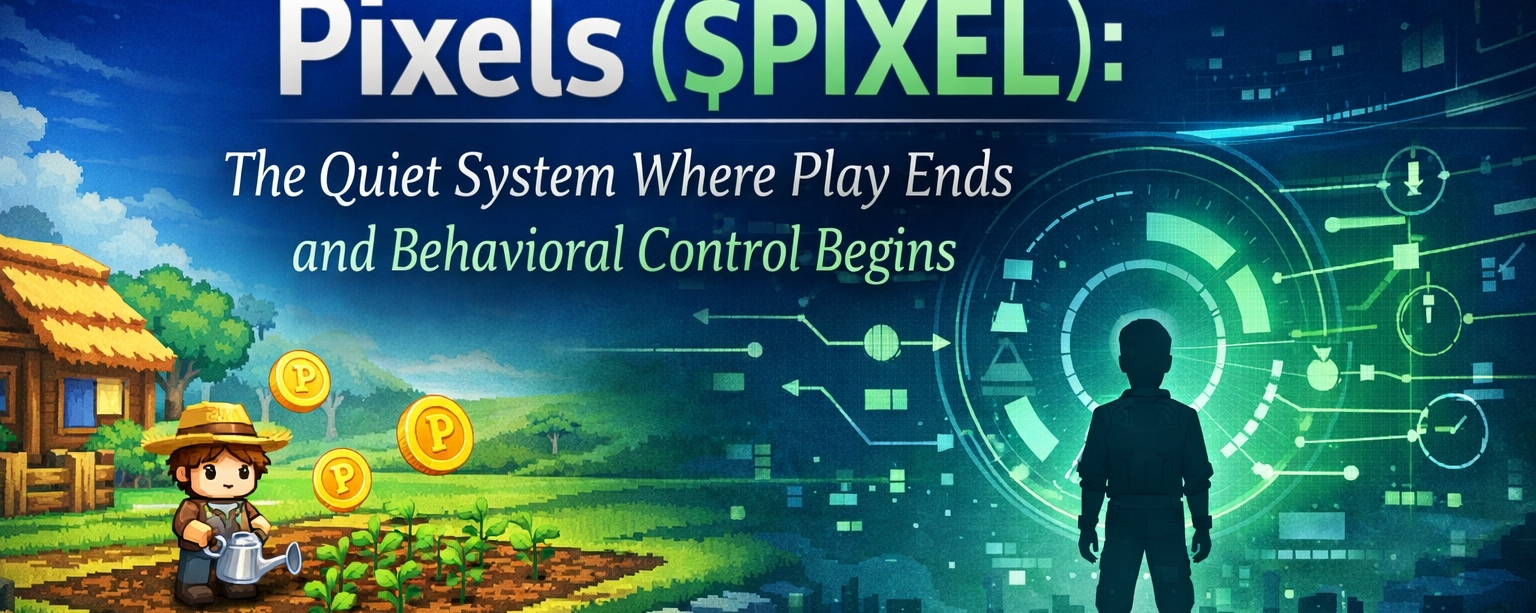
Lately, I keep noticing something subtle in the market.
The projects that get the most emotional reactions are the ones that do not look like crypto.
Not dashboards. Not charts. Not yield tables.
Worlds.
Soft ones.
Places you can sit in without feeling like you are being measured.
That shift is not accidental.
It is fatigue finding a new language.
People are tired of negotiating with systems that feel like spreadsheets wearing logos. So when something like Pixels shows up, it does not just attract attention. It absorbs it.
A farm.
A character.
A loop you can follow without reading a thread first.
At first glance, it feels like an escape from the financial surface of crypto.
And for a moment, I believed that too.
Pixels looks like it solved a problem most teams still ignore.
Not technical friction.
Cognitive friction.
The interface does not ask you to think in protocols.
It asks you to move.
Click. plant. harvest. return.
The UI is not just design.
It is instruction.
Every button is a suggestion about how your time should be spent.
Every loop is a quiet reinforcement of what “productive behavior” looks like inside the system.
This is where the tone shifts.
Because once you stop seeing Pixels as a game and start reading it as a behavioral system, the softness begins to feel engineered.
The farm is not just a setting.
It is a buffer.
A layer that absorbs resistance.
Underneath it, the structure is far more precise.
Time is segmented.
Actions are repeatable.
Output is trackable.
This is not accidental simplicity.
This is controlled rhythm.
And that is where the contradiction begins to form.
Pixels feels casual.
But it operates with discipline.
Not the loud kind.
The quiet kind that does not announce itself.
The system does not force you.
It trains you.
This is where infrastructure starts to matter more than aesthetics.
Ronin is not just a scaling choice.
It is a behavioral enabler.
Low fees are usually described as accessibility.
That is only half the story.
Low friction removes hesitation.
And when hesitation disappears, repetition becomes easier.
When repetition becomes easier, patterns begin to form.
And patterns are where systems start to shape people.
The network fades into the background.
But its impact moves to the foreground of behavior.
You stop thinking about cost.
You start thinking in loops.
That transition is subtle.
But it is everything.
Because once a system successfully moves you from decision to routine, it no longer needs to convince you.
It only needs to maintain you.
Pixels is very good at this.
It does not overwhelm you with complexity.
It surrounds you with familiarity.
But familiarity, in this context, is not neutral.
It is directional.
The interface becomes a kind of moral architecture.
It defines what counts as progress.
It defines what counts as wasted time.
It defines what counts as being “active.”
And slowly, without friction, you begin to agree.
Not consciously.
Operationally.
This is the part most people miss.
The system does not just host activity.
It standardizes it.
And once activity is standardized, it becomes measurable.
Once it becomes measurable, it becomes optimizable.
And once it becomes optimizable, it starts to look less like play.
And more like production.
But the experience never says that out loud.
That is the elegance.
Work is not introduced.
It is dissolved into atmosphere.
You are not told to grind.
You are given a reason to return.
You are not pushed to optimize.
You notice that optimization feels better.
This is not manipulation in the crude sense.
It is alignment.
But alignment always raises a deeper question.
Aligned to what?
Because beneath the calm surface of Pixels, there is still an economic system trying to sustain itself.
Tokens exist.
Resources flow.
Time converts into output.
And that output has meaning beyond the game.
This is where the tension sharpens.
Is the system giving structure to play?
Or is it shaping play into something the system can extract from more efficiently?
The answer is not clean.
On one side, Pixels avoids the obvious traps.
It is not screaming incentives.
It is not collapsing under unsustainable emissions.
There is restraint here.
There is pacing.
There is an understanding that economies die when they become too loud.
That deserves recognition.
But restraint does not remove control.
It refines it.
Because a stable loop is more powerful than a chaotic reward.
It keeps people inside longer.
And over time, it begins to define their behavior more precisely.
You start with curiosity.
You stay because the system makes sense.
And eventually, you adjust because the system rewards certain patterns more than others.
This is where tokenomics stops being a spreadsheet discussion.
And becomes a question of power.
Who absorbs volatility?
Who gets flexibility?
Who is allowed to play loosely, and who is pushed toward efficiency?
These answers are not written in bold.
They are embedded in the structure.
In access.
In progression.
In the cost of being inactive.
And once you notice that, the “casual” identity starts to feel conditional.
Open at the surface.
Selective underneath.
Welcoming to enter.
More demanding to sustain.
This does not make Pixels deceptive.
It makes it precise.
It understands that modern users do not respond well to pressure.
So it removes the feeling of pressure.
But the system still needs output.
So instead of pushing harder, it smooths the path.
It reduces friction until participation becomes the natural state.
And that is where the unease settles.
Because when a system becomes very good at removing resistance, you have to ask what that resistance was protecting in the first place.
Friction is not always a flaw.
Sometimes it is a boundary.
A moment where the user pauses.
Thinks.
Decides.
When that pause disappears, the system gains something.
Continuity.
But the user may lose something.
Distance.
And distance is where agency usually lives.
I still think Pixels is one of the more intelligent systems in this space.
Not because it is louder.
Because it is quieter.
It does not argue with you.
It guides you.
It does not demand participation.
It normalizes it.
And that is far more effective.
But effectiveness is not the same as neutrality.
Because every system that shapes behavior carries an implicit philosophy.
A belief about how users should act.
How often they should return.
What kind of engagement is considered valuable.
Pixels expresses that philosophy through design, not language.
Through loops, not promises.
Through repetition, not explanation.
And once you start seeing it that way, the entire experience feels different.
Less like a game you play.
More like a system you adapt to.
So the real question is not whether Pixels works.
It clearly does.
The real question is much harder to sit with.
When a system becomes so good at guiding behavior that participation feels natural, routine, almost voluntary…
at what point does that guidance stop being design, and start becoming control?