
@Pixels There wasn’t a big moment that made me question play-to-earn. No crash, no viral thread, no sudden realization that everything was broken. It happened quietly. I was watching a game that, on paper, looked fine. People were still logging in, rewards were still being distributed, and the on-chain activity hadn’t disappeared. But something felt off. The energy was different. Players weren’t there because they wanted to be there anymore. They were there to take what they could and move on. And once I noticed that shift, it became hard to ignore it everywhere else.
That feeling explains more about the collapse of Web3 gaming than most of the usual explanations. People like to point to the bear market, and sure, timing matters. But if you look closely, the cracks were already there. The systems weren’t just pressured from the outside. They were unstable from the inside. The way rewards were designed shaped the kind of behavior these games attracted. And in too many cases, they attracted the wrong kind.
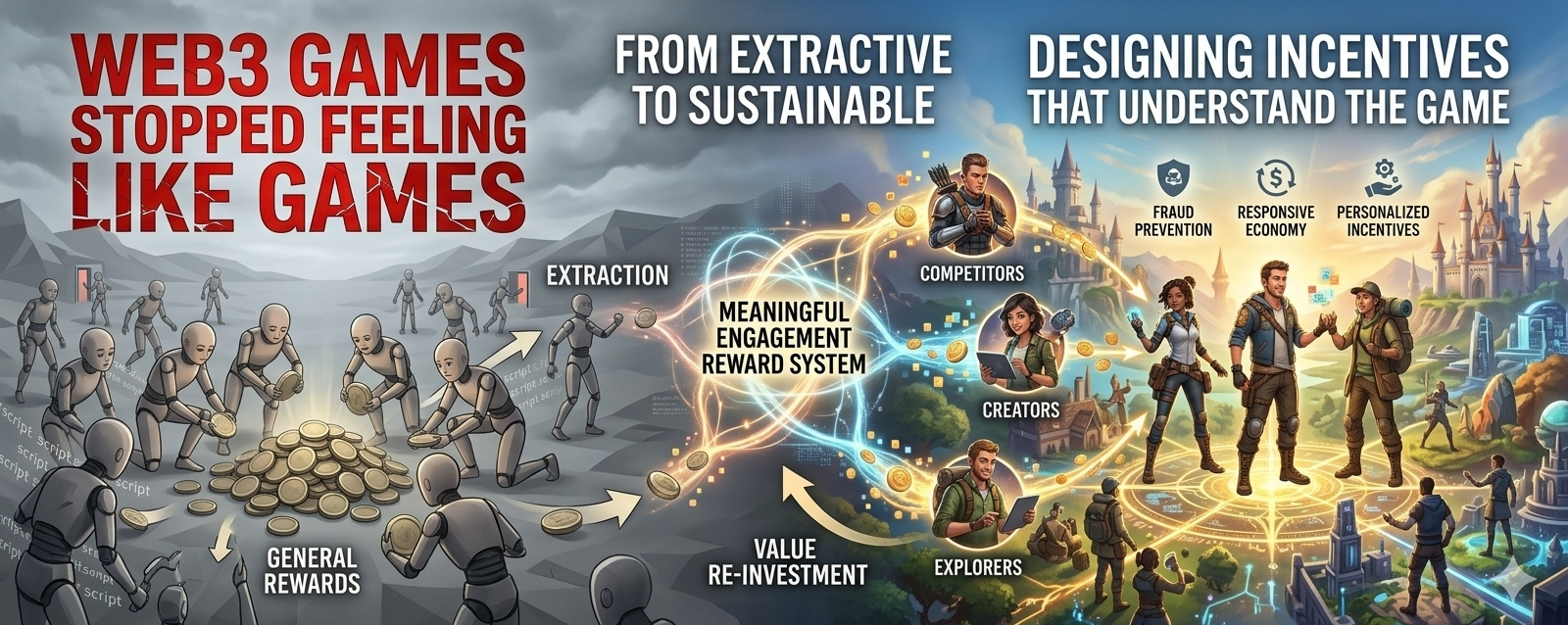
At the start, broad reward systems sounded fair. Anyone could participate. Anyone could earn. It felt open, almost idealistic. But what looked fair on the surface created problems underneath. There was no real way to separate someone who cared about the game from someone who was just farming it. Scripts, bots, multi-wallet setups — they all blended into the same stream of “activity.” And because the system didn’t know the difference, it rewarded them all the same.
That changed everything. When rewards don’t distinguish between real engagement and extraction, they don’t just bring in players — they invite exploitation. You end up with movement instead of meaning. Numbers go up, but connection goes down. Retention drops, not because people suddenly lose interest, but because many of them were never truly invested to begin with.
And once that behavior enters the system, it doesn’t stay small. It scales. Bots multiply. Farming becomes more efficient. One person operating dozens of wallets stops being an exception and starts becoming part of the ecosystem. From the outside, it can still look like growth. More users, more transactions, more activity. But underneath, it’s hollow. The economy is being drained by participants who were never going to stay.
That’s why so many games seemed healthy right before they started falling apart. The metrics told one story. The experience told another.
At the same time, there was another issue building quietly. The economies themselves weren’t being managed with enough clarity. Rewards kept flowing, but there wasn’t a clear understanding of what those rewards were actually achieving. Were they improving retention? Were they increasing meaningful engagement? Were they creating value that could sustain the system over time? In many cases, there wasn’t a real answer.
Without that feedback, rewards turned into guesswork. And guesswork at scale is expensive.
You could feel the impact of that inside the games. Over time, rewards stopped supporting gameplay and started replacing it. Players weren’t asking what was fun anymore. They were asking what paid the most. The experience flattened into repetition because repetition was efficient. And when the rewards slowed down, the illusion disappeared. There wasn’t enough depth left to hold people.
That’s the part that stuck with me the most. People didn’t leave just because the economy changed. They left because there wasn’t enough game underneath it.
Now, what’s interesting is how the approach is starting to shift. Instead of trying to make rewards bigger, some teams are trying to make them smarter. And that sounds simple, but it’s a completely different way of thinking.
The focus is moving toward precision. Not everyone should be rewarded the same way, because not everyone contributes in the same way. Real engagement has to be understood through behavior, not just activity. Who is actually playing? Who is coming back? Who is adding value to the ecosystem instead of just extracting from it?
If rewards can be directed toward those players, they stop feeling like a constant cost and start acting more like an investment.
Fraud prevention becomes part of that too, but not just in the obvious sense. It’s not only about banning bots. It’s about making fake behavior harder to pass as real. When systems get better at recognizing genuine engagement, it changes incentives across the board. Farming becomes less attractive. Real players face less distortion. The signal becomes clearer.
Then there’s the idea of making these economies more responsive. Instead of fixed reward schedules, some systems are starting to adjust in real time. If inflation rises, emissions can slow down. If engagement drops, incentives can shift. It’s not perfect, and it comes with its own risks, but it introduces something that was missing before — adaptability.
What matters even more is the ability to measure what rewards actually do. For every token distributed, what comes back? Are players staying longer? Are they contributing more? Are they building something that lasts? When those questions have clear answers, studios can stop guessing. They can design with intention.
Personalization plays into that as well. Not every player enjoys the same things. Some compete, some create, some explore. When rewards align with how people naturally play, the experience feels less forced. It becomes something closer to a real game again, instead of a system people are trying to optimize.
But even with all of these improvements, one thing doesn’t change. If the game itself isn’t worth playing, no reward system can fix it. Incentives can support a good experience, but they can’t replace it.
That’s why this shift matters, but also why it isn’t a complete solution. The space seems to be moving away from chasing growth at any cost and toward building something more sustainable. That’s a step forward. But the projects that actually last won’t just be the ones with better reward systems. They’ll be the ones that remember why people play games in the first place.
Looking back, that quiet moment I noticed wasn’t really about one game. It was about a pattern. A realization that something fundamental had been misunderstood.
The problem was never just too many rewards.
It was rewards given without understanding what they were really doing.