
The alert came in at 2:07 a.m., the kind that doesn’t ring loudly but lingers. No exploit confirmed. No funds drained. Just a pattern—wallet approvals clustering in a way that felt too neat to be accidental. The dashboards were green. Throughput was stable. Latency unremarkable. By every metric we had trained ourselves to celebrate, the system was performing exactly as designed.
And still, something felt wrong.
I’ve sat in enough risk committee calls to recognize the tone before the words form. It’s not panic. It’s not even urgency. It’s the quiet recalibration that happens when everyone in the room understands that the threat model has shifted without asking for permission. Someone mentions audit trails. Someone else pulls up session logs. There’s a debate about whether this is user behavior or design leakage. No one says “TPS” out loud. Not because it isn’t relevant, but because in moments like this, speed feels like a distraction.
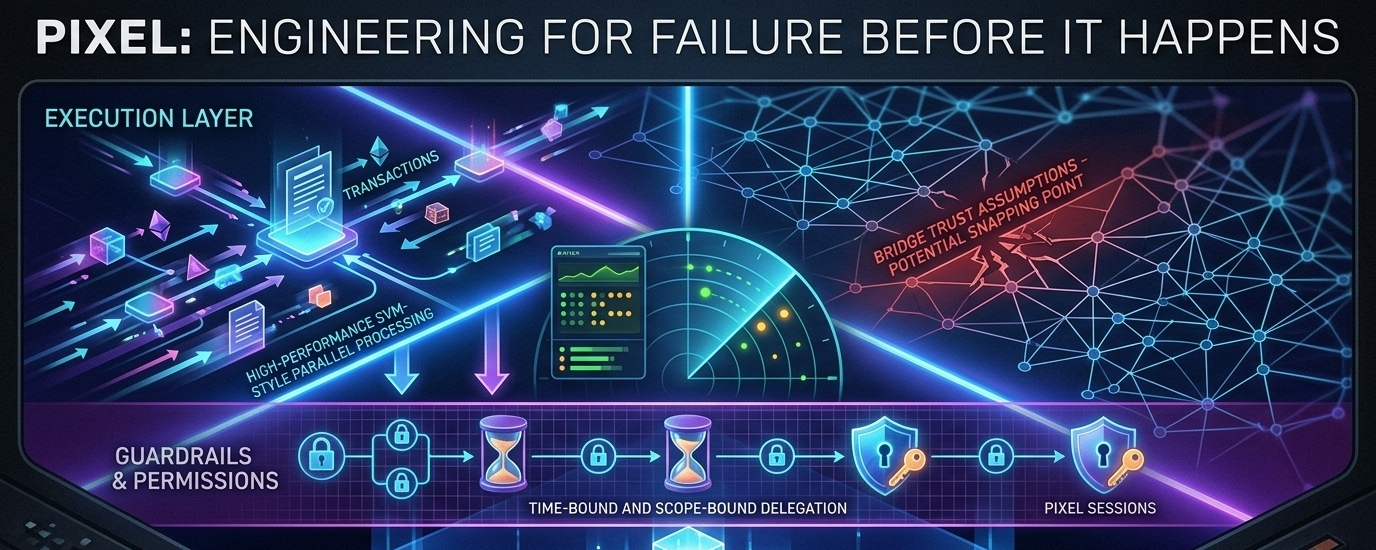
PIXEL doesn’t pretend that speed is safety. It never did. It was built as a high-performance L1 with guardrails, not as a race car with the brakes removed. The architecture leans into SVM-style execution—parallel, efficient, unapologetically fast—but it anchors that execution above a settlement layer that refuses to compromise on finality or correctness. That separation matters more than it sounds. Execution can be ambitious; settlement must be conservative. Anything else is theater.
The incident, if it can be called that, wasn’t about block times or congestion. It was about permissions. It was about the quiet, invisible surface area created when a user says “yes” too many times in too many places. Wallet approval debates don’t trend on social feeds, but they define the boundary between resilience and regret. We’ve seen this before: not catastrophic failures, but accumulations—keys exposed, scopes misunderstood, approvals left lingering like unlocked doors.
PIXEL Sessions were designed for exactly this edge. Not as a feature, but as a constraint. Enforced, time-bound, scope-bound delegation. You don’t hand over the house keys; you issue a temporary pass that expires, limited to specific rooms. It’s not frictionless in the naive sense. It’s disciplined. It assumes that users will make mistakes and builds a system that contains them when they do.
I’ve heard the argument that fewer signatures mean less security theater, that every confirmation dialog is a chance for confusion. That’s partly true. But the answer isn’t to remove friction blindly; it’s to reshape it. “Scoped delegation + fewer signatures is the next wave of on-chain UX.” Not because it feels smoother, but because it reduces the blast radius when something inevitably goes wrong.
The logs from that night told a familiar story. No breach. No exploit. Just overbroad permissions interacting with legitimate workflows in ways that no one had explicitly modeled. The kind of thing that passes audits because it isn’t technically incorrect. The kind of thing that keeps risk committees awake anyway.
Audits, for their part, are snapshots. They certify that a system behaves as expected under known conditions. They don’t guarantee that expectations are complete. That’s where architecture has to carry the burden. Modular execution helps here—not as a buzzword, but as a discipline. By isolating execution environments and constraining how they interact with settlement, PIXEL limits how far a mistake can propagate. It doesn’t eliminate risk. It localizes it.
There’s a temptation in this space to equate compatibility with safety. PIXEL maintains EVM compatibility, but only as a way to reduce tooling friction, not as a philosophical anchor. Familiar tools make it easier to build, to audit, to reason about behavior. They don’t make the underlying system safer by default. Safety comes from how permissions are structured, how keys are managed, how assumptions are constrained.
The native token exists in this context not as a symbol of value, but as security fuel. It powers the system, yes, but it also binds participants to its integrity. Staking isn’t yield; it’s responsibility. It’s a commitment to the idea that the system’s correctness matters more than its velocity.
Bridges complicate that picture. They always do. Interoperability extends reach, but it also extends trust assumptions beyond the system’s immediate control. We’ve all seen how that plays out. “Trust doesn’t degrade politely—it snaps.” When it does, it doesn’t matter how fast your blocks were or how elegant your execution model looked on paper. What matters is whether the system anticipated the failure and limited its consequences.
By 3:30 a.m., the alert had been downgraded. No funds lost. No contracts compromised. The pattern was understood, documented, and folded back into the next audit cycle. Another line item for the committee. Another reminder that most failures don’t announce themselves with fireworks. They accumulate in the margins, in the permissions we grant and forget, in the keys we expose without realizing it.
Speed didn’t cause the problem, and it wouldn’t have solved it. If anything, it would have made the outcome arrive sooner.
PIXEL’s bet is quieter than that. It assumes that performance is necessary but insufficient. That the real work happens in the constraints—in sessions that expire, in scopes that are narrow by default, in a settlement layer that refuses to be rushed. It assumes that users will demand better UX, and that the only sustainable way to provide it is to make safety implicit rather than optional.
A fast ledger is impressive. A fast ledger that can say “no” is useful. And in a system where most failures are predictable if you’re willing to look at them long enough, usefulness is the only metric that holds up at 2 a.m.
