

And…Most Web3 games begin by talking about ownership, then struggle to make that ownership feel meaningful in actual play.i am very interested to Pixels because it starts from the opposite direction.
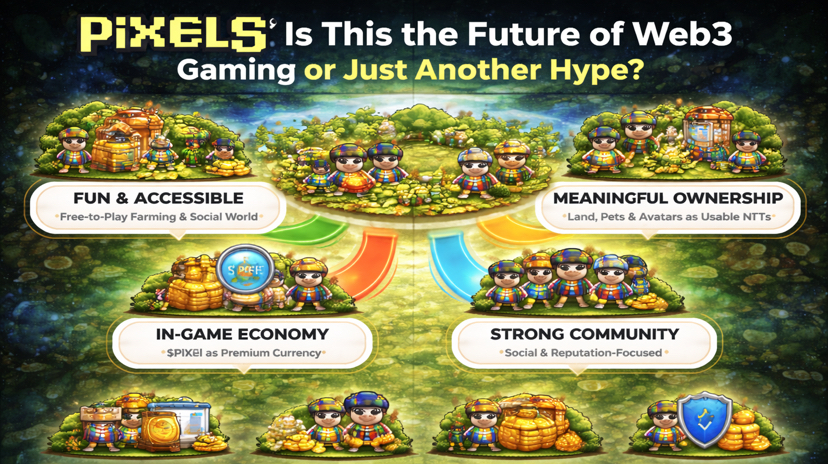
The project presents itself as a free-to-play game first, with farming, exploration, and a social world built around play with friends and community building. Its official materials also frame it as part of a broader attempt to solve the weaknesses of traditional play-to-earn by using stronger incentive design, better economics, and a “fun first” philosophy.It is not trying to win by being more technical than the competition. It is trying to be more playable.
What stands out to me is the way Pixels lowers the entry barrier without lowering the ambition.
The public facing experience is simple enough for a mainstream player to understand quickly: make your home explore master skills and build with other people. In practice, that means the game is not just asking players to click through a reward loop. It is asking them to inhabit a world that feels social, persistent, and worth returning to. That distinction matters. A lot of blockchain games are built around participation. Pixels is built around residence.
The mechanics reinforce that philosophy.
PIXEL documentation describes it as an openended world where players gather resources, advance skills and build relationships while exploring the story and quests woven through the universe. The same materials also show that the game’s economy is not an afterthought….resources feed progression and progression feeds a larger sense of ownership over time.I think that is one of the project’s smarter choices. It avoids the trap of making every mechanic immediately financial. Instead, it makes the loop legible. Players farm because farming is useful.They explore because exploration opens more of the system. They keep going because the world keeps giving them new reasons to care.
Land and NFTs deepen that structure.
Pixels’ help center explains that NFT farms can be acquired through the official marketplace, and the NFTs collection covers land, pets, and avatars as game assets. players must claim purchased farms, and the land can be bridged to Ronin, which points to a deliberate effort to make ownership practical rather than symbolic. That matters because it turns blockchain from a background label into a usable part of the world. In Pixels, land is not just something you hold. It is something you operate.
PIXEL fits into the same logic.
The official token documentation describes it as a premium in-game currency used for items, upgrades, cosmetics, minting new land, speeding up build times, temporarily boosting energy, and placing special items on land. The key point is that pixel is positioned outside the core gameplay loop, which is an important design choice.
It is there to amplify the experience, not replace it. The staking documentation says users can put $PIXEL to work by staking it into different game projects, supporting development and expansion while gaining access to potential future benefits tied to those projects. That is a more disciplined model than the usual “token first, game second” pattern.
The social layer is just as important as the economic one. Pixels’ community rules emphasize a safe, trustworthy environment, while the reputation system is designed to reward loyal users and help distinguish good actors from bad ones.In other words, Pixels is not simply building a game with chat on the side. It is building a social economy where trust, participation, and status are part of the design. That is a more demanding model, but also a more realistic one for a persistent online world.
i keep coming back to the same tension: Pixels wants mainstream accessibility, but it also wants meaningful blockchain depth. That balance is hard. Too much complexity, and casual players walk away. Too little, and the Web3 layer becomes decorative. The project’s own materials suggest that it is aware of this trade-off. It describes itself as fun-first, easy-going, and blockchain-backed, while also arguing that it wants to be a gateway for millions into Web3.
That is an ambitious target, but it is at least coherent. The game is trying to make ownership feel natural instead of academic. Speed matters, but trust matters more. A system like this survives only when players feel they are playing a game, not operating a dashboard.
That ultimately is why Pixels is worth paying attention to.
It is not just another Web3 farming title with a token attached. It is an attempt to make a blockchain world that behaves like a real community and plays like a real game. The project’s strength is not that it promises instant transformation.it is that it understands the long route…make the game fun make the ownership usable, make the social layer matter and let the economy support the experience instead of overwhelming it.
If Pixels keeps holding that line, it could remain relevant for a simple reason.
It is building toward a world players can understand, not just one they can speculate on.