
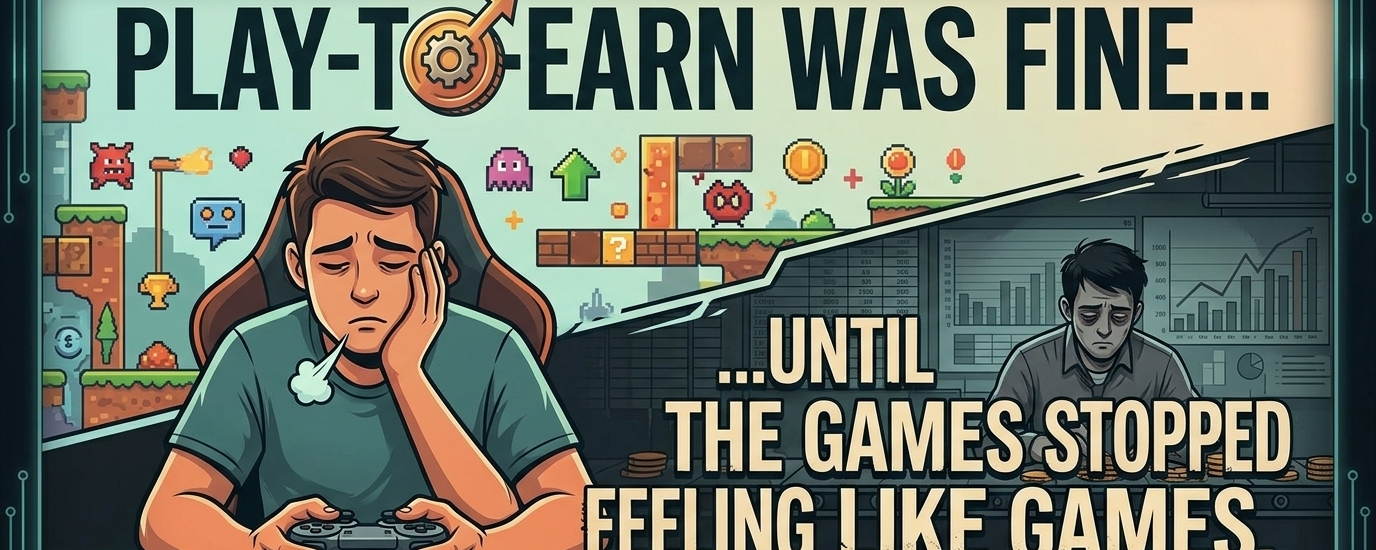
I didn’t really question play-to-earn at first. Like a lot of people I was just excited to see something new happening in crypto. The idea sounded almost too good to ignore: play games, earn tokens, maybe even turn some free time into income. It felt like one of those rare moments where fun and finance were finally meeting in the middle.
But somewhere along the way, something shifted. I didn’t notice it immediately. It was gradual. The games I used to open out of curiosity started feeling like tasks I had to complete. The excitement faded and in its place came this quiet question I couldn’t ignore anymore: when did this stop being a game?
At the beginning play-to-earn had this raw experimental energy. It reminded me of early crypto in general. People weren’t just playing they were exploring. Figuring things out. Sharing tips in Discord servers talking about strategies, even laughing at bugs and weird mechanics. It wasn’t perfect but it felt alive.
Then the focus slowly tilted. Instead of asking is this fun? the conversation became how much does this earn per day? That shift changed everything.
I’ve noticed that when earnings become the main reason to play the experience itself starts to shrink. Every action becomes optimized. Every decision is measured. You’re not exploring anymore, you’re calculating. And once that mindset kicks in, it’s hard to go back.
A lot of early play-to-earn games leaned heavily into repetitive mechanics. Click this. Complete that. Wait for energy to refill. It worked at first because the tokens had value. But once prices dipped, the cracks started to show. Without the financial incentive, there wasn’t much left holding players in.
It feels like many of these games were built backwards. Instead of starting with a good game and adding earning mechanics they started with tokenomics and tried to wrap a game around it. And players can feel that, even if they don’t say it directly.
From my perspective that’s where the disconnect really began. Games are supposed to pull you in without asking for anything upfront. You play because you enjoy it. Earning should feel like a bonus not the main objective.
There’s also the issue of sustainability. Early adopters often made the most, while later players struggled to break even. That created a strange dynamic where new players weren’t just joining a game they were entering an economy that depended on constant growth. And we all know how that tends to end.
I remember talking to a friend who was deep into one of these games. He wasn’t having fun anymore but he kept playing because he felt like he had to recover his investment. That stuck with me. When a game starts to feel like a job you can’t quit, something is clearly off.
One thing that stood out to me is how quickly communities shifted. At first people shared gameplay moments funny clips even fan art. Later most discussions revolved around token prices updates affecting earnings or exit strategies. The vibe changed completely.
That doesn’t mean the idea of play-to-earn is broken. I don’t think it is. I think it just matured too fast without the right foundation. The tech moved quickly the money flowed in but the actual game design didn’t always keep up.
Now we’re starting to see a different approach. Some newer projects are focusing on gameplay first. They’re trying to build something people would actually play even without rewards. That feels like a step in the right direction even if it’s still early.
There’s also a growing awareness among players. People aren’t jumping in as blindly as before. They ask better questions. They look beyond the earning potential. And honestly, that’s healthy for the space.
Crypto tends to go through these cycles. Big idea rapid hype reality check then a quieter rebuild phase. Play-to-earn feels like it’s somewhere between the reality check and the rebuild right now.
Looking back I don’t regret being part of that early phase. It was chaotic sometimes frustrating but also interesting to witness. It showed what’s possible, even if it didn’t fully deliver on the promise yet.
I think the real future isn’t about play-to-earn as a headline. It’s about games that people genuinely enjoy with ownership and rewards integrated naturally. Not forced. Not the main selling point. Just part of the experience.
Because at the end of the day if it doesn’t feel like a game people won’t stay. And if people don’t stay no token model can fix that.
Maybe that’s the lesson a lot of us learned the slow way.
