
Let’s be real for a second
Most GameFi projects didn’t die because people weren't playing. They died because their math didn't add up
We’ve all seen it: bots vacuuming up rewards, tokens crashing because of hyper-inflation, and gameplay
that felt more like a chore than a hobby. It was a cycle of hype followed by a fast exit
But @Pixels decided to do something different. They didn't just build a popular game; they built Stacked, the infrastructure they needed to survive. And it might just be the blueprint the rest of the industry has been looking for
Beyond the Quest Board:
What Stacked Actually Does
Most reward platforms are just fancy to-do lists. Stacked is different - it’s a LiveOps engine with a brain. It uses an AI game economist to solve the black box problems that keep developers up at night:
The Day 3 Wall:
Why are players dropping off right after they start?
Quality over Quantity:
Who are the actual loyal players, and who is just here to farm and dump?
Budget Bleed:
Where are rewards going to waste?
Instead of throwing tokens at a wall and hoping they stick, studios can finally use data to drive retention and lifetime value (LTV)
Battle-Tested, Not Just Theory
In a space full of coming soon whitepapers, Stacked is already in the trenches. The numbers aren't just projections; they're historical:
200M+ rewards processed
Millions of active players supported
$25M+ in revenue contributed to the Pixels ecosystem
That kind of track record is incredibly rare in Web3. It’s proof that the system works under heavy pressure
The AI Advantage
Anyone can build a dashboard, but building a moat is harder
Stacked’s real power lies in its ability to:
1. Spot bots at scale (the silent killer of game economies).
2. Adjust incentives on the fly to keep the economy balanced.
3. Learn from behaviour across a massive user base
This isn't just about giving away tokens; it’s about economic engineering.
Killing the Middleman Tax
Game studios already spend billions on Facebook and Google ads just to find players. Stacked flips that script
> The New Model:
Instead of paying big tech platforms for clicks, studios pay the players directly for their time and loyalty.
> This creates a win-win:
studios get a better ROI, and players actually see a piece of the value they help create. It turns marketing spend into a sustainable growth loop.
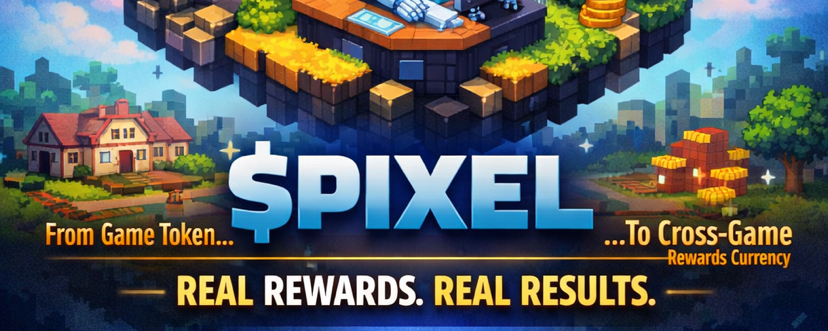
The Evolution of $PIXEL
This is where it gets interesting for holders. $PIXEL is evolving from a single-game currency into something much bigger:
A cross-ecosystem reward layer
A loyalty standard that works across multiple titles
The primary bridge between player value and studio demand.
As more games plug into Stacked, $PIXEL isn't just tied to one farm - it’s tied to a growing network of economies.
The Big Picture: Gaming Infrastructure
The most important takeaway?
Stacked isn't just for Pixels. It's being positioned as the operating system for the next generation of games. It shifts the conversation away from Is this one game fun? to Is this system robust enough to power a hundred games?
The Bottom Line
Web3 gaming doesn’t need more flashy trailers or complex tokenomics - it needs foundations that don't crumble. Stacked is a serious attempt to fix the engine while the car is moving, and Pixels is the living proof that it works