
I realized something around 2:30 AM.
Screen still glowing. Wallet tabs open. Numbers not even moving anymore.
Just… loops.
Same loops. Different skins.
And it hit me in a way that felt almost stupid.
We didn’t escape the machine.
We just made it prettier.
FROM GOLD RUSH TO AUDIT MODE
There was a time when none of this needed explaining.
You clicked. You farmed. You dumped. You moved on.
The GameFi era wasn’t subtle. It was loud, messy, and borderline embarrassing. But it was honest in one way.
Everyone knew they were chasing extraction.
No one called it a “world.”
No one pretended it was a “place.”
It was a gold rush with bad UI.
And somehow, that made it easier to trust.
Because the knife was visible.
Now?
Now we’re in audit mode.
People don’t ask “how much can I make” first.
They ask quieter questions.
Where is this coming from?
Who is subsidizing this?
How long does this hold?
The tone changed.
The market got colder.
Smarter.
Suspicious.
And right in the middle of that shift, Pixels shows up.
Not as a system.
As a feeling.
A farm. A character. A routine.
No pressure. No noise.
Just… something you can sit inside.
At first, I almost respected it too quickly.
It felt like crypto finally learned restraint.
Stop shouting.
Stop front-loading tokenomics.
Let people move before you measure them.
But that was the first layer.
And Pixels is not a first-layer project.
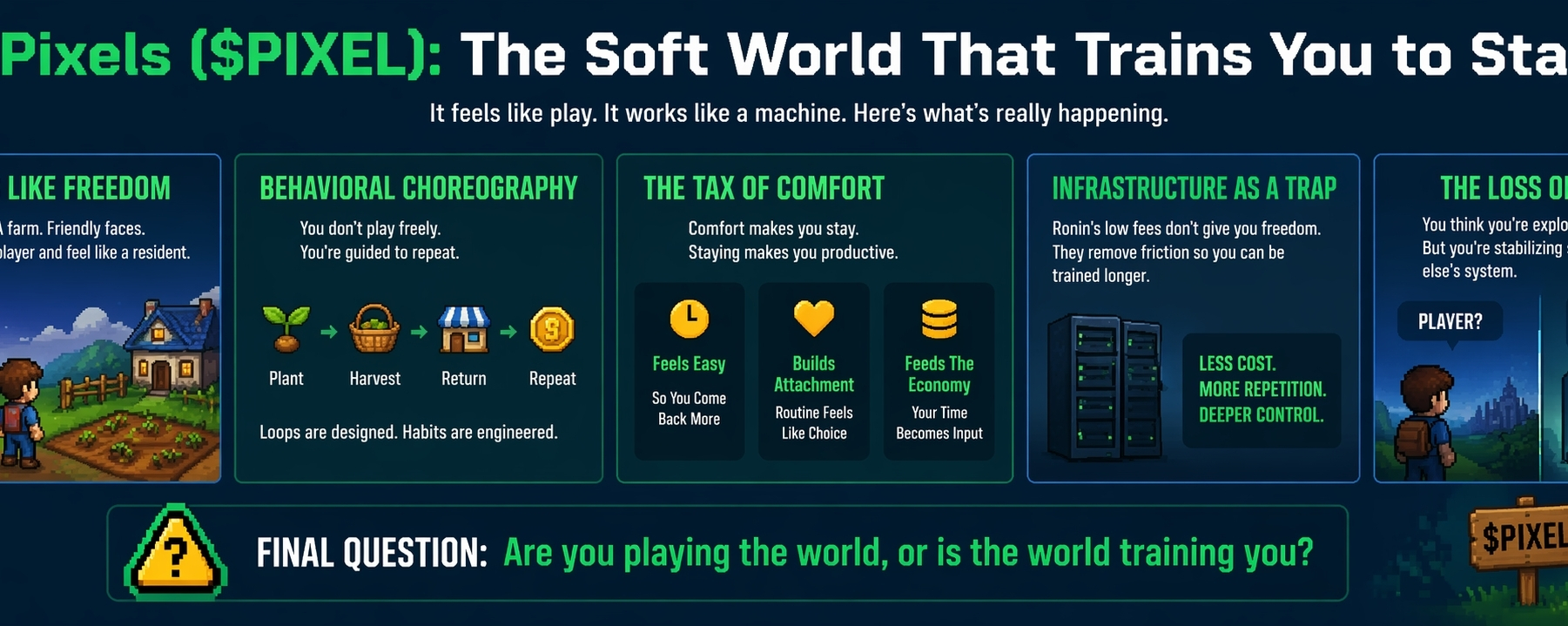
BEHAVIORAL CHOREOGRAPHY
You don’t “play” Pixels.
You get arranged by it.
Softly.
Quietly.
Repeatedly.
The brilliance of Pixels is not that it removes economic pressure.
It’s that it reroutes it.
Instead of telling you what to optimize, it teaches your hands what to repeat.
Walk.
Plant.
Harvest.
Return.
Again.
Again.
Again.
There’s no moment where the system says:
“Here is your role in the economy.”
It doesn’t need to.
Because by the time you ask that question, your behavior has already been shaped.
This is not gameplay.
This is choreography.
And the scary part?
It doesn’t feel forced.
It feels natural.
Which means it’s working.
Every loop is calibrated.
Every delay is intentional.
Every reward is placed just far enough to keep you moving.
Not thinking.
Moving.
Old GameFi tried to control you through incentives.
Pixels controls you through rhythm.
That’s a higher level of design.
And a more dangerous one.
THE TAX OF COMFORT
Pixels feels soft.
That’s the hook.
That’s also the trap.
Because comfort is not neutral.
Comfort is a lubricant.
It reduces friction so the system can run longer without resistance.
You’re not being forced to grind.
You’re being invited to return.
Which is worse.
Because forced behavior creates pushback.
Invited behavior creates attachments.
The farm isn’t just aesthetic.
It’s psychological infrastructure.
You stop thinking in terms of effort.
You start thinking in terms of routine.
“I’ll just check in.”
“I’ll just plant once.”
“I’ll just finish this cycle.”
That’s not play.
That’s compliance with better lighting.
And once the loop becomes part of your day, the system doesn’t need to convince you anymore.
You’re already aligned.
This is where Pixels separates itself.
It doesn’t extract aggressively.
It normalizes participation until extraction feels invisible.
INFRASTRUCTURE AS A TRAP
Everyone praises Ronin.
Cheap transactions. Fast execution. Smooth experience.
And they’re not wrong.
But they’re not thinking far enough.
Low fees don’t free you.
They enable repetition.
In a high-cost environment, loops break naturally.
You hesitate.
You calculate.
You stop.
In a low-cost environment?
You don’t think.
You just continue.
Ronin doesn’t remove the machine.
It removes the pain of staying inside it.
That’s a critical difference.
Because once repetition becomes painless, it becomes endless.
Pixels only works because the cost of doing the same thing over and over again has been engineered to feel negligible.
That’s not freedom.
That’s optimized containment.
The world feels alive.
But it runs on rails.
THE LOSS OF PLAY
People say Pixels makes you feel like a “resident.”
I get what they mean.
It feels persistent.
Social.
Lived-in.
But let’s be honest about what that really implies.
A resident is not free.
A resident is accounted for.
Tracked.
Expected to return.
You’re not exploring a world.
You’re stabilizing an economy.
Your time isn’t just time.
It’s input.
Your actions aren’t just actions.
They’re signals feeding a system that needs consistency more than creativity.
The game rewards presence.
Not unpredictability.
And that’s where something subtle breaks.
Because real play is chaotic.
It wastes time.
It ignores efficiency.
It resists structure.
Pixels doesn’t want that version of you.
It wants the version that shows up.
Performs.
Repeats.
You’re not a player.
You’re a managed asset with a friendly avatar.
FINAL VERDICT
I’m not here to tell you Pixels is bad.
It’s not.
That’s the problem.
It’s too good at what it’s doing.
Too smooth.
Too aware of how people behave when they’re tired of being treated like traders.
It learned something most of crypto didn’t.
You don’t need to remove the machine.
You just need to make people comfortable living inside it.
That’s the real innovation.
Not farming.
Not social loops.
Not even the token.
The innovation is making discipline feel like choice.
So here’s where I land.
If you understand the machine, you can use it.
You can navigate the loops.
You can extract without getting absorbed.
But if you confuse comfort for freedom…
If you start believing this is just a harmless world…
Then you’re not playing the system.
The system is playing you.