
When a Game Says “Community Treasury,” Who Actually Becomes the Community?
Lately, I have noticed a change in how people talk about crypto games.
The loud fantasy used to be escape. Play, earn, leave richer.
Now the mood is different.
People sound less drunk on upside and more obsessed with belonging. They want to know who gets a say. Who captures value. Who stays relevant after the event, after the airdrop, after the first wave of attention fades.
That shift is why treasury governance lands differently now.
A year ago, it might have sounded like another token utility line. Today, it sounds like adulthood. It sounds like a project trying to move from extraction toward shared ownership.
That is what makes PIXELS interesting to me.
On the surface, it is easy to see the appeal. PIXELS is not just selling a token. It is selling a world, a soft environment where digital progress, social presence, and on-chain assets are meant to feel native to each other. The official framing already points in that direction, with PIXELS described as a platform for game experiences built around digital collectibles, while $PIXEL is positioned not only for in-game utility but eventually for governance over a community treasury.
That is the kind of sentence people want to believe.
A community treasury sounds like the cleanest version of crypto legitimacy. Not just users spending inside a system, but users helping direct the system. Not just consumers, but stakeholders.
And honestly, I get why that is compelling.
Games have always had economies. Very few have had a believable story for political ownership. So when a project like PIXELS suggests that players may eventually govern shared capital, it feels like a graduation. The world is no longer just somewhere you grind. It becomes somewhere you might shape.
That is the attractive version.
Then I keep thinking a little longer.
Because governance never arrives inside a vacuum. It arrives inside an already structured economy. And PIXELS already has structure everywhere.
Not just obvious market structure. Social structure. Access structure. Status structure.
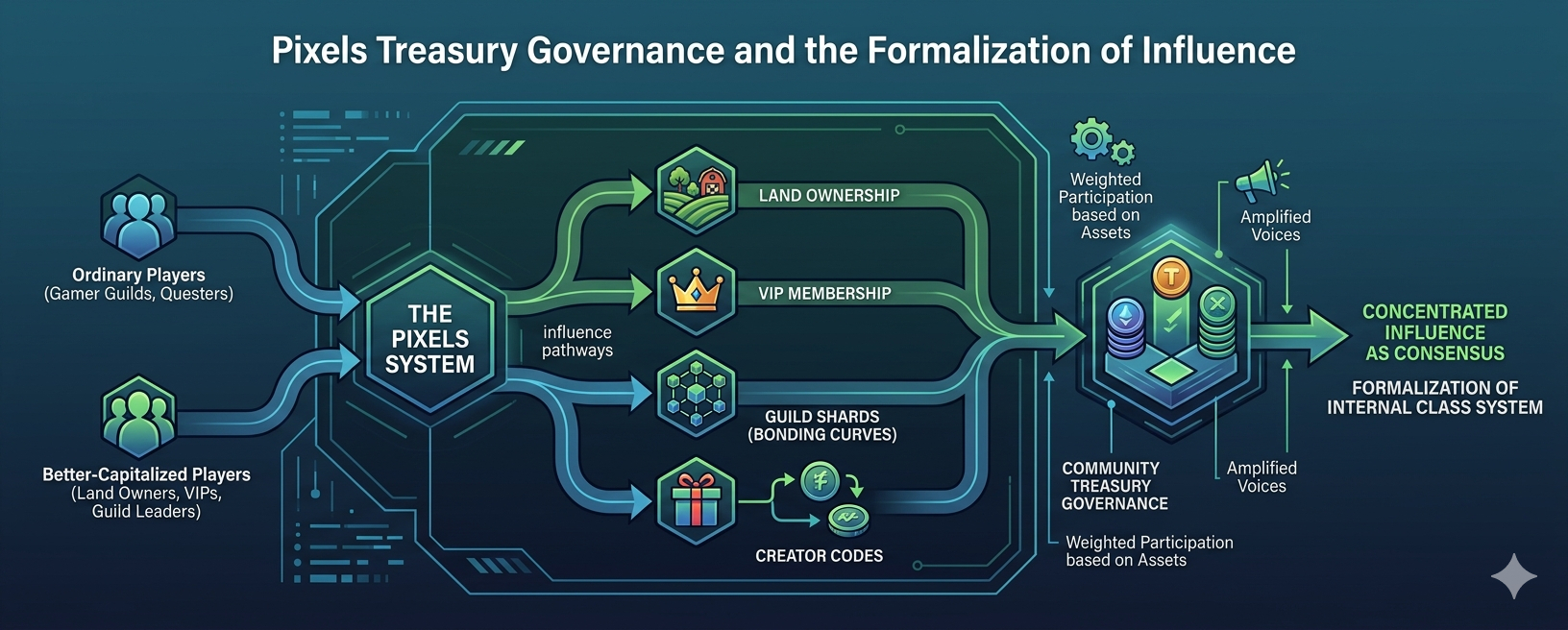
The project’s own systems show that reputation can be influenced by things like land ownership, VIP purchase, pets, quests, live events, connected socials, guild participation, and general gameplay history. In other words, the game is already measuring who counts, and those measurements are not politically neutral.
That is where my tone changes.
Because once governance enters a world like that, the question is no longer whether players get a voice.
The question is which players arrive at governance already amplified.
This is the part crypto often softens with nice language. It says community, but usually means weighted participation by whoever accumulated enough assets, access, or positioning before the vote even starts.
And PIXELS has several ways that positioning can harden.
Land and VIP are not just cosmetic identity markers. They have been tied to practical in-game advantages and higher limits before. Guild structures are not flat social clubs either. Guild shards follow a bonding curve, so the cost rises as more shards are issued, and guild leaders receive pre-minted shards from the start. Even creator codes can route a portion of $PIXEL spending back to a guild treasury.
Individually, none of that is scandalous.
Taken together, it starts to look like an upstream map of influence.
That is what makes the treasury question harder than it first appears.
If treasury governance is eventually attached to token holdings, or to participation that is already easier for better-capitalized players, then the language of stakeholder ownership may hide a much older pattern. The people with the most ability to shape the economy early become the people most able to define the public good later.
And that changes the emotional meaning of governance.
It stops feeling like a democratic reward for loyal players.
It starts feeling like the legal formatting of an internal class system.
I do not say that as a cheap attack. Every on-chain world has this problem in some form. Open participation sounds fair until you remember that wallets do not enter open systems equally. Some arrive with size. Some arrive with time. Some arrive with better social coordination. Some arrive already close to the people who understand the rulebook earliest.
What makes PIXELS especially worth watching is that it is good enough to make this problem matter.
That is important.
Weak projects do not create real political tension because nobody serious wants to govern them. But when a world becomes sticky, when people actually care about its future, governance stops being decorative. It becomes a fight over who gets to define value inside that world.
That is why I cannot read “community treasury” as a simple positive.
It might create real stakeholder alignment. It might make players more invested in the long-term health of the ecosystem. It might fund better public goods, better creator support, better incentives, better continuity.
But it might also do something colder.
It might convert economic advantage into moral legitimacy.
It might let larger wallets speak in the name of the community because they can now point to a formal process and call it consensus.
That is the contradiction I cannot shake.
PIXELS looks compelling precisely because it feels more alive than a token wrapper. It gives people a place, a rhythm, a reason to care. That makes treasury governance sound noble.
But the more alive a world becomes, the more dangerous it is to confuse participation with power.
So the trust question is not whether PIXELS can build a community treasury.
It is whether that treasury will actually let ordinary players shape the world, or simply teach them to call concentrated influence by a friendlier name.