
I’ve spent the past few days thinking about this not just as a player, but as someone trying to understand how gaming systems evolve when economics and data start driving design decisions.
What I’m seeing with Pixels isn’t just game expansion. It’s a structural shift.
This isn’t “play-to-earn” anymore. It’s moving toward something closer to a data-driven publishing infrastructure.
What I Actually Observed
At first glance, Pixels still looks simple farming, tasks, social play. But when I looked deeper into how its systems are evolving, a different picture emerged.
1. First-party games are not just games they’re data layers
Take Pixels Pals. It feels casual: raising pets, interacting socially. But underneath, it’s tracking behavior:
What rewards keep users engaged
How often players return
Which actions drive retention
This data doesn’t sit idle. It feeds directly into a smart reward system.
👉 Rewards are no longer random or generous they are calibrated based on behavior.
That’s a major shift. The system is learning how to shape player actions.
2. Mobile expansion is solving infrastructure, not gameplay
With Pixels Mobile, the goal isn’t simplification it’s scalability.
From what I’ve analyzed, the focus is on:
Handling massive concurrent users
Reducing latency
Making the system globally accessible
This moves the problem from game design to infrastructure engineering.
👉 At scale, Pixels is trying to behave less like a game and more like a live service network.
3. Monetization is embedded from day one
The integration of vPIXEL across games shows something important:
Monetization isn’t added later
It’s built into the system from the start
That means:
👉 User experience and token flow are part of the same loop
Players don’t just play they participate in an economic system by default.
Where It Becomes Something Bigger
The real turning point, in my view, is the partner game criteria.
This is where Pixels stops acting like a game studio and starts behaving like a:
👉 Selective publisher + economic gatekeeper
Here’s what stands out:
RORS threshold (~0.9)
→ Rewards must nearly match economic return
→ Games are judged on capital efficiency, not just funMandatory data sharing (Events API)
→ Developers feed player behavior into a central system
→ The ecosystem continuously learns and adapts2%+ monetization benchmark (MAU conversion)
→ Filters out low-engagement games
→ Forces real economic participationAgile development requirement
→ Slow teams can’t survive
→ Ecosystem speed dictates developer behavior
What This System Is Really Doing
All these conditions create one thing:
👉 Selection pressure
Only certain types of games and developers can exist inside this system.
And those who enter must adapt to:
Data-driven feedback loops
Reward-driven behavior shaping
Continuous economic optimization
In return, they get:
Built-in user acquisition
Analytics and fraud detection
Access to an existing active player base
My Conclusion (As an Analyst)
At this point, Pixels is no longer just publishing games.
It’s building a:
👉 Curated economic layer for games
Where:
Data flows continuously
Rewards guide behavior
Developers operate inside defined economic rules
The Real Question
This is where it gets interesting.
When a system:
Decides who can enter
Shapes how players behave
Controls how value is created
Then what are we interacting with?
Is it still an open gaming economy?
Or is it becoming a controlled, optimized system?
My Take
I don’t think this is accidental.
Pixels is trying to solve scalability by reducing unpredictability through data and incentives.
But that comes with a trade-off:
More structure → more efficiency
More control → less organic gameplay
And that raises a real concern:
👉 Are we improving gaming systems…
or slowly replacing the soul of play with optimization logic?
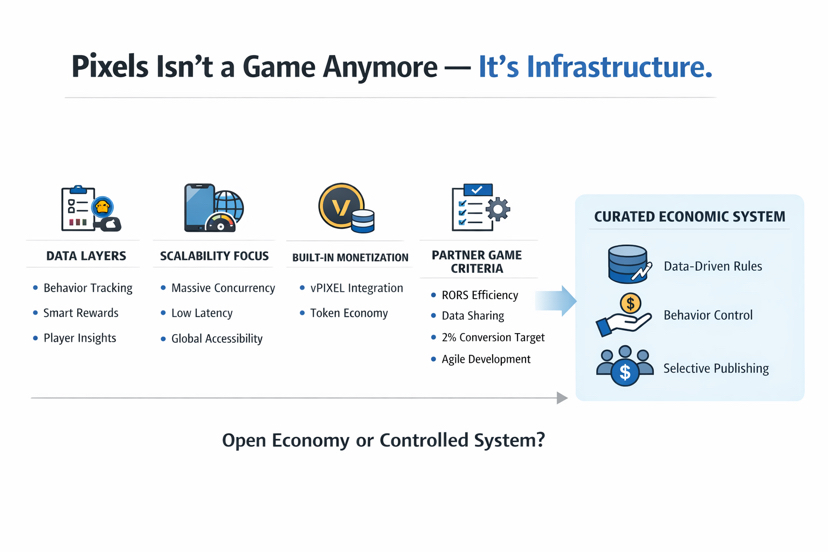
This isn’t a final judgment but from what I’ve seen, Pixels is no longer just a game.
It’s becoming infrastructure.