
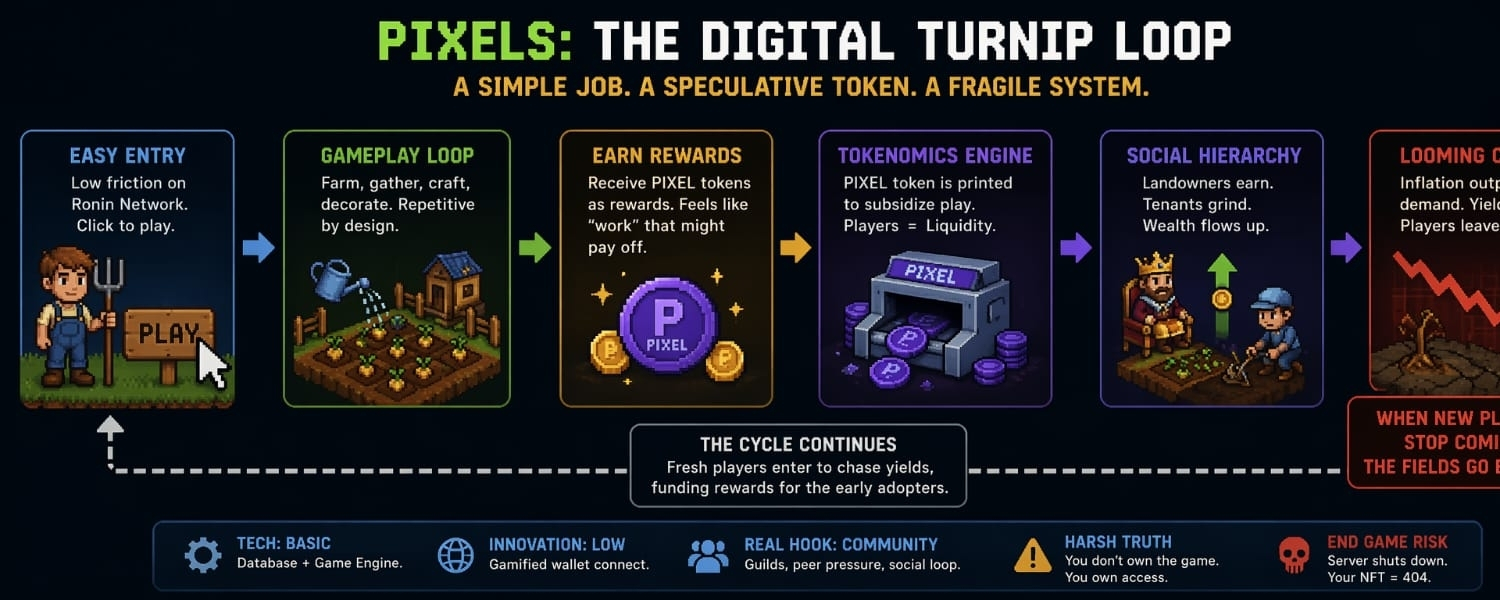
Let’s be brutally honest about something right out of the gate: most people do not want to "own" their digital assets. They just want to play a game without needing a degree in computer science to log in. For years, the Web3 gaming sector has been banging its head against a wall, trying to sell the masses on complex wallet setups and gas fees, completely ignoring the fact that your average punter just wants to click a button and see a number go up. Enter Pixels. It’s not some technological messiah, and it certainly isn’t the saviour of the internet, but for whatever reason, this farming simulator has managed to do what a thousand over-hyped metaverse projects failed to do it actually got people to show up and stay.
You have to understand the infrastructure here to really get why this thing isn't dead yet. It runs on the Ronin Network. Remember Axie Infinity? That was the first big bubble, the one that popped and left a lot of retail investors holding bags of worthless digital pets. Ronin was the chain built specifically for that mess. It’s specialised, unsexy plumbing. Actually, calling it plumbing is probably too generous; it’s more like a private railroad track for a specific type of product. But that’s the point. By moving onto Ronin, Pixels sidestepped the Ethereum mainnet’s ridiculous fees. It lowered the barrier to entry just enough that the friction didn't burn the players' skin off immediately. That’s not innovation, really. It’s just basic logistics.
The gameplay itself? It’s Stardew Valley with a tax form. You farm, you water crops, you decorate a little plot of land. It’s mind-numbingly repetitive. But and this is where the cynical analyst in me perks up that repetition is the hook. It’s the same psychological loop that made Farmville a hit back in the Facebook dark ages. People like ticking boxes. They like seeing resources stack up. The twist here is that those resources are theoretically tied to a token, PIXEL. So the grinding feels like "work" that might pay off, rather than just a waste of your Tuesday evening.
Now, let's look at the tokenomics, which is usually where these things implode. The PIXEL token is the fuel, the currency, the whole shebang. The whitepapers and the discord mods will tell you it’s about governance and ecosystem growth. Spare me. It’s a carrot on a stick. The developers are essentially printing money to pay people to play their game. It’s a subsidy. When you peel back the layers of "Web3 social casual gaming," you find a very simple, gritty reality: they are paying for liquidity. The players are the liquidity. And eventually, someone has to pay the bill.
There’s a weird political dynamic at play inside the game’s social structures, too. It’s not just a game; it’s a hierarchy. You have landowners and you have tenants. It’s feudalism with a pixelated aesthetic. If you were early, you bought land, and now you sit back while other players ones who couldn't afford to buy in work your fields for a split of the yield. It’s an unapologetic wealth transfer from the latecomers to the early adopters. That sounds harsh, and it is, but weirdly, the tenants keep showing up. Why? Because the dream of earning a living by clicking on turnips is persistent, even if the reality is a grind that pays less than minimum wage in most developed nations.
I’ve watched twenty years of market cycles, and this one feels particularly fragile. The user numbers are decent, sure. The daily active users look good on a pitch deck. But are these users sticky? Or are they just mercenaries waiting for the yield to dip so they can jump ship to the next yield farm? The "social" aspect is the only thing holding the bag together. Without the community, the peer pressure to log in, and the guild structures, this is just a very boring farming simulator from 2012.
Let’s be honest here, the tech is boring. It’s just a database with a game engine slapped on top. The "innovation" isn't the gameplay; it’s the ruthless efficiency of the economic extraction. They’ve managed to gamify the wallet connect. That’s it. That’s the whole trick. And while the purists scream about "true ownership," the reality is that if the servers shut down tomorrow, your NFT land is just a hyperlink to a 404 error. You don’t own the game; you own a seat at a table that the casino can fold up whenever they want.
So why am I even paying attention to this? Because it’s a working model of digital serfdom that functions. It’s messy, the inflation is a looming disaster, and the gameplay loop is about as deep as a puddle. But it works. For now. The lesson isn’t that Web3 gaming is the future; the lesson is that if you give people a simple job and a token of value, no matter how speculative, they will grind for it. The magic isn't in the code. It's in the desperation of the player base looking for an exit from the real economy.
The harsh truth is that Pixels will likely face a massive token crisis eventually. These things always do. The inflation of the PIXEL token will outpace the demand, the rewards will shrink, and the casual farmers will drift away. It’s a cycle as old as time, or at least as old as the dot-com bubble. We aren't witnessing the birth of a new digital nation; we’re watching a very elaborate, very engaging pump scheme that relies entirely on fresh blood entering the system to pay the yields for the old guard. When the new players stop coming, the fields will go barren. And no amount of "community engagement" can fix a broken balance sheet.
