
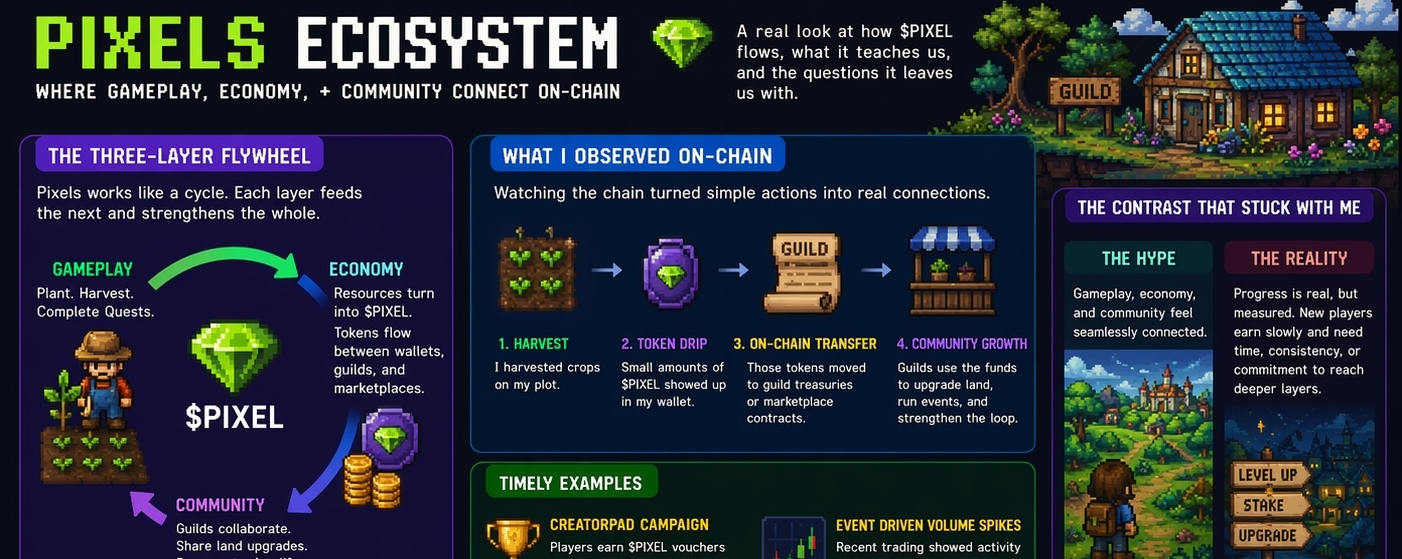

There is a certain kind of clarity that only appears when you stop looking at a project through announcements and start watching it breathe on chain. The Pixels ecosystem sits in that rare category where the theory and the practice are close enough to compare in real time, yet different enough to raise meaningful questions. What you described is not just an observation of token movement. It is a direct encounter with how a GameFi loop actually behaves when it is left to players rather than presentations.
does not try to overwhelm the player at first contact. The entry point is deliberately simple. Plant, harvest, complete small tasks, repeat. At a surface level, it resembles countless casual farming loops that have existed long before blockchain integration. But that familiarity is precisely what allows the deeper mechanics to hide in plain sight. The moment those harvested crops translate into measurable token flows, the experience quietly shifts from game to system.
The $PIXEL token, native to the ecosystem, acts as more than a reward. It becomes a bridge between intention and consequence. A player clicking to harvest is no longer just progressing in a game. They are initiating a chain of economic activity that can be tracked, verified, and aggregated into something larger than individual play. That is the subtle transformation that makes Pixels worth examining beyond its visual simplicity.
What stands out most in your reflection is the emergence of what can be described as a three layer flywheel. Gameplay generates resources. The economy translates those resources into token utility. The community redistributes and amplifies that utility through shared structures like guilds and land ownership. This is not a new conceptual model in GameFi, but it is rare to see it operating with enough transparency that a casual observer can trace it live across wallets.
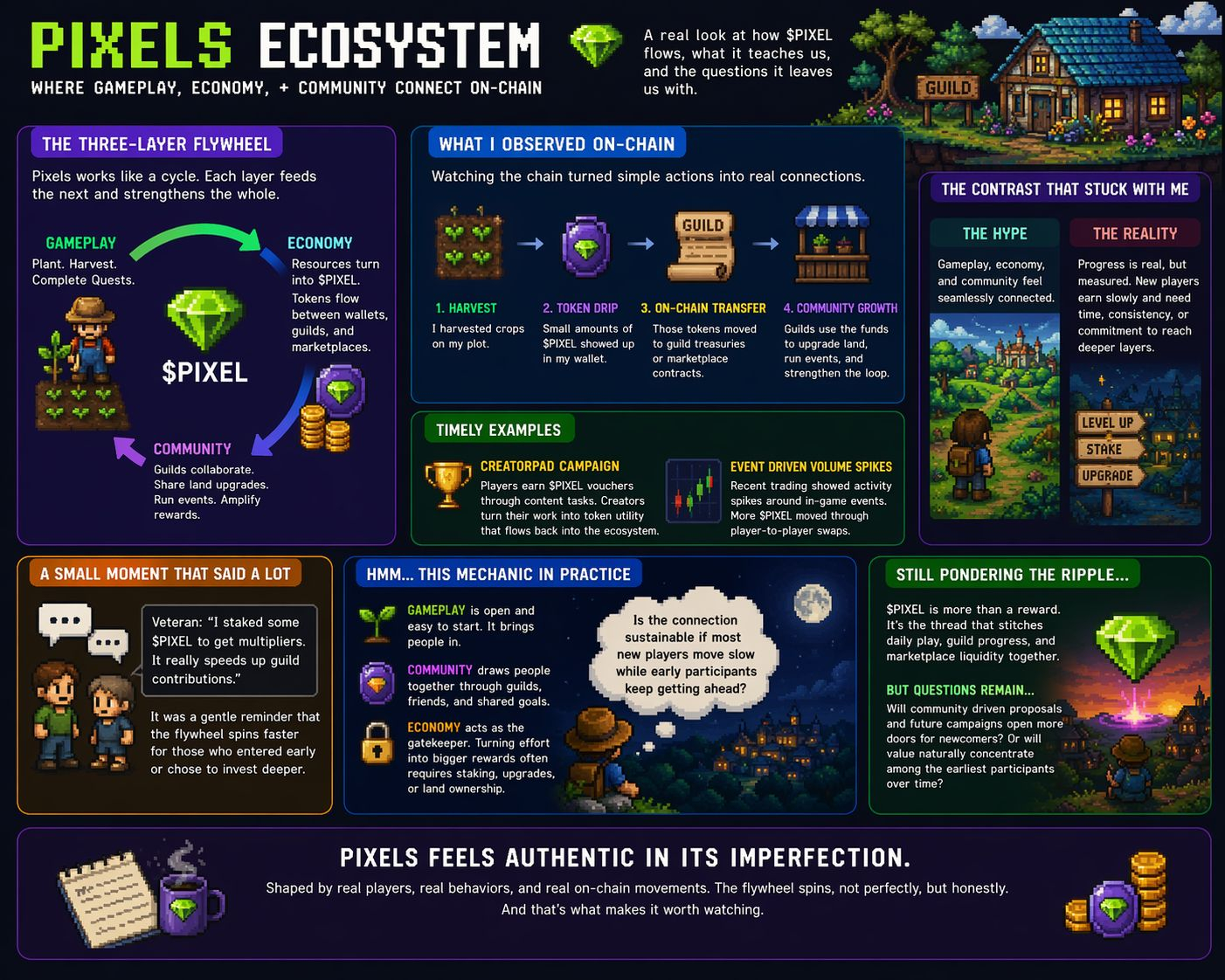
The interesting part is not that the flywheel exists. It is how unevenly it spins depending on where a player stands within it.
At the base layer, gameplay is intentionally frictionless. Anyone can enter, interact, and begin producing small amounts of value. This design choice is critical. Without a wide funnel of new players, the entire system would collapse into a closed loop of existing holders. The accessibility ensures constant inflow of activity, which in turn feeds the visible on chain volume you noticed. Every new player contributes small but consistent signals to the network.
However, the transition from gameplay to meaningful economic participation is not immediate. This is where the system introduces subtle resistance. The rewards from early activities are real, but they accumulate slowly. The player experiences progress, but not influence. That distinction matters. Influence in this ecosystem comes from the ability to redirect flows, not just generate them.
This is where land ownership and prior token positioning begin to matter. Players who hold land NFTs or larger amounts of $PIXEL are not just participants. They are nodes of redistribution. When other players farm their land, a portion of the output routes back to them. When guilds coordinate activity, those with higher stakes can amplify collective rewards. The flywheel accelerates, but only for those already connected to its inner layers.
Your observation about watching tokens move from harvest actions into guild treasuries captures this dynamic perfectly. It reveals that value does not remain at the point of creation. It travels. And more importantly, it tends to accumulate in predictable places.
This is not necessarily a flaw. In fact, it mirrors real world economic systems where capital concentration emerges from structural advantages rather than explicit exclusion. Pixels does not prevent new players from advancing. It simply requires time, consistency, or additional commitment to reach the layers where acceleration begins.
The presence of campaigns like the introduces an interesting external variable. These campaigns effectively inject new pathways into the ecosystem. Instead of earning $PIXEL purely through in game actions, players can convert creative output into token value. This expands the definition of participation. It allows individuals who may not yet be deeply invested in gameplay mechanics to still enter the economic loop.
But even here, the same structural pattern appears. The rewards from such campaigns are meaningful, yet their long term impact depends on how they are reintegrated into the system. If the earned tokens are used for upgrades, staking, or guild participation, they strengthen the flywheel. If they are extracted and sold externally, they introduce pressure without reinforcing internal dynamics.
Your mention of volume spikes aligning with in game events adds another layer of credibility to the system. It suggests that player behavior, not speculative trading, is driving at least a portion of token movement. This is a critical distinction. Many GameFi tokens show activity that is disconnected from actual gameplay. In contrast, Pixels appears to maintain a visible link between in game events and on chain outcomes.
That said, the clustering of activity among a smaller set of wallets raises an important concern. It indicates that while participation is broad, influence remains concentrated. This creates a divergence between perceived community growth and actual economic distribution. The system feels alive because many players are active, but the benefits of that activity may not be evenly spread.
This is where your skepticism becomes valuable rather than critical. It highlights a tension that often determines the longevity of such ecosystems. Can a system sustain itself if most new participants experience slow progression while a smaller group captures accelerated returns?
The answer depends on how the system evolves its middle layer. If the transition from casual play to meaningful economic participation remains too steep, new players may disengage before reaching deeper involvement. On the other hand, if the system introduces too many shortcuts, it risks diluting the value of existing commitments.
Pixels seems to be navigating this balance through controlled friction. Small token expenditures, such as upgrades or staking mechanisms, act as gates that unlock faster progression. These are not barriers in the traditional sense. They are thresholds that signal a shift from passive participation to active investment.
The conversation you had with a veteran player about staking reinforces this idea. Staking is not just a financial decision. It is a declaration of intent to remain within the system. Players who stake are effectively choosing to align their incentives with the long term health of the ecosystem. In return, they gain access to accelerated rewards and deeper integration into community structures.
This creates a layered experience where different types of players coexist. Casual players contribute to baseline activity. Committed players drive economic momentum. Early adopters benefit from structural advantages. The challenge lies in ensuring that movement between these layers remains possible.
What makes Pixels particularly interesting is that it does not hide these dynamics behind complexity. Instead, it allows them to emerge naturally through player interaction. The imperfections you noticed are not signs of failure. They are indicators that the system is being shaped by real behavior rather than controlled outcomes.
The question of long term retention ultimately circles back to perception. If players believe that their efforts can eventually translate into meaningful participation, they are more likely to stay. If the gap between effort and impact feels too wide, engagement will decline regardless of how elegant the system appears on paper.
Community driven adjustments could play a crucial role here. If reward structures, guild mechanics, or progression pathways are periodically refined based on player feedback, the system can adapt without losing its core identity. This is one of the advantages of operating on chain. Transparency allows for informed iteration.
At the same time, external integrations like CreatorPad campaigns must be handled carefully. They can attract new users and inject fresh energy, but they can also distort incentives if not aligned with in game progression. The key is to ensure that external rewards reinforce internal loops rather than bypass them.
What remains compelling about your experience is the absence of a definitive conclusion. Instead of confirming a preconceived narrative, the observation opened multiple lines of inquiry. This is often a sign that a system is complex enough to sustain long term interest.
Pixels does not present itself as a perfect model. It reveals itself as a living structure where gameplay, economy, and community continuously interact, sometimes smoothly and sometimes with resistance. The flywheel spins, but not uniformly. It accelerates for some, stabilizes for others, and occasionally slows down in ways that invite scrutiny.
That unevenness may ultimately be its strength. A perfectly balanced system often lacks the tension needed to evolve. By allowing disparities to exist, Pixels creates space for adjustment, experimentation, and player driven change.
The unresolved question you are left with is the right one to carry forward. Will the ecosystem expand outward, bringing more players into meaningful participation, or will value continue to concentrate among those who entered early and committed deeply?
The answer will not come from announcements or roadmaps. It will emerge from the same place you observed it the first time. On chain activity. Player behavior. The quiet movement of tokens that reflects decisions made in fields, guilds, and marketplaces.
And perhaps that is what makes the Pixels ecosystem worth watching. Not because it promises a revolution, but because it exposes its reality in a way that invites you to keep asking questions.
