

In my opinion, if Pixels really wants to be a big Web3 game, then community governance should not only be written on the poster, but some real power should be given to the players. There is no use in just having a vote button, if the final decision is always taken by the team. I think Pixels is now in a place where governance can be successful, and can be just a showpiece.
Many projects at the beginning say "community will decide," but later it is seen that the community votes only on small issues. Big decisions like token emission, reward system, land utility, treasury spending, update timing - all these are decided by the team itself. If the pixels go the same way, the governance name will be there, but the power will not be there.
In the Pixels ecosystem, the PIXEL token is known as the utility and governance token. This means that in the future, token holders will be able to give an opinion on some issues. That's a good idea. Because those who give time to the game, hold tokens, buy land and support - they should have an opinion. But here's the big question: Who's going to vote? The ones who actually play the game, or the ones who just buy and hold more tokens?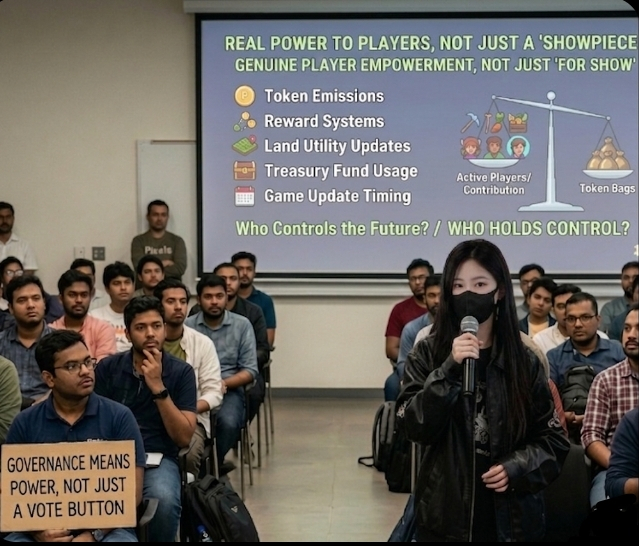
Suppose there are two players. One is playing games every day, farming, crafting, active in the community. Another big investor, does not play games, only holds a lot of tokens. If the governance is completely token based, then the power of the second person will be more. The voice of active players will be reduced. This is dangerous in the long run. Because the game survives with the players, not just with the holders.
In my opinion, if Pixels want to do smart governance, then not only token balance, player activity, reputation, contribution - all these should be considered. Then those who help in building the game will also be important.
An example is the economy. If the reward is more, everyone will be happy in the short term. But the selling pressure of the token will increase, the price will decrease. Players will be happy with the rewards. This balance is very difficult. If the community votes only for its own benefit, then the system can be destroyed. So governance does not always mean democracy, sometimes educated decisions are needed.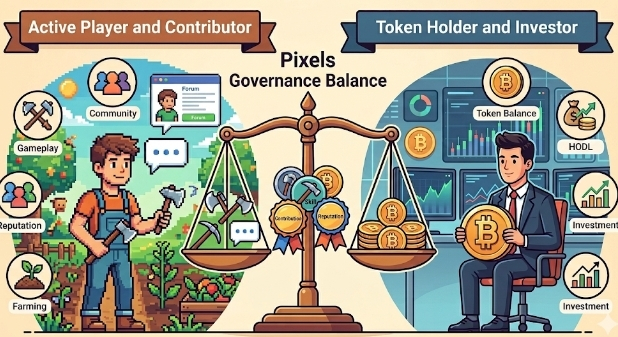
Another issue is the control of the treasury. If Pixels Treasury goes into community control in the future, it will be a big test. Are you going to fund the community's marketing? Are you going to the tournament? Do you want to develop it? The creator of the program? If there is no clear reporting here, the drama will start. Governance will then become politics instead of improving the game.
The greatest risk is in the control of the whale. If some large wallets hold a majority of the tokens, they can influence the vote. Then the smaller players will think there is no use in voting. Once this feeling comes, the participation will decrease. And if the participation is less, the governance system becomes dead.
New players come to the game for fun. They don't read the governing papers. If the gameplay is weak, the grind is high, the earning is low, the market access is hard - then the player will leave. Even if there is governance later, there is no use, because there will be no people to vote. Community power is meaningful only when the community is active. Some player feedback has also shown frustration with the progression barrier, which is a warning sign for retention.
I think the team of Pixels still controls a lot of the ecosystem direction, which is normal in the early stage. Because the game requires fast decisions to run live operation. It is not possible to update everything with the community vote. Bug fix, exploit patch, balance emergency - this is what the team has to do. So the handover of the whole control in one day is not realistic.
But it can be a step-by-step model. Such as:
The first thing the cosmetic / content vote community will do
The event rewards structure
and then stacking incentives.
After the Treasury Allocation
At the end of the big economy proposal
This is how trust is built.
In the Pixels stacking model, there is a discussion about community influence, where the users involved can make an impact on the ecosystem resource direction. It can be a practical beginning of governance, if there is transparency.
Another issue is transparency. The vote result needs to be public, the proposal needs to be clear, the team needs to explain why it accepted or rejected. If the community votes and then there is silence, trust will be lost. It's hard to regain trust in a Web3 project.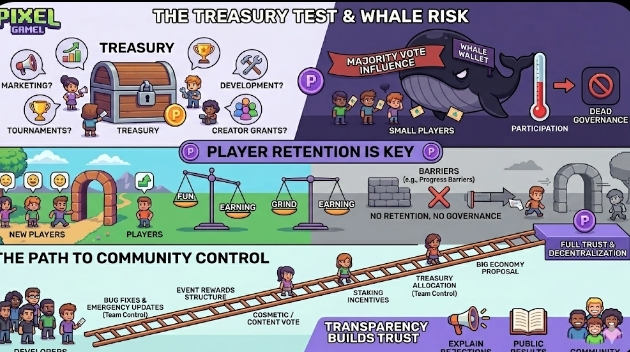
I want the Pixels governance to be real. The game has a community driven feel. But there is no real governance if there is only governance token. Real governance is when the community can disagree, can propose, and can actually make some changes.
Lastly, I think the Pixels are now at the crossroads. It can be a genuine player-powered ecosystem, and also use governance as a marketing word. It all depends on how much the team is willing to give up, and how much the community is willing to take responsibility.
In my opinion, the Pixels give power to the community, but in a smart way. Because it is easy to give control, it is difficult to make sustainable governance.