At first, Pixels did not strike me as the kind of thing that would hold my attention for long.
It has that surface simplicity that makes you think you already understand it. A game loop. A familiar Web3 rhythm. A few familiar incentives moving around in the background. On a quick pass, it can look like a lot of other systems that depend on momentum and hope and people staying interested long enough to keep the machine moving.
But after sitting with it for a while, I started noticing something a little off.
Not broken. Not weak. Just uneven in a way that made me look twice.
The obvious story is easy to tell. Pixels gives people things to do. It gives them progression, ownership, rewards, social motion, and a reason to come back. That part is visible. It is almost too visible. And maybe that is exactly why the deeper shape is easy to miss.
Because the thing that kept bothering me was not the front-facing loop. It was what seemed to happen underneath it.
The longer I watched, the more Pixels felt less like a single product and more like a system trying to absorb attention in layers. Not by shouting. Not by forcing itself into the room. More quietly than that. The kind of quiet that makes you underestimate it.
And that is where the hypothesis started to form for me.
Maybe the moat is not in any one feature.
Maybe the moat is in the way the pieces begin to depend on each other.
That idea took a while to settle in. Because when people talk about moats, they usually talk about something clean and obvious. Network effects. Brand. Liquidity. Technical advantage. Something you can point at.
Pixels does not feel like that to me. At least not on first contact.
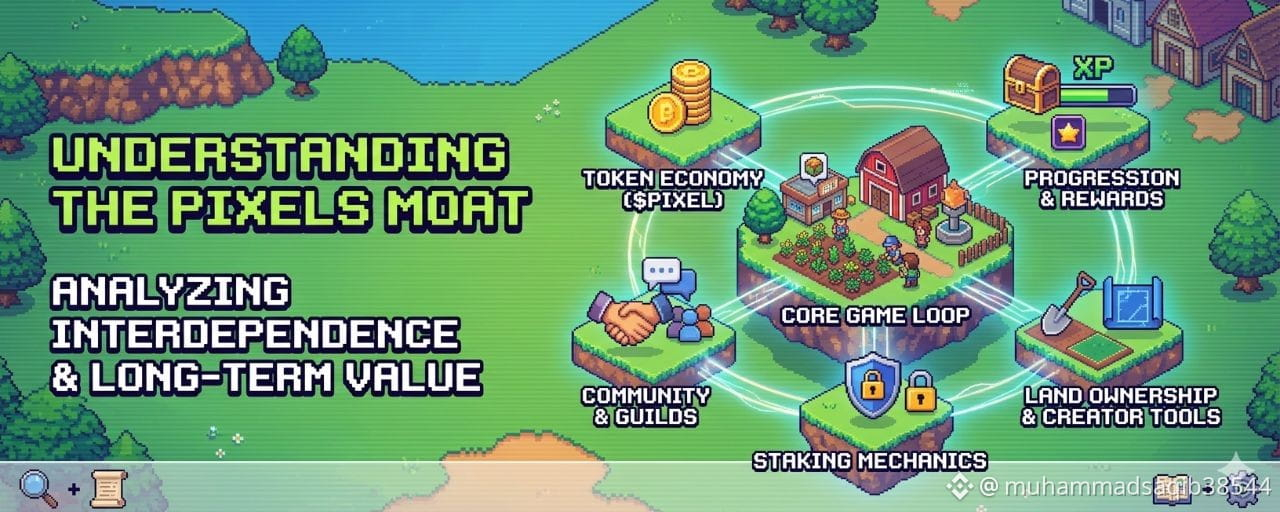
It feels more distributed. More relational. The value seems to come from the way gameplay, progression, staking, economy, and community behavior start to reinforce one another. Not perfectly. Not in a neat circle. More like overlapping systems that gain weight simply because they touch each other in enough places.
And once that starts happening, the product stops being just a place to play.
It becomes a place where participation has memory.
That part matters.
Because memory changes everything. A system with memory does not treat every action as isolated. It remembers your movement. Your habits. Your commitment. Your place in the flow. And once a system starts remembering, users stop feeling like temporary visitors. They begin to feel embedded, even if they never say it out loud.
That is where I think Pixels gets interesting.
Not because it looks complex on the surface, but because the complexity seems to emerge only after repeated exposure. The first layer invites you in. The second layer quietly starts shaping behavior. The third layer makes the whole thing harder to separate into parts.
At that point, the moat stops looking like a wall.
It starts looking like interdependence.
And interdependence is harder to copy than features. Much harder, maybe, than people want to admit. A feature can be cloned. A mechanic can be mirrored. But once a system gets enough small dependencies tied together, the real work is not imitation. It is reconstruction. And reconstruction takes time. It takes context. It takes the same invisible layering that made the thing feel alive in the first place.
That is what I keep coming back to with Pixels.
It does not announce its advantage. It accumulates it.
The game side matters because it creates reason to stay. The economic side matters because it makes staying feel meaningful. The social side matters because it turns participation into presence. The publishing and creator side matter because they extend the system beyond play and into interpretation. Each layer adds a little more gravity. Each layer gives the next one more weight.
And maybe that is the real pattern here.
Pixels is not trying to win by being the loudest system in the room. It feels more like it is trying to make leaving slightly harder than staying.
Not in a blunt way. Not through lock-in in the crude sense.
More like through familiarity. Through accumulated context. Through small benefits that become difficult to replace once they start fitting together.
That kind of design is easy to ignore because it does not look dramatic. There is no single moment where you say, yes, this is the moat. It is more like a slow realization that the product has already become part of the user’s habit structure, and the habit structure is what holds it in place.
That has consequences.
If the system works the way I think it might, then growth is not just about acquisition. It is about deepening internal connections. It is about turning surface participation into repeated participation, and repeated participation into something closer to routine. And once routine enters the picture, the system becomes less dependent on novelty and more dependent on fit.
That seems like a big shift.
Because novelty fades. Fit stays.
And fit is a quieter kind of power.
It is also the kind that can be underestimated from the outside. A person looking at Pixels casually might see a game with incentives. A person sitting inside it a little longer might start seeing a structure that is trying to organize behavior across multiple layers at once. Not perfectly. Not with absolute control. Just enough to matter.
That is what gives me pause.
The moat is not obvious in the way people usually expect. It does not arrive as a single sharp advantage. It shows up as a pattern of reinforcement. A layered system. A place where each part makes the next part harder to separate from the whole.
I am still not sure I would call that a clean thesis.
But I think that is the point.
Some moats do not look like moats when you first find them. They look like repetition. Like friction. Like small loops that only reveal their shape after you have moved through them enough times.
Pixels feels a little like that to me.
Not flashy. Not fully legible. But quietly built in a way that starts to make sense only after you stop looking for the obvious answer.
@Pixels #pixel $PIXEL