
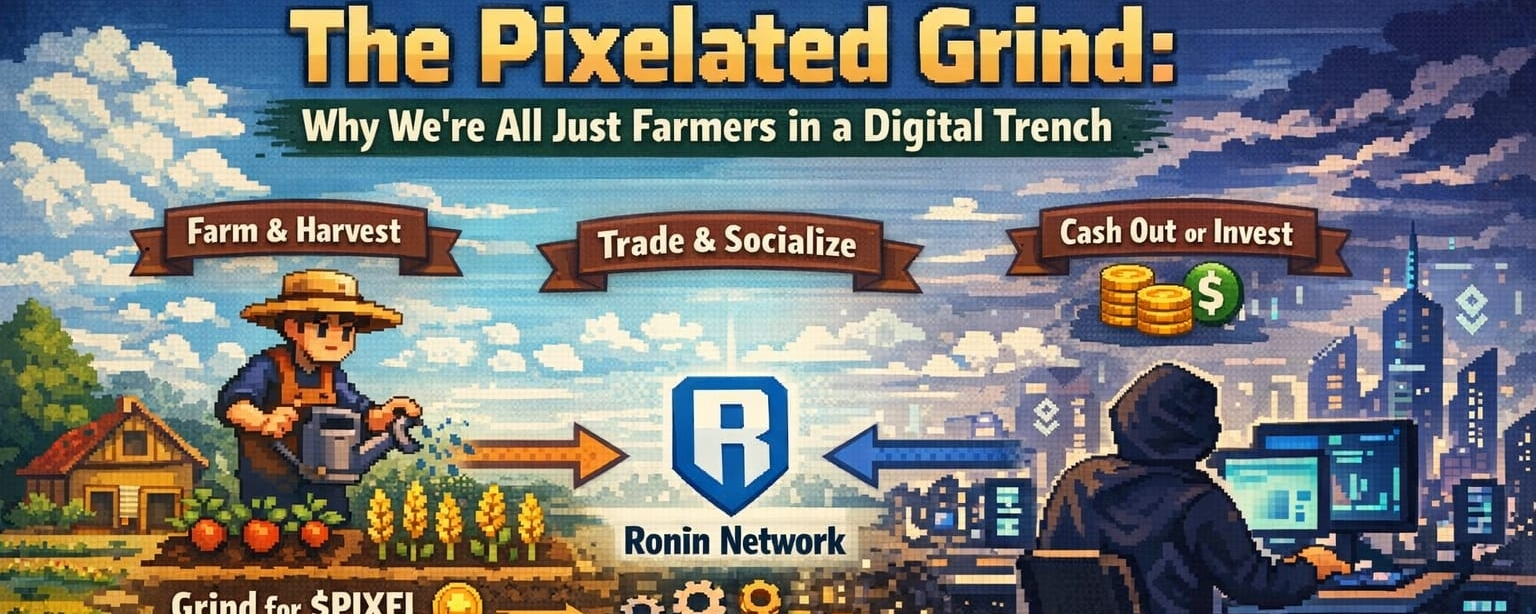
Let’s be honest with each other for a second. When you strip away the buzzwords, the roadmap PDFs, and the hype about "ownership," what is a game really? It’s a loop. It’s a Skinner box dressed up in pixel art. I’ve been watching this space for two decades, and I’ve seen a thousand pitches about how some new token is going to change the way we live, but rarely do they hold up to the scrutiny of a late-night bear market. Enter Pixels. It’s a farming game. That’s the brutal, unsexy truth of it. You plant seeds, you water them, you wait, and you harvest. It’s the kind of mundane activity we usually pay money to escape from in our real lives, yet here we are, grinding digital soil on the Ronin Network. It’s weird, right? But weirdly, it’s working, and the reasons why are messier than the marketing team would have you believe.
First, you have to look at the plumbing. The team moved this whole operation over to Ronin, and that wasn’t just a tactical shift; it was a survival instinct. Ronin is the chain built by the Sky Mavis folks, the ones who brought you Axie Infinity. You remember Axie. It was the darling of the last bull run, a phenomenon that put butter on the bread for millions in the Philippines before the tokenomics collapsed under their own weight. Pixels settling there is like a new shop opening in a town that was built on a gold rush that’s mostly dried up. But the infrastructure is there. The pipes work. It’s specialized, unsexy plumbing designed specifically for games that require a thousand micro-transactions a second without costing a fortune in gas fees. But the chain itself is a ghost town of nostalgia and speculative bets. By launching there, Pixels didn’t just choose a blockchain; they chose a demographic. They chose the grinders, the people who have already accepted that "play-to-earn" is really just "play-to-earn-a-few-cents," but they’re okay with that.
Now, let’s talk about the actual gameplay loop, because this is where my scepticism usually hits a wall. The game itself is charming, I’ll give it that. It has that Stardew Valley vibe, a casual, low-stress aesthetic that tricks your brain into thinking you’re just relaxing. But you aren’t relaxing. You’re working. You’re engaging in a complex web of resource management where the ultimate goal isn’t a high score or saving the princess; it’s getting enough $PIXEL to maybe, just maybe, cash out for a pizza on Friday. There is a deep, almost cynical irony here. We have digitized the very labour we spend our lives trying to automate or escape. I watched a guy spend four hours clicking on berry bushes the other day. Four hours. He told me he was "building his empire." I didn't have the heart to tell him he was just providing liquidity for the early investors. That’s the friction no one talks about. The "fun" is inextricably linked to the potential for financial reward, and once that reward dips, the game exposes its hollow core. It’s a fragile relationship.
And the social layer? That’s the real glue, or perhaps the trap. Pixels forces you to interact, to trade, to visit other farms. It creates a digital society of mutually assured convenience. I need your resources, you need my land. It’s a transaction dressed up as a friendship. I’ve seen these communities turn toxic in a heartbeat when the token price dips. The "vibrant community" becomes a lynch mob. That’s the reality of Web3 gaming. It’s not really about the art of game design; it’s about managing expectations and keeping the plates spinning. The developers aren’t just game designers; they are reluctant central bankers trying to balance an economy without causing a revolution in the Discord server. It’s a headache I don’t envy.
Actually, wait. Maybe I’m being too harsh. There is something compelling about the transparency of it all. In a regular game, you grind for a sword that lives on a server owned by a corporation that could shut down tomorrow. In Pixels, that berry you grew is technically yours. You can sell it. You can move it. It’s on the ledger. Does that matter to the average player? Probably not as much as the crypto evangelicals think it does. Most people just want to click buttons and see numbers go up. But for the 1% who care, it changes the psychology of the grind. It validates the wasted time. It turns a hobby into a "portfolio," which is simultaneously brilliant and depressing. It monetises our downtime in a way that capitalism has been dreaming of for decades.
The truth is, Pixels is a fascinating case study not because it is revolutionary, but because it is honest about what it is. It doesn't try to be a triple-A cinematic experience. It’s a casual game with a financial heartbeat. The economy is the game. The graphics are just the user interface for the speculation. As long as the token holds some value, the farms will be tended. The moment that collapses, the servers might as well be unplugged. It’s a race against time, a constant need for new content, new sinks for the tokens, new reasons for players to stay. It’s an exhausting cycle of creation and consumption that mirrors the very industrial farming loops it mimics.
So, where does that leave us? We are looking at a project that has successfully captured the attention of the Web3 die-hards by offering them the one thing they can’t resist: a reason to log in tomorrow. Whether that reason is fun or profit is a distinction that gets blurrier by the day. The migration to Ronin was a bet on a specific type of user, the battle-hardened, yield-seeking creature of habit that survived the winter. It’s a smart bet, but a cynical one. It assumes that we are all just looking for the next digital job, the next token to stack, the next community to farm. And honestly? Looking at the numbers, they might be right. The game isn't the point. The grind is the point. And we just keep watering those berries, hoping the rain comes.