

There is a very specific kind of attention that only shows up when something looks familiar on the surface but feels structurally different underneath. It is not doubt. It is not excitement either. It is closer to recognition without clarity. You know something has changed, but the language used to describe it has not caught up yet.
That is the feeling many players experienced reading the Chapter 2 roadmap from .
On paper, the update reads exactly how a game like this is expected to evolve. Guilds are introduced. Exploration expands. A task system deepens engagement. The framing is social, collaborative, and immersive. Players are encouraged to coordinate, to build together, to participate in something larger than themselves. It is the kind of messaging that resonates because it speaks to what makes games meaningful beyond mechanics.
But there is a layer beneath that framing that deserves closer attention.
Because in a Web3 game, social systems are never just social.
They are economic structures.
The Illusion of Purely Social Design
Guilds are not new. They are one of the oldest forms of player organization in online games. They provide identity, belonging, and long term engagement. In traditional gaming, their primary function is social cohesion. They help players stay invested.
In Web3, that same structure carries additional weight.
A guild is not just a group of players coordinating for fun. It is a coordinated economic unit operating within a shared token system. Every action taken collectively has financial implications that extend beyond individual gameplay.
The language used to introduce guilds often avoids this layer. It focuses on collaboration, shared goals, and community building. That is not incorrect, but it is incomplete.
Because the moment coordination enters a tokenized environment, the nature of participation changes.
From Individuals to Collective Actors
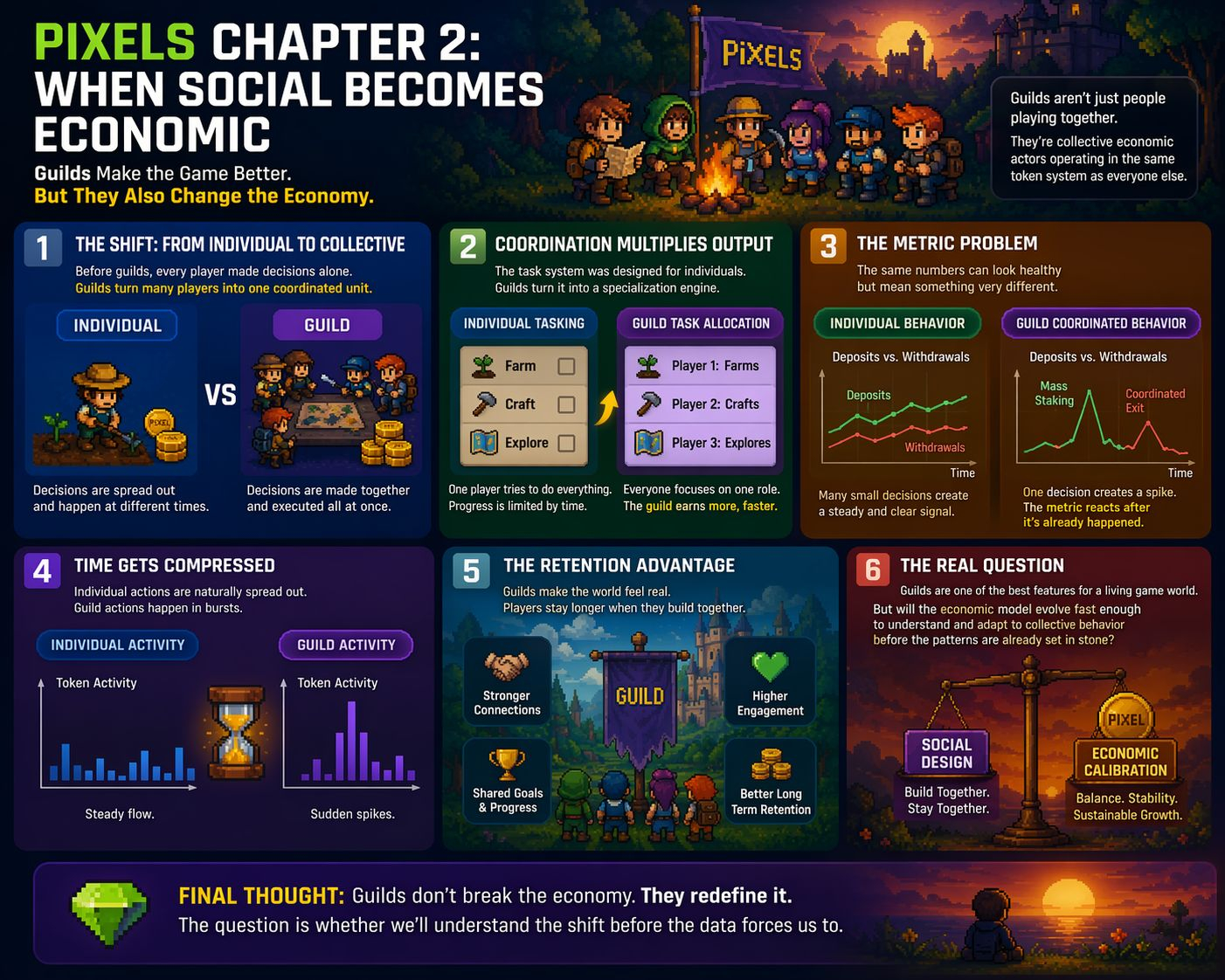
Before guilds, the Pixels economy largely functioned as an aggregation of individual decisions.
Players farmed, crafted, explored, and interacted with the token independently. Even when patterns emerged, they were the result of distributed behavior. One player staking did not depend on another. One player selling did not require coordination.
This is what made certain economic signals meaningful.
When deposits began to outpace withdrawals, it suggested a collective preference toward holding. But that signal was built on the assumption that each player was acting independently. The aggregate behavior reflected a decentralized consensus formed through many small, uncoordinated decisions.
Guilds disrupt that foundation.
A guild does not behave like ten independent players. It behaves like one entity with ten execution points.
When a guild decides to stake, it is not a gradual accumulation of individual choices. It is a synchronized action. When a guild decides to liquidate, the same applies. What would have been spread across time becomes concentrated.
This changes the shape of economic activity.
Not the total volume necessarily, but the timing, intensity, and predictability of that volume.
Coordination as a Force Multiplier
The introduction of a structured task system adds another layer to this shift.
Tasks, when designed for individual players, create a system of optimization at the personal level. Each player navigates their own path, making tradeoffs based on time, skill, and opportunity.
Guilds transform this dynamic entirely.
Instead of each player attempting to optimize across all available activities, roles can be distributed. One player focuses on farming. Another on crafting. Another on exploration. The guild, as a unit, covers more ground in less time.
This is not just cooperation. It is specialization.
And specialization leads to efficiency.
Efficiency leads to increased output.
In a token economy, increased output translates directly into higher emission velocity at the group level.
The system that was balanced around individual pacing now has to contend with coordinated acceleration.
The Metric Problem No One Talks About
One of the more subtle challenges introduced by guilds is not in the gameplay itself, but in how the health of the economy is measured.
Metrics like deposits versus withdrawals are useful, but only within the context they were designed for. They assume a certain distribution of behavior.
When that distribution changes, the interpretation of the same metric can become misleading.
A guild that coordinates staking can create a strong holding signal. On the surface, this looks identical to a healthy accumulation trend driven by individual confidence. But the underlying behavior is different. It is centralized within a group decision rather than dispersed across many independent ones.
The same applies in reverse.
A coordinated exit from a guild can produce a sharp spike in withdrawals. By the time it appears in the data, the decision has already been made and executed.
The metric does not lose its value, but it loses its clarity.
It becomes reactive instead of descriptive.
The Timing Shift
One of the most important yet least discussed effects of guild coordination is the compression of time.
Individual players act on different schedules. Their decisions are influenced by personal circumstances, playtime, and perception. This naturally spreads economic activity across a timeline.
Guilds compress that timeline.
Decisions are discussed, agreed upon, and executed together. This creates bursts of activity instead of a steady flow.
From an economic perspective, this introduces volatility.
Not necessarily in price alone, but in liquidity patterns, staking cycles, and reward distribution.
Systems that are stable under distributed behavior can become unpredictable under synchronized action.
The Retention Advantage
It would be a mistake to view this shift purely as a risk.
Guilds solve one of the hardest problems in Web3 gaming, which is retention.
Players are far more likely to stay engaged when they feel part of a group. Social accountability, shared goals, and collective progress create emotional investment that no reward system can replicate on its own.
This matters.
A game with strong retention has more time to refine its economy. More opportunities to balance emission, adjust incentives, and introduce new sinks.
In that sense, guilds are not just an economic variable. They are a stabilizing force at the player level.
But stability in player engagement does not automatically translate to stability in token dynamics.
The Gap Between Design and Reality
What makes this moment interesting is not that guilds exist, but that the economic model may not yet fully reflect their impact.
Design often moves faster than calibration.
Features are introduced based on what improves gameplay. Economic adjustments follow based on observed behavior. This creates a gap where systems operate under assumptions that are no longer fully accurate.
Guilds expand that gap.
They introduce a new layer of coordination that amplifies both positive and negative outcomes.
If the system adapts, this can lead to a more mature and resilient economy.
If it does not, the mismatch can create pressure points that only become visible after patterns are established.
The Unspoken Tension
There is a tension here that is rarely addressed directly.
On one side, there is the desire to build a living world. A space where players interact, collaborate, and create shared experiences.
On the other, there is the need to maintain a balanced token economy.
These goals are not in conflict, but they are not automatically aligned either.
Guilds strengthen the first goal.
They complicate the second.
The challenge is not choosing between them, but integrating them in a way that acknowledges their interaction.
What Happens Next
The real impact of guilds will not be determined by their introduction, but by how players choose to use them.
Coordination patterns will emerge over time. Some guilds will focus on efficiency. Others on exploration. Some will prioritize long term accumulation. Others short term gains.
These patterns will shape the flow of the economy in ways that no roadmap can fully predict.
The important question is whether the system is flexible enough to respond.
Not reactively, but proactively.
Final Thought
Guilds make the world feel real. That part is undeniable.
They turn a collection of mechanics into a shared experience. They give players a reason to stay, to invest time, and to care about what happens next.
But in a tokenized environment, every layer of meaning carries weight.
What looks like a social upgrade on the surface can reshape the underlying structure in quiet but significant ways.
The shift from individual actors to collective decision making is one of those changes.
It does not break the system.
It redefines it.
And the outcome will depend on how well that redefinition is understood before it fully plays out in the data.
