
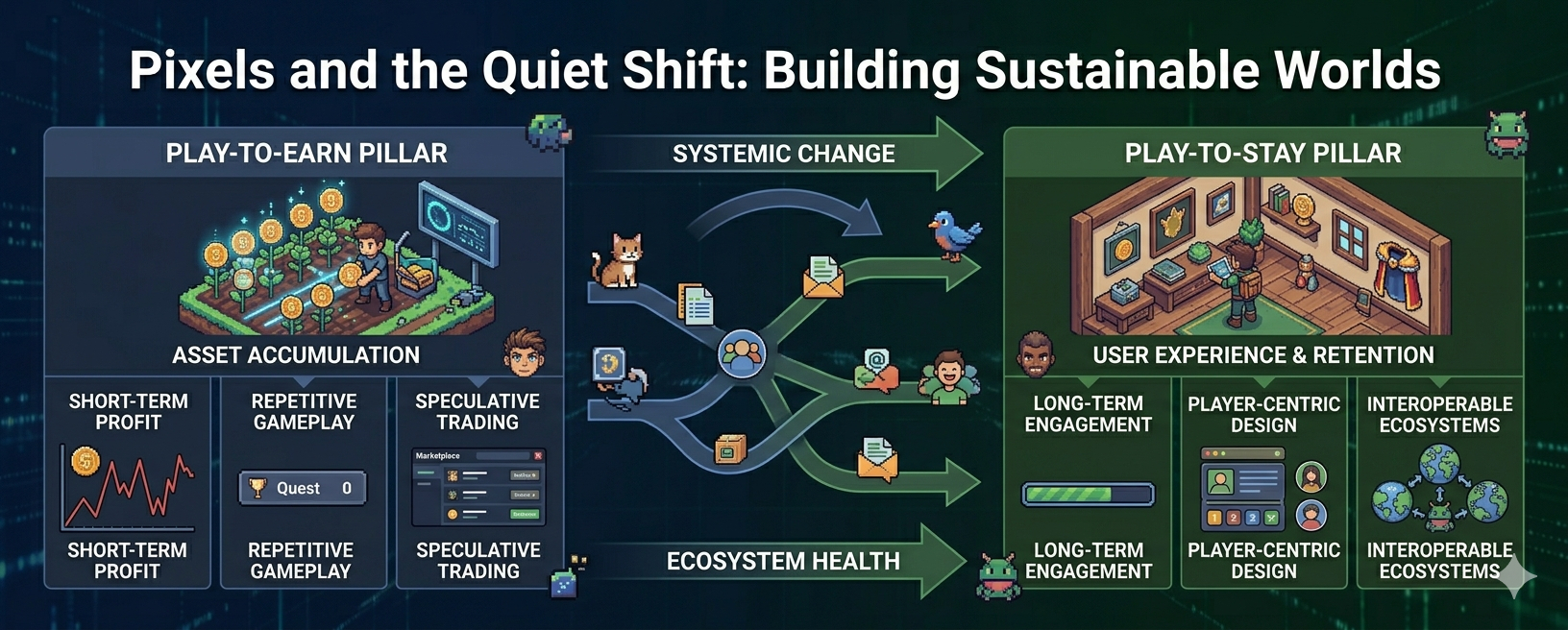
Pixels and the Shift From Play-to-Earn to Play-to-Stay
Lately, I keep noticing a change in how people talk about crypto games.
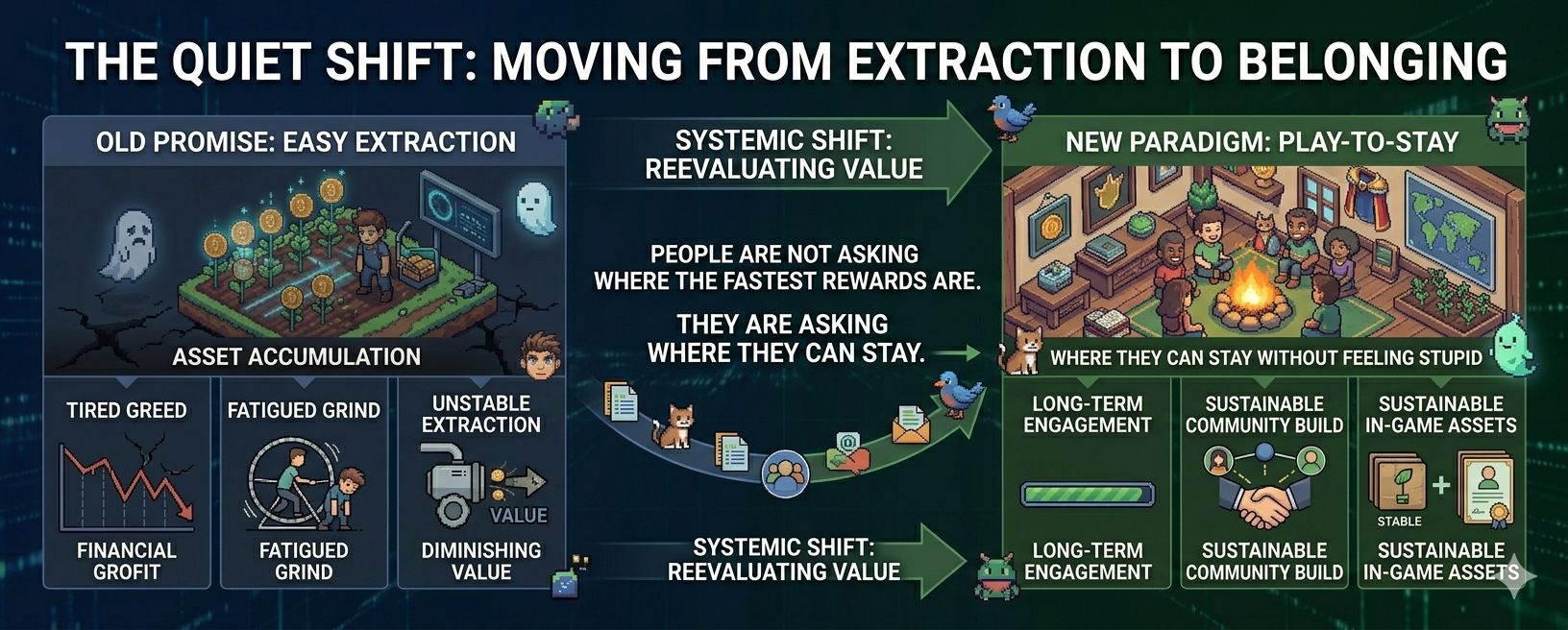
The loud excitement is weaker now. The old promise of easy extraction does not land the same way it used to. People sound less greedy, but also more tired. They are not asking where the fastest rewards are anymore. They are asking where they can stay without feeling stupid.
That is part of why Pixels makes sense to me.
At first, it looks like one of the more successful answers to a market that finally got exhausted by its own fantasies. It does not lead with financial aggression. It leads with softness. A world you can enter without feeling like you are immediately being priced, measured, and pushed into a spreadsheet. In crypto, that alone is enough to stand out.
And honestly, I respected that.
A lot of projects still act like users want intensity. More complexity. More token logic. More things to optimize. Pixels seems to understand the opposite. Most people are tired of systems that feel like work before they have earned the right to become meaningful. So it lowers the temperature. It makes participation feel light. Familiar. Repeatable.
That is not a small design choice.
It is the whole thesis.
For a while, I thought that was the real achievement here. Not just making a game people could play, but making a crypto system people could return to without constant resistance. In a market full of noisy token mechanics and collapsing reward loops, that kind of friction management looks almost mature.
But the more I sat with it, the more the project started to feel less like play-to-earn and more like something else.
Play-to-stay.
And that shift matters.
Play-to-earn was always unstable. Everyone knows that now. If too many people arrive for extraction, the system becomes a waiting room for disappointment. So the smarter move is obvious. Stop promising wealth. Start building habit. Stop paying people to come. Give them reasons to remain.
That sounds healthier on the surface.
Maybe it is.
But it also changes the emotional contract.
When a system is built around earning, the pressure is visible. The user knows what the game is asking. Time goes in. Rewards come out, or they do not. The transaction is crude, but honest in its own way.
Play-to-stay is more subtle.
Now the value of the system depends less on what it gives you today and more on whether it can keep you inside tomorrow. That means the design priority shifts. The goal is no longer just distribution. It becomes retention, routine, identity, and soft dependency. The economy does not need you to win. It needs you to remain legible to it.
That is where my respect started turning into discomfort.
Because Pixels is good at this.
Too good, maybe.
The world feels casual, but the logic underneath it is disciplined. Every loop is small enough to feel harmless. Every return feels reasonable. Nothing screams obligation. But over time, the structure starts to reveal itself. The game is not just rewarding activity. It is training continuity. It is teaching the player that staying connected to the system is itself the real behavior being valued.
That is a very different model from the early play-to-earn era.
And to be fair, it is probably more durable.
A system built on recurring presence is stronger than one built on extraction spikes. A system that filters for committed users will usually outlive one that attracts opportunists. I understand the logic. In many ways, it is the grown-up version of crypto gaming. Less fantasy. More behavioral stability.
Still, something about it keeps bothering me.
Because once “staying” becomes the true product, the line between engagement and dependence starts getting harder to read.
The player thinks they are returning because the world is pleasant. Maybe that is true. But the system also learns to make pleasantness part of the retention engine. It smooths the surface. Reduces friction. Organizes rewards, access, and progression in a way that makes exit feel less dramatic, but more quietly expensive.
Not expensive only in tokens.
Expensive in rhythm.
In familiarity.
In social position.
In the small psychological comfort of knowing where to log in and what to do next.
That is what makes Pixels interesting to me now. Not as a game that solved crypto gaming, but as a system that may have realized something more important. People no longer need to believe they are getting rich. They only need to feel that leaving would break a pattern that has started to make sense.
And that is a much deeper kind of power.
So yes, I get why people are drawn to Pixels. I am drawn to it too. It understands the mood shift better than most projects do. It knows this market is no longer looking for fantasy returns. It is looking for sustainable attachment.
But that leaves me with a harder question than the usual token debate.
If crypto games stop paying users to extract value and start designing them to quietly remain inside the system, who is really being served by that stability?