Here’s a cleaner, post-ready version of your text that keeps your tone and argument but tightens repetition and improves readability:
The cycles of crypto narratives have become increasingly repetitive. Every time something “new” emerges, it often feels less like innovation and more like a reconfiguration of familiar ideas.
The latest iteration revolves around AI, automation, and agent-based systems. But even these feel like another layer on an existing stack: smart contracts enabled programmable ownership, DeFi unlocked idle capital, Layer 2s improved accessibility, and now AI is reshaping how users interact with decentralized applications.
What’s more interesting is what happens in the transition periods—when capital and attention rotate between narratives without fully committing to the next dominant theme. Historically, this is when gaming ecosystems tend to emerge.
Web3 gaming is particularly difficult to evaluate because it sits at the intersection of speculation, culture, and product design. Many previous ecosystems failed because they over-optimized for token incentives rather than gameplay. Once rewards declined, users left just as quickly as they arrived.
That appears to be slowly changing.
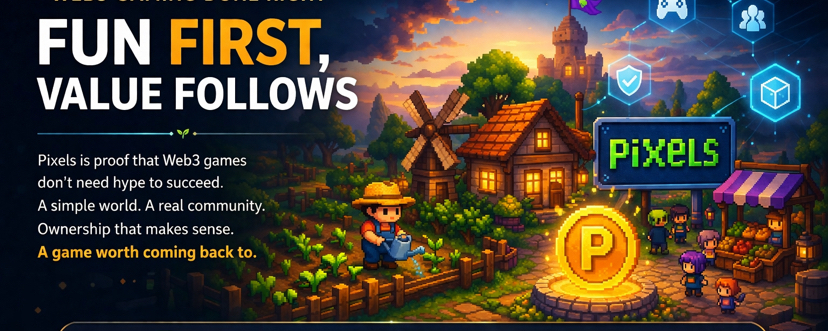
Projects like Pixels (PIXEL) on the Ronin network illustrate a different approach. Instead of relying purely on financial incentives, they lean into more traditional game loops: farming, exploration, and social interaction in an open-world environment. Tokens exist, but as a secondary layer rather than the core reason to participate.
From a behavioral perspective, this shift matters. Retention in Web3 games is less about earnings and more about habit formation—repeated actions in low-friction environments, reinforced by social ties and community interaction.
Visibility also plays a role. As projects gain exposure on major exchanges and ecosystems, they attract broader participant profiles, from long-term players to short-term yield seekers, each interpreting the same system differently.
Paradoxically, this divergence in perception is often what extends a project’s lifespan beyond what fundamentals alone might justify.
Timing, then, becomes critical.
Gaming tends to perform best when attention is not dominated by pure financial mechanics. It fades during DeFi-heavy cycles, retreats during infrastructure phases, and re-emerges during rotation periods when narratives are less defined.
The real question is whether ecosystems like this can sustain enough engagement to survive until the next sustained attention cycle.
In crypto, everything ultimately comes down to rotations of attention—where infrastructure shapes behavior, and behavior shapes value.
So the question remains:
Is this the beginning of a new gaming wave… or just another temporary narrative bridge?
@Pixels $PIXEL #pixel