
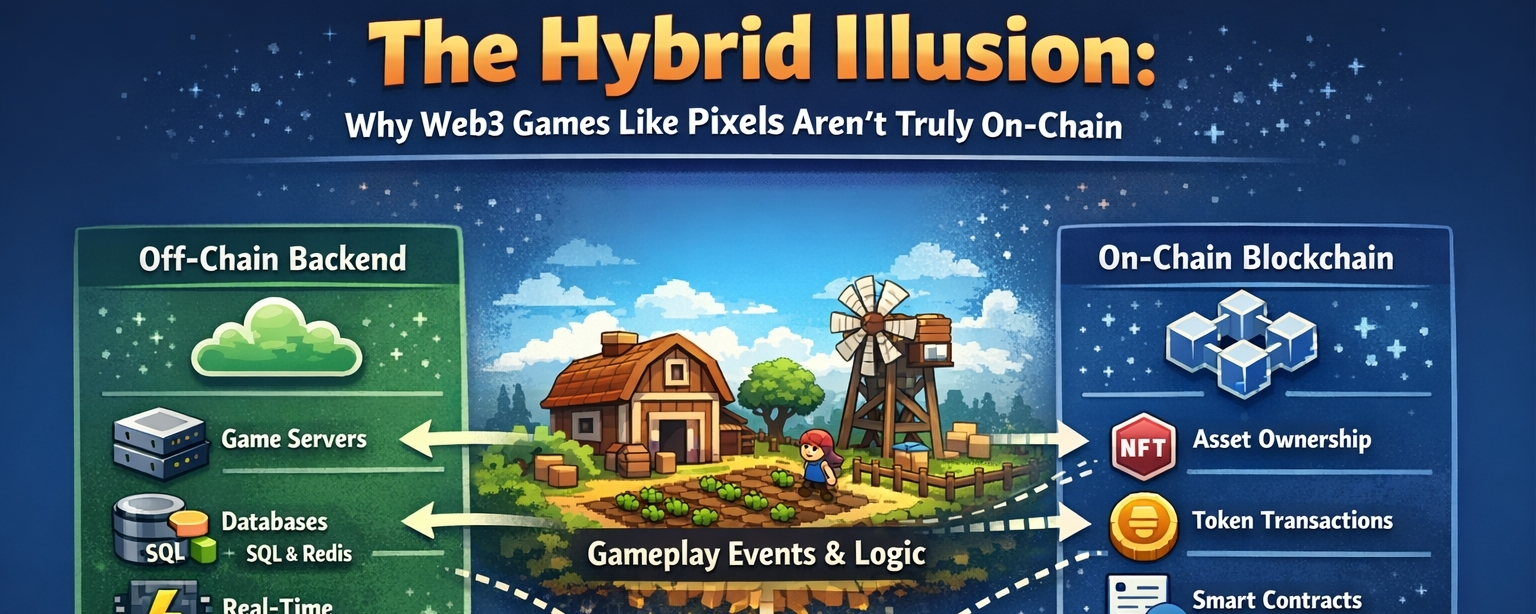
At first glance, games like Pixels (PIXEL) feel like proof that Web3 gaming has finally “figured it out.” A persistent world, player-owned assets, seamless interactions—it all suggests a future where everything lives on the blockchain. But the reality is far less romantic, and far more interesting.
Modern Web3 games are not fully on-chain. Not even close.
What they actually run on is a carefully engineered hybrid architectureone that blends traditional backend systems with selective blockchain integration. And if you look closely, it’s this hybrid model—not the chain itselfthat makes these games playable at scale.
The Illusion of On-Chain Gameplay
Blockchains are excellent at what they’re designed for: trustless verification, immutable ownership, and transparent transactions. But they are fundamentally constrained systems. High latency, limited throughput, and transaction costs make them unsuitable for real-time gameplay.
Imagine trying to execute every player movement, crop harvest, or interaction in a farming game directly on-chain. Every action would require a transaction. Every transaction would need confirmation. The result? A game that feels less like a living world and more like waiting in line.
So developers don’t do that.
Instead, games like Pixels treat the blockchain as a settlement layer, not an execution layer. Ownership of assets, token balances, and key economic actions are recorded on-chainbut the moment-to-moment gameplay happens elsewhere.
The Real Engine: Event-Driven Backend Systems
Under the surface, these games resemble modern distributed systems more than decentralized applications.
At their core, they rely on event-driven server architectures. Every player action—planting a crop, moving across the map, interacting with an object—generates events that are processed asynchronously. These events flow through message queues, worker services, and microservices that handle specific domains like inventory, crafting, or world state.
This design allows the system to scale horizontally. Thousands of concurrent players can interact with the game world because the backend isn’t bottlenecked by synchronous processing or blockchain confirmation times. Instead, it reacts to events in near real time, distributing workload across services.
Cloud infrastructure plays a critical role here. Auto-scaling clusters, load balancers, and distributed storage ensure that the system can handle spikes in player activity without degrading performance. The “Web3” label may be front-facing, but the backbone is unmistakably Web2 in its engineering discipline.
Database Layering: Speed Meets Structure
To maintain both speed and consistency, hybrid architectures rely on layered data storage strategies.
Relational databases (like PostgreSQL) manage structured, persistent data—player profiles, inventories, progression states. These systems ensure data integrity and enable complex queries across large datasets.
Meanwhile, in-memory systems like Redis handle real-time state. Player positions, temporary interactions, cooldown timers—anything that requires ultra-low latency is stored and updated in memory. This allows the game to feel responsive, even under heavy load.
The combination is powerful: durable storage for long-term state, and lightning-fast access for moment-to-moment gameplay.
Latency: The Deciding Factor
Latency is where hybrid systems truly justify themselves.
If every action required a blockchain interaction, gameplay would grind to a halt. Instead, core game logic is executed off-chain, where responses can happen in milliseconds. Only critical events—such as minting an asset, transferring ownership, or executing a marketplace trade—are pushed to the blockchain via APIs.
This selective interaction minimizes latency while preserving the benefits of decentralization where it matters most: ownership and trust.
But this approach introduces a subtle tension.
The Trade-Offs: Trust, Dependency, and Drift
Hybrid systems are efficient, but they are not without compromises.
First, they introduce dependency on external APIs and infrastructure. Blockchain nodes, indexing services, and third-party providers become critical components. If these fail or lag, parts of the system can stall.
Second, there’s the risk of state desynchronization. The off-chain backend and on-chain data must remain consistent, but they operate in fundamentally different environments. Network delays, failed transactions, or indexing lag can create temporary mismatches between what the game shows and what the blockchain records.
Finally, there’s a philosophical trade-off. The more logic you move off-chain, the more you rely on centralized systems—reintroducing trust assumptions that Web3 originally aimed to eliminate.
A Necessary Compromise—or a Temporary Phase?
Hybrid architecture isn’t a shortcut. It’s a necessity.
Without it, games like Pixels wouldn’t exist in any playable form. The responsiveness, scale, and user experience players expect today simply can’t be delivered by current blockchain infrastructure alone.
But this raises a deeper question:
If Web3 gaming continues to scale by layering complexitymixing off-chain systems, cloud infrastructure, and selective on-chain interactionsare we building toward true decentralization, or just engineering around its limitations?
And more importantly: as these hybrid systems grow more intricate, will their complexity eventually become the very thing that limits their scalability—and challenges the vision they were meant to realize?
