
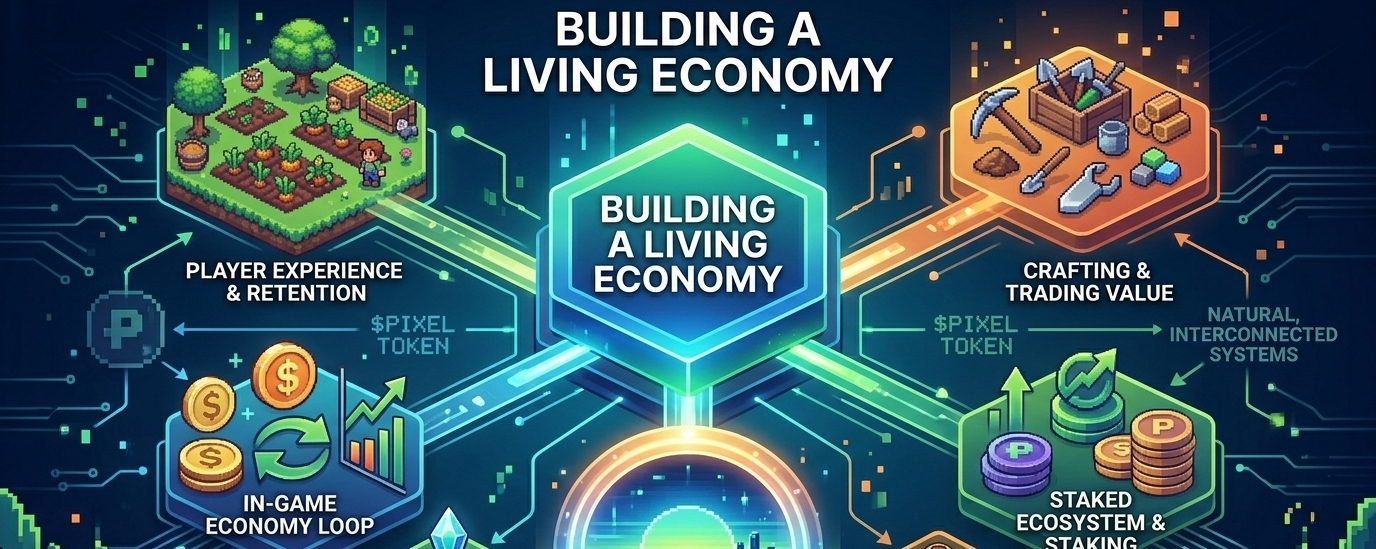
 In a space where most Web3 games compete for instant attention, @Pixels is quietly taking a different route. Instead of pushing fast rewards and short-term hype, it focuses on something much harder to achieve — creating a world where players actually want to stay.
At first glance, Pixels feels simple. It’s a social casual game centered around farming, exploration, and creation. You plant crops, gather materials, and interact with a pixel-style environment that feels relaxed and easy to enter. But the longer you spend in it, the more you begin to notice something deeper. Every action has a purpose, and nothing feels disconnected.
This is where the strength of the ecosystem starts to reveal itself.
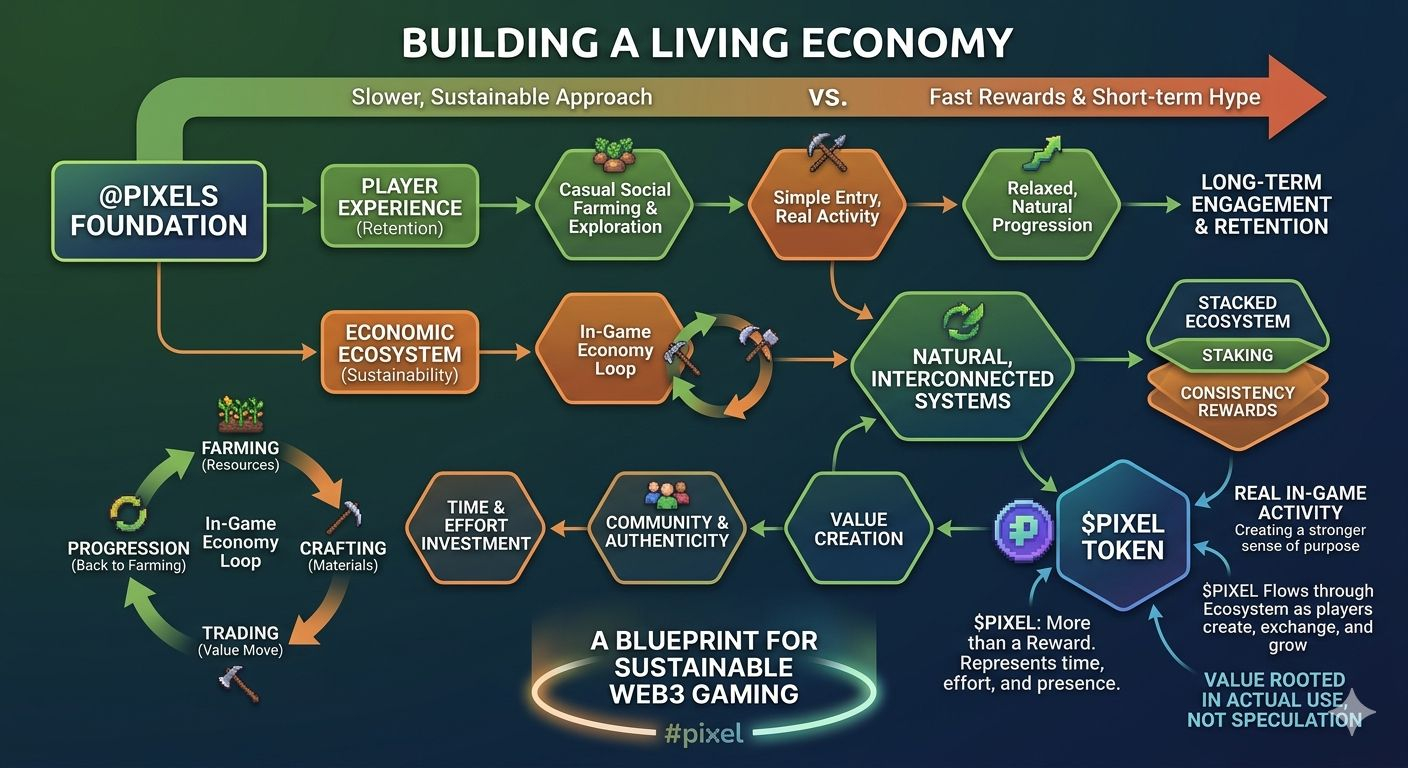
Unlike many Web3 projects that depend heavily on aggressive reward systems, @Pixels builds its foundation around real activity. The introduction of $PIXEL is not just about earning — it’s about participation. When players farm, craft, or trade, they’re contributing to a loop where value moves organically across the entire ecosystem.
That loop becomes even more powerful within the Stacked ecosystem. Pixels doesn’t treat its features as separate elements. Instead, it layers them in a way that keeps everything connected. Farming leads to resources, resources lead to crafting, crafting leads to trading, and trading feeds back into progression. On top of that, staking introduces another dimension, allowing players to stay committed and benefit over time.
What stands out is how natural this all feels.
There’s no pressure to rush or maximize everything instantly. Players are free to move at their own pace, and that freedom changes the entire experience. It shifts the focus away from “earning quickly” to “building gradually.” That difference may seem small, but it has a major impact on how players engage with the game.
When people are not constantly chasing short-term rewards, they begin to form a deeper connection. They invest time, build routines, and slowly become part of the world. Over time, this leads to a more stable and loyal community — something that many Web3 games struggle to maintain.
Another key element is the social aspect. Pixels isn’t designed to be a solo journey. It encourages interaction between players, whether through trading, collaboration, or simply sharing the same space. This adds a layer of authenticity that makes the experience feel alive.
And this is where $PIXEL gains real significance.
In many projects, tokens exist mainly for speculation. Their value often depends more on market trends than actual usage. In Pixels, the situation feels different. The token is directly tied to in-game activity. It flows through the ecosystem as players create, exchange, and grow. This gives it a stronger sense of purpose beyond just price movement.
The Stacked ecosystem reinforces this by rewarding consistency rather than quick participation. It’s not about joining for a moment and extracting value. It’s about staying, contributing, and growing alongside the game. This naturally encourages long-term behavior and supports a healthier economy.
Of course, this slower approach may not appeal to everyone. Some players are used to fast rewards and immediate returns. But @Pixels seems focused on building something sustainable rather than something temporary. And in the long run, that choice could make all the difference.
Because Web3 gaming doesn’t just need attention — it needs retention.
One of the biggest challenges in blockchain games has always been keeping players engaged. When rewards are too high, economies become unstable. When incentives drop, players leave. Pixels addresses this by focusing on experience first. If the game itself is enjoyable, players will continue to engage even when rewards fluctuate.
This creates a stronger foundation for everything else.
The economy becomes more balanced because it’s driven by real player activity. The community becomes more meaningful because people feel connected. And the token gains more stability because its value is rooted in actual use, not just speculation.
Another thing worth noticing is how smooth the overall design feels. The systems are layered, but they’re introduced in a way that doesn’t overwhelm new players. You don’t need to understand everything at once. You grow into it step by step, just like your character grows inside the game.
That gradual progression is part of what makes Pixels feel genuine.
Instead of forcing complexity, it allows discovery. Players naturally learn how different parts of the ecosystem connect, and that process builds stronger engagement over time. It’s not just about playing — it’s about becoming part of something that evolves.
Looking ahead, this approach could influence how future Web3 games are designed. If more projects begin to prioritize sustainability, player experience, and interconnected systems, the overall space could mature significantly. Pixels may not rely on loud hype, but it’s offering a model that feels practical and long-lasting.
In the end, what makes @Pixels stand out is not just its gameplay or its token. It’s the philosophy behind it. A focus on steady growth, meaningful participation, and a system where players genuinely matter.
$PIXEL , in this context, becomes more than a reward. It represents time, effort, and presence within a growing digital world.
And if this vision continues to develop, Pixels might not just be another Web3 game — it could become a blueprint for what sustainable blockchain gaming should look like.