


For a long time, LiveOps in games was treated as something close to intuition driven craftsmanship. Teams gathered in rooms, looked at dashboards, shared past experiences, and tried to predict player behavior based on what “felt right.” It was not irrational. In fact, it was built on years of accumulated knowledge. But it was still, at its core, a system shaped by interpretation rather than direct understanding.
The idea sounded simple. If you run an event at the right time, players will return. If you increase rewards, engagement will rise. If you create urgency, activity will spike. These assumptions often worked just enough to reinforce themselves. That partial success made them feel reliable. But if you slow down and examine the process carefully, there is a large gap between what we think players want and what they actually need.
That gap becomes more visible when player scale increases.
In smaller systems, noise hides patterns. Individual behaviors blur together, and it becomes difficult to distinguish coincidence from causation. But in large scale environments like Pixels, something different happens. Behavior stops looking random. It begins to form consistent structures. Patterns repeat. Signals become clearer. What once felt like guesswork starts to look measurable.
This is where a shift in thinking begins.
Instead of asking what kind of event might bring players back, the question becomes more precise. What does this specific group of players need right now to continue their journey
That change may sound subtle, but it transforms the entire LiveOps approach.
One of the most interesting developments in this space is the introduction of an AI game economist. Not as a replacement for human decision making, but as a system designed to interpret behavioral data at a level that humans struggle to process consistently. Its role is not simply to output numbers or forecasts. It helps answer a deeper question about player intent.
What makes this powerful is not the technology itself, but the type of understanding it enables.
Traditional segmentation often relies on static attributes. Account age, player level, spending tier. These categories are easy to define but limited in meaning. Two players at the same level can have completely different motivations. One may be highly engaged and exploring systems deeply. Another may be progressing quickly but losing interest.
When segmentation is based on behavior instead of labels, a different picture emerges.
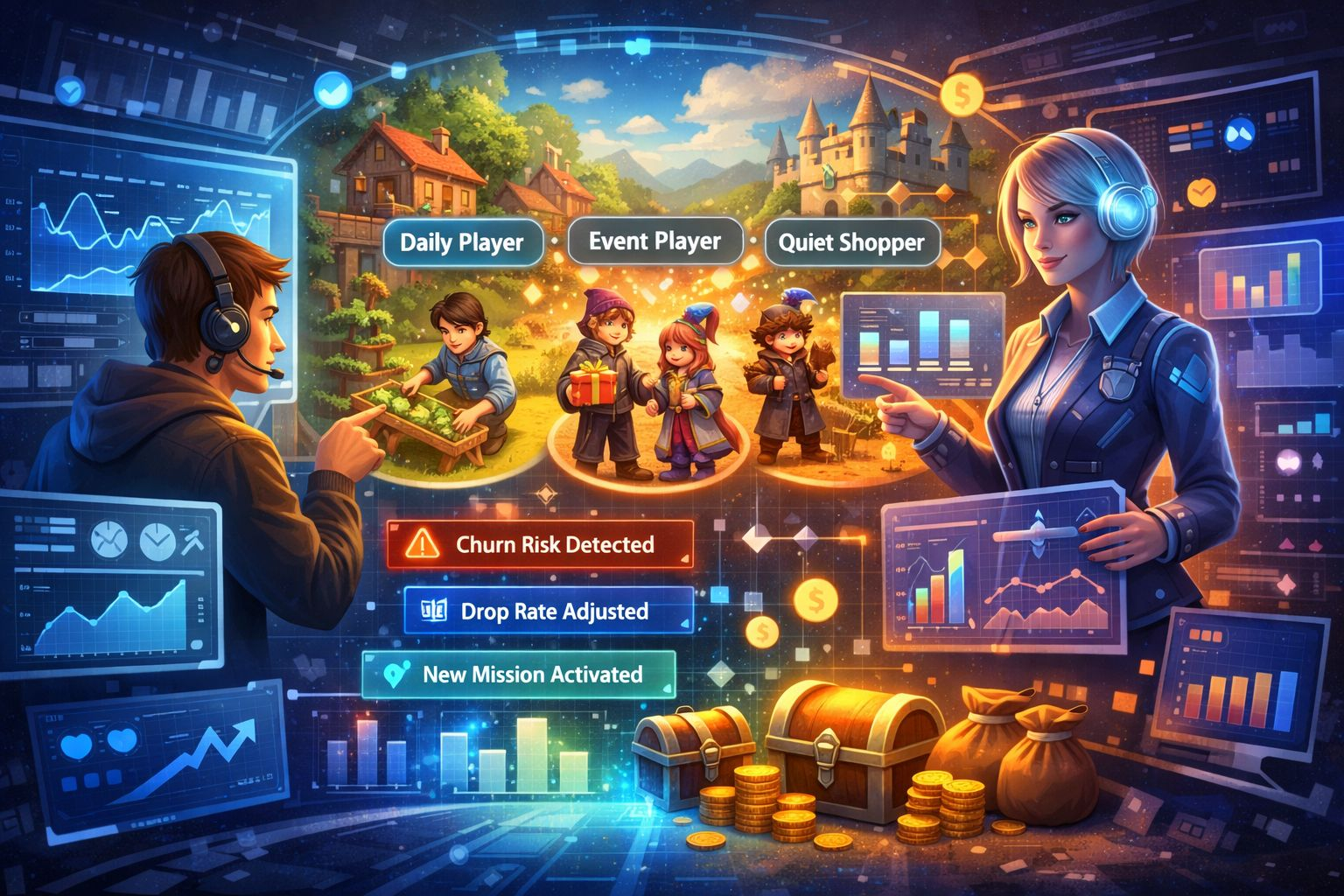
Players begin to group themselves naturally through their actions. Some log in daily and engage consistently. Some appear only during events. Some rarely interact but make purchases quietly. These are not predefined segments. They are patterns discovered through observation.
This shift removes a layer of human bias.
Instead of deciding in advance how players should be categorized, the system observes how they actually behave and organizes them accordingly. It becomes less about defining players and more about understanding them.
What feels surprisingly human about this approach is its ability to detect subtle changes before they become obvious problems.
One of the most challenging aspects of LiveOps has always been churn prediction. By the time a player stops logging in, the opportunity to retain them is already shrinking. Traditional systems react to outcomes. Behavioral systems focus on signals.
A slight drop in session frequency. A change in activity patterns. Reduced interaction with certain features. Individually, these signals may not seem significant. But when analyzed together, they can indicate a shift in player intent.
The AI does not interpret these changes emotionally. It identifies them as deviations from established behavior patterns. That distinction matters.
Because once a potential disengagement is detected early, the response does not need to be dramatic.
This is where many LiveOps strategies have historically gone wrong.
The instinctive reaction to declining engagement is often to increase rewards or launch large scale events. These actions are visible and measurable, but not always effective. They can attract attention temporarily, but they do not necessarily address the underlying reason for disengagement.
In contrast, small and targeted interventions can be far more impactful.
For a player who is losing interest, a slight adjustment in drop rates for relevant items may restore a sense of progression. For another, a mission aligned with their preferred playstyle can reignite motivation. These changes are not designed to overwhelm. They are designed to reconnect.
Timing becomes more important than magnitude.
A well placed adjustment at the right moment can achieve more than a large reward delivered too late or to the wrong audience. This is where data driven systems provide a clear advantage. They operate continuously, identifying when intervention is needed rather than relying on scheduled campaigns.
Another important implication emerges from this approach.
Not all players need to be convinced to stay.
In traditional LiveOps planning, rewards are often distributed broadly. Events are designed to appeal to as many players as possible. While this increases participation, it can lead to inefficiencies. Loyal players who are already engaged receive incentives they did not require. Meanwhile, players at risk of leaving may not receive the specific support they need.
This misalignment represents a hidden cost.
Resources are spent, but not always where they create the most value. Over time, this can lead to inflation in reward systems without a proportional increase in retention or revenue.
By focusing attention instead of distribution, the system becomes more efficient.
Attention in this context means recognizing when a player needs support and delivering it in a form that aligns with their behavior. It is not about giving more. It is about giving appropriately.
This also changes how success is measured.
Instead of evaluating campaigns based solely on participation or short term spikes, the focus shifts toward sustained engagement and long term retention. The impact of small interventions accumulates over time, creating a more stable player ecosystem.
There is also an operational advantage.
In many LiveOps environments, decision making involves multiple layers of discussion. Teams debate which events to run, what rewards to offer, and how to balance competing priorities. These discussions are valuable, but they can slow down response time.
When insights are generated directly from behavioral data and can be translated into actions within the same system, the feedback loop becomes shorter.
Decisions are still guided by human judgment, but they are supported by evidence that reflects real player activity rather than assumptions.
This does not eliminate the role of intuition.
Human insight remains important, especially in designing content, understanding emotional context, and shaping the overall player experience. But intuition becomes more grounded. It is no longer operating in isolation. It is informed by data that reveals patterns beyond what individuals can easily perceive.
This balance between intuition and data represents a more mature stage of LiveOps evolution.
It acknowledges that while human creativity drives engagement, data provides clarity.
One of the more profound realizations from this shift is how many past decisions may have been misdirected.
It is not difficult to imagine scenarios where significant rewards were given to players who were already highly engaged. These players appreciated the rewards, but their behavior may not have changed significantly because they were already committed.
At the same time, players who were quietly disengaging may not have received any meaningful intervention. Their departure was not dramatic. It was gradual. And without clear signals, it went unnoticed until it was too late.
This creates a subtle imbalance.
Retention appears stable in the short term because loyal players remain active. But underlying churn increases, affecting long term growth.
By identifying and addressing disengagement earlier, the system corrects this imbalance.
It ensures that effort is directed toward players who need it most, rather than those who are easiest to reach.
In environments like Pixels, where player scale allows patterns to emerge clearly, this approach has demonstrated measurable improvements in both retention and revenue.
But perhaps more importantly, it changes how teams think about their role.
Instead of trying to predict player behavior through assumptions, they begin to observe and respond to actual behavior. This reduces uncertainty and increases confidence in decision making.
It also introduces a level of humility.
Data often reveals that player behavior does not always align with expectations. Features that were expected to perform well may underperform. Simple adjustments may have larger impacts than anticipated.
Accepting these insights requires a willingness to challenge existing beliefs.
But it also creates an opportunity to improve continuously.
Another interesting aspect of this system is how it reframes the concept of personalization.
In many cases, personalization has been interpreted as offering different rewards or content to different segments. While this is part of the picture, true personalization goes deeper.
