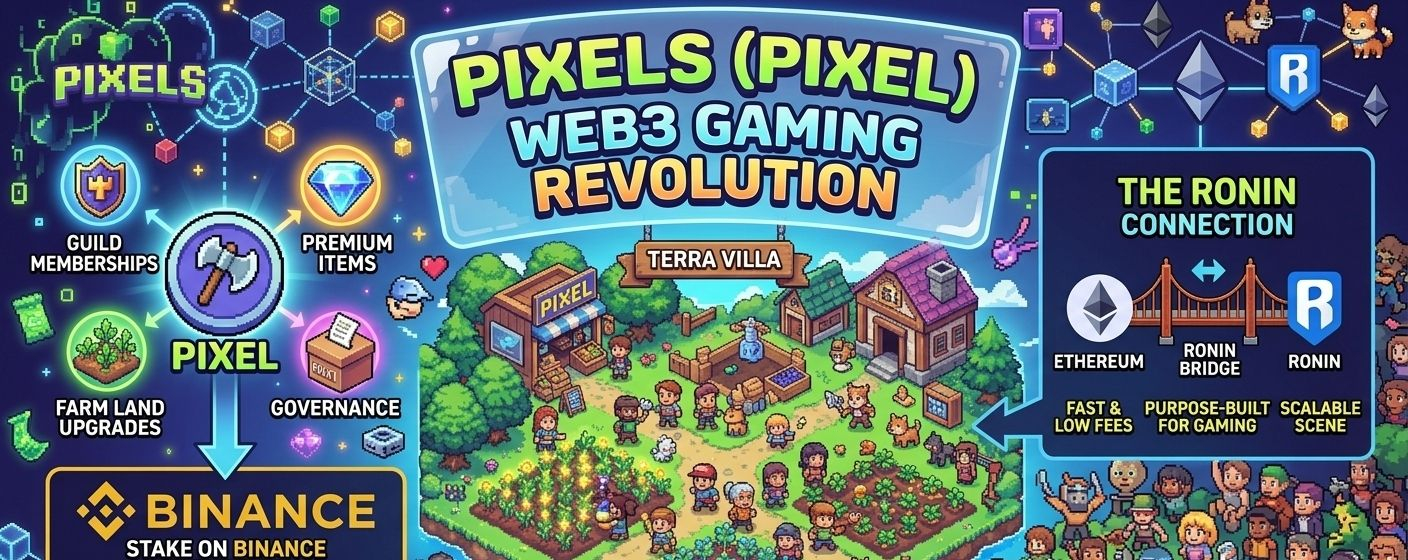
Pixels Might Be Turning $PIXEL Into a Market for Which Player Behavior Deserves to Scale
The phrase "Pixels Might Be Turning Pixel Into a Market for Which Player Behavior Deserves to Scale" encapsulates a shift in how Web3 gaming thinks about economy. In the world of Pixels (a popular blockchain-based social farming MMO), the native token $PIXEL isn't just a currency; it is becoming a filter.
Here is a detailed breakdown of how Pixels is transforming player behavior into a scalable market asset.
## 1. Moving Beyond "Play-to-Earn" to "Play-to-Own"
In the early days of Web3 gaming, the model was simple: play the game, get tokens, sell tokens. This led to "extractive behavior," where players (or bots) drained value without contributing to the ecosystem.
Pixels is changing the narrative. By making Pixel a core utility for progression—buying land, upgrading tools, and speeding up timers—the game forces players to decide: Is my time worth more than the token? When players choose to spend $PIXEL to enhance their experience, they are signaling that the gameplay itself has value. This turns "playing" into a behavior that scales the game's economy rather than depleting it.
## 2. The Market for "Proof of Play"
One of the biggest challenges in digital economies is distinguishing between a loyal player and a sybil (bot) attacker.
The Pixel token acts as a reputation layer. When a player invests $PIXEL into their farm or guild, they are providing "Proof of Play." The game's developers are essentially creating a market where:
*High-Value Behavior:** Long-term resource management, social interaction, and strategic farming.
*Low-Value Behavior:** Repetitive clicking and instant liquidating of rewards.
By rewarding the former and making the latter expensive (via VIP passes or energy costs paid in $PIXEL), the game scales "good" player behavior.
## 3. Scaling Social Coordination (Guilds)
With the introduction of Guilds, Pixel has taken on a new role in social scaling. Joining a guild often requires a bond or a purchase. This creates a market for organizational behavior.
The game isn't just scaling how many carrots are grown; it’s scaling how many people can work together toward a collective goal. If a guild behaves efficiently, the value of their "territory" and their $PIXEL-denominated assets grows. This incentivizes players to act as "citizens" of a digital nation rather than solo extractors.
## 4. The Economy of Scarcity and Desire
For an economy to scale, there must be a reason to hold the currency. Pixels uses Pixel to gatekeep aspirational content.
| Feature | Impact on Player Behavior |
|---|---|
| Cosmetic Upgrades | Encourages "flexing" and social status, which keeps tokens in the system. |
| Efficiency Boosts | Incentivizes long-term planning and reinvestment of profits. |
| Land Ownership | Creates a "landlord" class that must provide value to "sharecroppers" to remain profitable. |
By making these features desirable, the game creates a market for ambition. The players who "deserve" to scale are those willing to reinvest their earnings back into the world.
## 5. Identifying "Value-Additive" Players
The phrase "which player behavior deserves to scale" suggests a meritocracy. In Pixels, the algorithm and the economy are being tuned to identify players who:
1. Create Content: Engaging in the social hub and streaming.
2. Provide Liquidity: Trading resources in the marketplace.
3. Invest Time: Mastering complex crafting chains.
If you are a bot, your behavior is penalized. If you are a dedicated community member, the Pixel ecosystem provides you with more "surface area" to grow your influence. This is the marketization of loyalty.
## 6. The Risk of Hyper-Financialization
While scaling "good" behavior is the goal, the risk is that everything becomes a financial transaction. If Pixel becomes the only metric for success, the "fun" might be sidelined by "efficiency."
However, the Pixels team has been vocal about "sustainable rewards." They aren't trying to make everyone rich; they are trying to create a sustainable world where the right kind of work is rewarded. They are building a system where the market rewards those who treat the game like a hobby or a business, rather than a vending machine.
### Conclusion
Pixels is a massive social experiment. By turning Pixel into a tool that filters player intent, the developers are building a filter for the future of the Metaverse.
The behaviors that "deserve" to scale are sustainability, community, and long-term investment. If Pixels succeeds, it will prove that a digital currency can do more than just facilitate trades—it can actually shape the culture of the people using it. pixel is becoming the "gas" for a social engine that prioritizes the health of the ecosystem over the greed of the individual.