

I remember watching someone experience Pixels for the first time and feeling mildly puzzled by how relaxed everything appeared on the surface. Nothing seemed pressing. No obvious nudge to spend money, no aggressive mechanics pushing you ahead. It almost felt like the game had no opinion about how you chose to play. But after some time, that impression began to change. Not because anything was visibly different, but because certain players just seemed to operate at a different level. Not quicker in any obvious way. Just… better placed.
That's the piece I think most people are overlooking.
We still discuss game tokens as though they're primarily about pace. Pay to advance sooner, earn to sustain your cycle, leave when the returns slow. That model is well-known. It also fails in predictable ways. What's less apparent is when a system stops caring about pace altogether and begins quietly determining which behaviors are worth encouraging in the first place.
Pixels seems to be drifting in that direction — whether by deliberate design or simply as a natural consequence of how it was built.
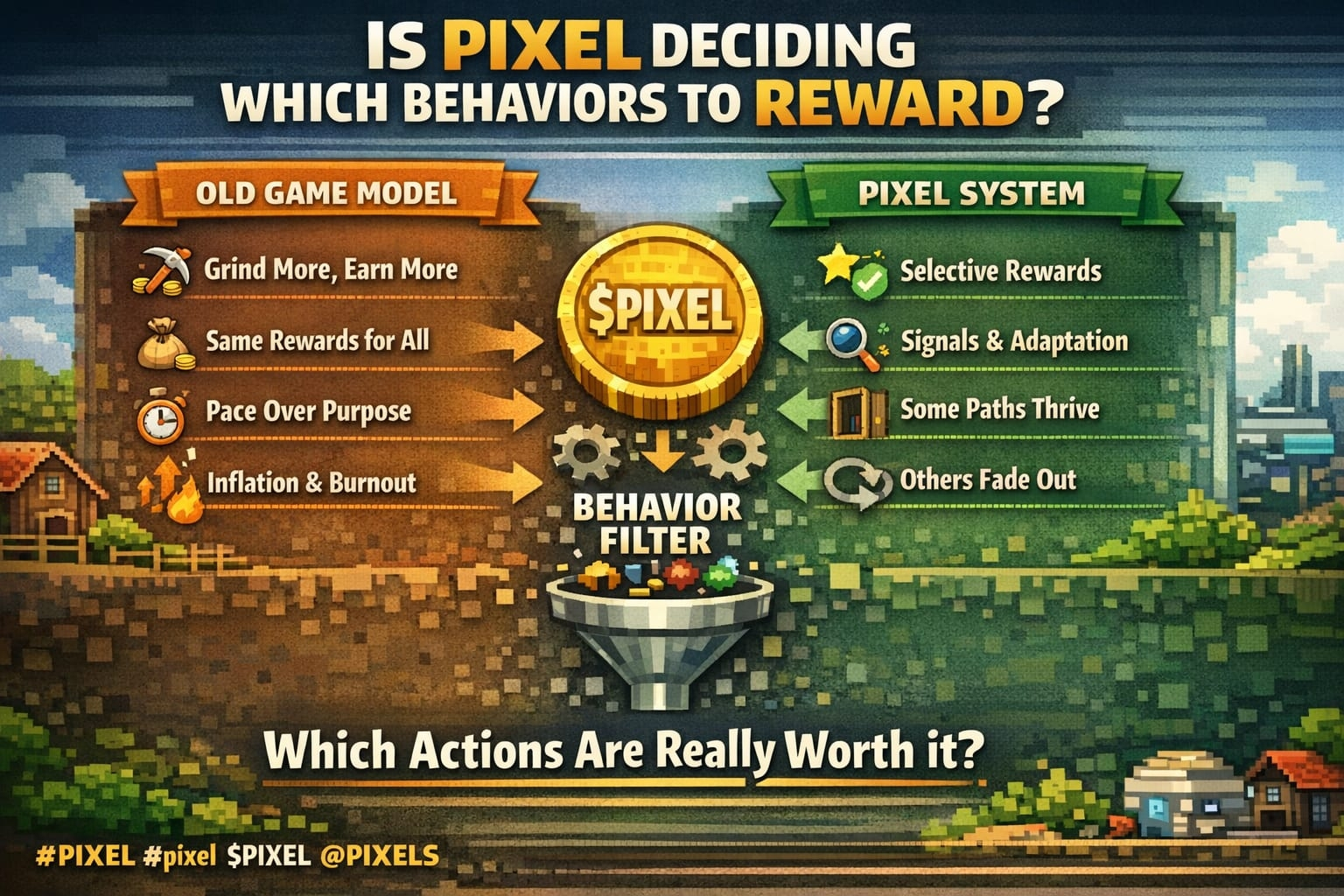
Most game economies don't really evaluate behavior. They just track it. Farm more, get more. Grind longer, earn more. The system never stops to ask whether that activity actually adds anything. It operates on the assumption that volume equals value. That assumption, in my view, has caused more harm than inflation ever has.
Because once everything is rewarded at the same rate, players stop caring about what actually matters. They just chase whatever is easiest to repeat.
In Pixels, I don't get the impression that everything is treated the same anymore. And it wasn't something I picked up on right away. It appears in subtle ways. Certain loops feel heavier as time goes on. Others, strangely, seem to open new doors the longer you stay with them. That imbalance is quiet, but it changes how you engage with the whole system.
It's not about doing more. It's about doing what the system actually recognizes.
I've tried to find a clear way to describe that, but there isn't one. It sits somewhere between incentive design and behavioral filtering. $PIXEL sits right at the center of it — but not in the way you'd expect. It's not simply the thing you spend or accumulate. It feels more like the layer that determines which patterns get reinforced over time.
That sounds vague until you draw a comparison outside of gaming.
On platforms like TikTok or YouTube, not all content grows at the same rate. The algorithm doesn't reward hard work. It rewards what it can amplify. Creators don't always understand why certain things take off, but they adjust regardless. Over time, the platform quietly reshapes behavior without ever telling anyone what to do.
Pixels is beginning to feel similar. Just slower. Less obvious.
Rather than a central algorithm controlling the outcome, the system relies on economic signals. Rewards shift. Access shifts. Some actions build into better positioning over time, while others stay stuck in cycles that go nowhere. You can technically still play however you like. But not every path leads to the same kind of result.
And that's where $PIXEL becomes something beyond a utility token.
It starts to function like a way of pricing the system's own attention. Not attention in the social sense — but which behaviors the system actually "notices." Which ones does it quietly pass over? That distinction carries more weight than raw activity, even if it's harder to measure.
I used to think demand for a token like this would come from the obvious sources. More users, more transactions, more spending. That still matters, but it feels like a secondary factor. What actually drives value — at least structurally — is whether players genuinely believe certain behaviors will keep paying off over time.
If they do, they commit to those behaviors. If they don't, they leave or start extracting whatever they can.
The difficult part is that this kind of system can break down in ways that aren't immediately obvious.
If Pixels ends up encouraging the wrong behaviors, players won't voice frustration right away. They'll adapt. They'll find the shortest route to whatever the system is rewarding and repeat it until it collapses. That's how most play-to-earn cycles fell apart — not because the design was clearly broken, but because players figured it out too well.
There's also a transparency problem I haven't been able to fully work through. When rewards become more selective, the system starts to feel less predictable. That can be a good thing — it makes simple exploitation harder. But it can also produce a quiet kind of frustration, where players sense a more effective way to play exists but can't quite identify it.
And then you get this strange dynamic where how you play becomes speculative. Not just the token's price — but the act of playing itself.
Maybe that's the real change happening here.
Pixels isn't just sitting on top of gameplay anymore. It's shaping which versions of gameplay are allowed to grow. Some loops expand. Others plateau. Over time, that gap compounds into something that looks less like a basic game economy and more like a selection mechanism.
I'm not certain whether that's intentional design or something that developed organically as the system scaled. It's difficult to know from the outside. But once you see it, it's hard to look past.
And it leaves me with a question that's somewhat unsettling.
If the system is continuously deciding which behaviors deserve to grow, then at what point does playing the game start to feel less like free exploration… and more like trying to stay in sync with something you can't fully understand?