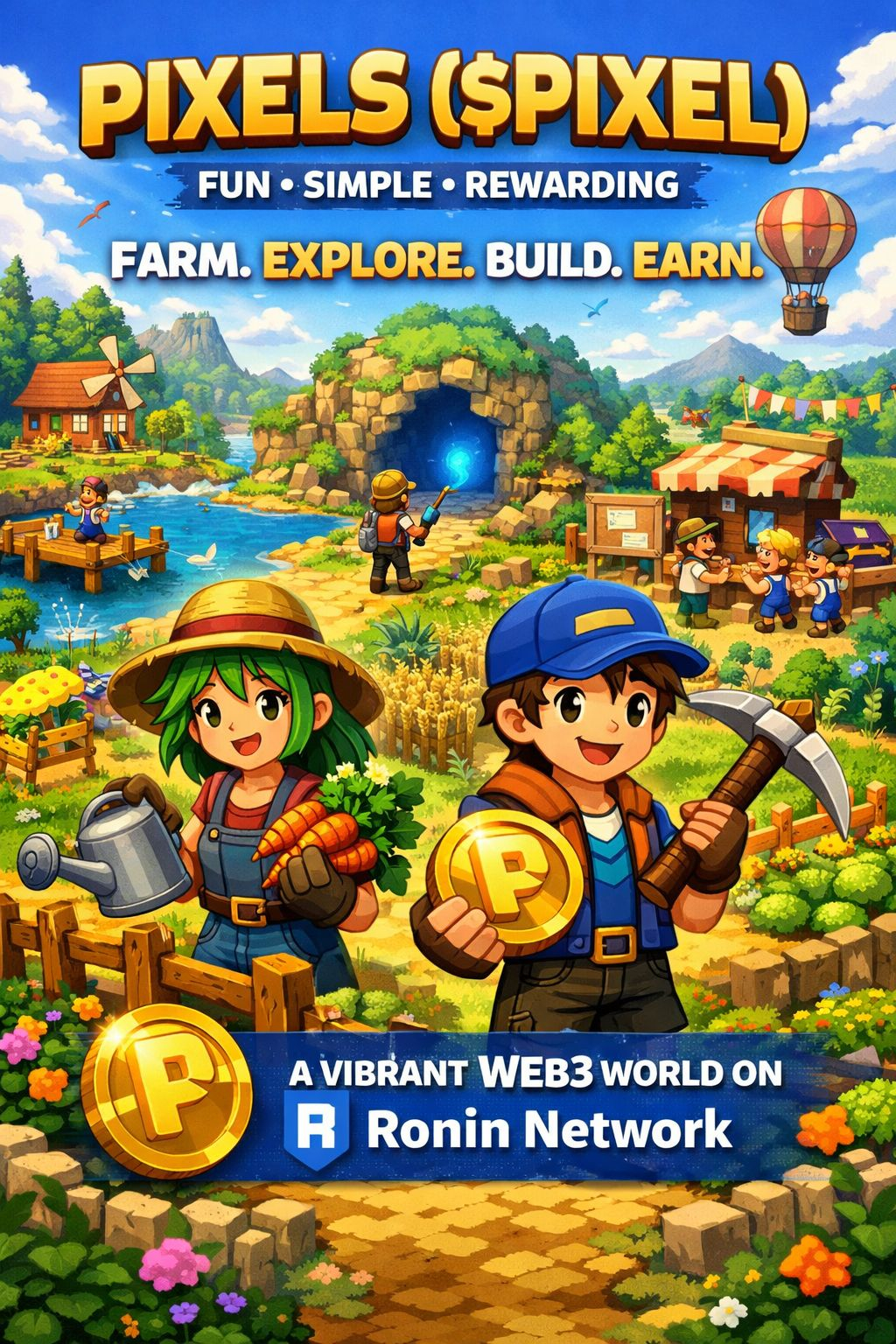
Agar aapko 100% best article chahiye ranking aur traffic ke liye, isi title par banaen. Why Pixels (PIXEL) Is Becoming the Most Exciting Web3 Game in 2026
The world of blockchain gaming has changed dramatically over the last few years. Many projects entered the market with loud promises, flashy marketing campaigns, and bold claims about revolutionizing gaming forever. Some created temporary excitement, while others disappeared as quickly as they arrived. In the middle of all that noise, a quieter and more genuine success story has been taking shape. That story is Pixels, a game that has steadily grown into one of the most talked-about names in Web3 gaming.
Pixels is not trying to impress players with impossible promises or complicated mechanics. Instead, it offers something surprisingly rare in the crypto gaming world: a game that feels enjoyable, social, alive, and worth returning to. In 2026, as more people look for blockchain games that provide real entertainment instead of empty token hype, Pixels is standing out for all the right reasons.
At first glance, Pixels may look simple. The retro-style graphics, farming systems, colorful world, and relaxed gameplay might remind players of classic online social games from earlier internet days. But that first impression misses the deeper appeal. Pixels has managed to combine nostalgia, accessibility, ownership, community, and real progression into one smooth experience. That combination is exactly why it is becoming one of the most exciting Web3 games of 2026.
One of the biggest reasons Pixels is growing so quickly is that it understands something many blockchain games forgot: players come for fun before profit. In earlier years, many Web3 titles focused almost entirely on earning systems. They treated gameplay as secondary. The result was predictable. When token prices dropped, users left because there was no real emotional connection to the game itself. Pixels took a different path. It built a world people actually enjoy spending time in. Farming crops, gathering resources, exploring land, meeting other players, completing tasks, and customizing progress all create a loop that feels natural and rewarding.
That matters more than many realize. Games survive when players care about the experience, not only the rewards. Pixels gives users reasons to log in even when they are not thinking about tokens. That is the foundation of long-term success.
Another major strength of Pixels is accessibility. Traditional blockchain games often scared away new users with wallet confusion, expensive entry costs, or overly technical systems. Many people were curious about Web3 gaming but gave up before they even started. Pixels removed much of that friction. It offers a much smoother onboarding process, especially through its connection with the Ronin Network.
Ronin has become one of the most important ecosystems in blockchain gaming because it focuses on speed, lower costs, and user-friendly experiences. That partnership gives Pixels a huge advantage. Players can enter the game world more easily, move assets efficiently, and interact without the painful fees that damaged earlier blockchain ecosystems. In simple terms, Pixels feels closer to modern gaming and farther from the clunky crypto experiments of the past.
The visual style of Pixels deserves attention too. Many people underestimate how powerful art direction can be. Ultra-realistic graphics are not always necessary. Some of the most beloved games in history used stylized worlds, charming simplicity, and personality instead of technical showmanship. Pixels understands that perfectly.
Its world feels warm, inviting, and recognizable. There is something comforting about entering a colorful pixelated environment where progress is clear and systems are understandable. In an era where many games overwhelm players with complexity, Pixels feels refreshing. It respects your time while still giving you goals to chase.
Community is another reason Pixels feels alive in ways many competitors do not. A lot of blockchain games built economies before building culture. That was a mistake. Pixels appears to understand that lasting ecosystems need people who genuinely want to participate. The game encourages social interaction, cooperation, identity, and daily presence. When users talk about a game outside the game, share progress, invite friends, and feel attached to the world, momentum becomes organic.
This kind of momentum cannot be bought with marketing alone. It comes from real engagement. That is why Pixels has gained attention from both gamers and crypto communities. One side sees a fun game. The other sees a functioning digital economy. When both groups meet in one place, growth becomes much stronger.
The PIXEL token also plays an important role, but importantly, it does not need to carry the entire experience alone. In weaker projects, tokens become the only attraction. That creates dangerous pressure. If price drops, interest collapses. In Pixels, the token exists inside a broader ecosystem of activity. It supports participation, progression, rewards, and ownership, rather than acting as the sole reason to play.
That healthier balance gives Pixels resilience. Markets rise and fall. Speculation comes and goes. But if users still enjoy the game, the ecosystem remains active. That is one reason many observers believe Pixels has more staying power than earlier play-to-earn trends.
Timing also matters. In 2026, the gaming audience is smarter than before. Players have seen hype cycles. They know the difference between a rushed token launch and a carefully built ecosystem. Investors are more cautious too. They are looking for products with real user retention, active communities, and visible momentum. Pixels benefits from entering this more mature stage of Web3 adoption.
Instead of selling dreams, it is showing results. Instead of promising future gameplay, it already has a living world people use now. That difference is powerful. Markets eventually reward products that function.
There is also an emotional reason Pixels resonates with so many people. Modern digital life can feel exhausting. Many online experiences are competitive, stressful, noisy, or built around endless urgency. Pixels offers a softer rhythm. Farming, collecting, building, exploring, and socializing create a calmer environment. That atmosphere matters more than spreadsheets can measure. People often return to places that make them feel good.
This emotional comfort gives Pixels an edge. It becomes not just a game, but a habit. Something players check daily. Something they care about improving. Something they associate with progress and relaxation. Those feelings build loyalty stronger than temporary incentives ever could.
The developers behind Pixels also appear to understand the importance of iteration. Great games are rarely finished products. They grow through updates, listening, balancing, and responding to community behavior. In the Web3 world, where many teams disappeared after launch, active development creates trust. When players feel that a game is improving over time, they invest more energy into staying.
Trust is extremely valuable in blockchain spaces. Users remember abandoned roadmaps, broken promises, and unsustainable tokenomics. Pixels benefits when it consistently shows activity, communication, and forward movement. Every update strengthens confidence that the project is serious.
Another exciting factor is how Pixels could become a gateway game for mainstream adoption. Many traditional gamers still feel skeptical about Web3. They imagine complicated wallets, aggressive monetization, or low-quality products. Pixels challenges those assumptions because it leads with gameplay and atmosphere first.
If someone enjoys Pixels before caring about blockchain elements, that onboarding path becomes much more natural. Ownership and tokens feel like added features instead of barriers. This is likely how mainstream adoption actually happens—not through technical lectures, but through enjoyable products people naturally want to use.
The broader market also supports Pixels’ rise. As blockchain infrastructure improves, transaction speeds increase, and user interfaces become smoother, games built on strong foundations gain more room to shine. Pixels is positioned well because it already has identity, community, and recognizability. If the Web3 gaming sector grows in 2026, Pixels is one of the names most likely to benefit.
Of course, no project is guaranteed success. Competition remains intense. User expectations continue rising. Token economies must be managed carefully. Content must stay fresh. But Pixels appears stronger than many because its appeal is not based on one fragile promise. It succeeds through multiple layers: gameplay, social energy, accessibility, style, ownership, and consistent engagement.
That layered strength matters. If one area weakens temporarily, others still support the ecosystem. Very few Web3 games have achieved that balance.
There is something almost ironic about Pixels becoming such a major force. In a space often obsessed with looking futuristic, Pixels wins partly by feeling human. It is approachable instead of intimidating. Playful instead of sterile. Community-driven instead of purely financial. Relaxed instead of frantic. Those qualities may seem small individually, but together they create a powerful experience many players were quietly waiting for.
Sometimes the biggest winners are not the loudest projects. They are the ones that understand what people actually want. In gaming, people want progress, identity, fun, connection, and worlds worth returning to. Pixels delivers those fundamentals while still embracing the possibilities of Web3 technology. That is a rare combination.
As 2026 continues, Pixels is no longer just another blockchain game trying to survive. It is becoming an example of what the next generation of Web3 gaming can look like when developers prioritize real player experience. It proves that ownership models and tokens can support a game instead of replacing one. It shows that simple visuals can carry deep charm. It reminds the industry that communities matter more than hype.
That is why Pixels is becoming one of the most exciting Web3 games in 2026. Not because it shouted the loudest, but because it quietly built something people genuinely enjoy. And in the long run, that kind of magic often wins.