
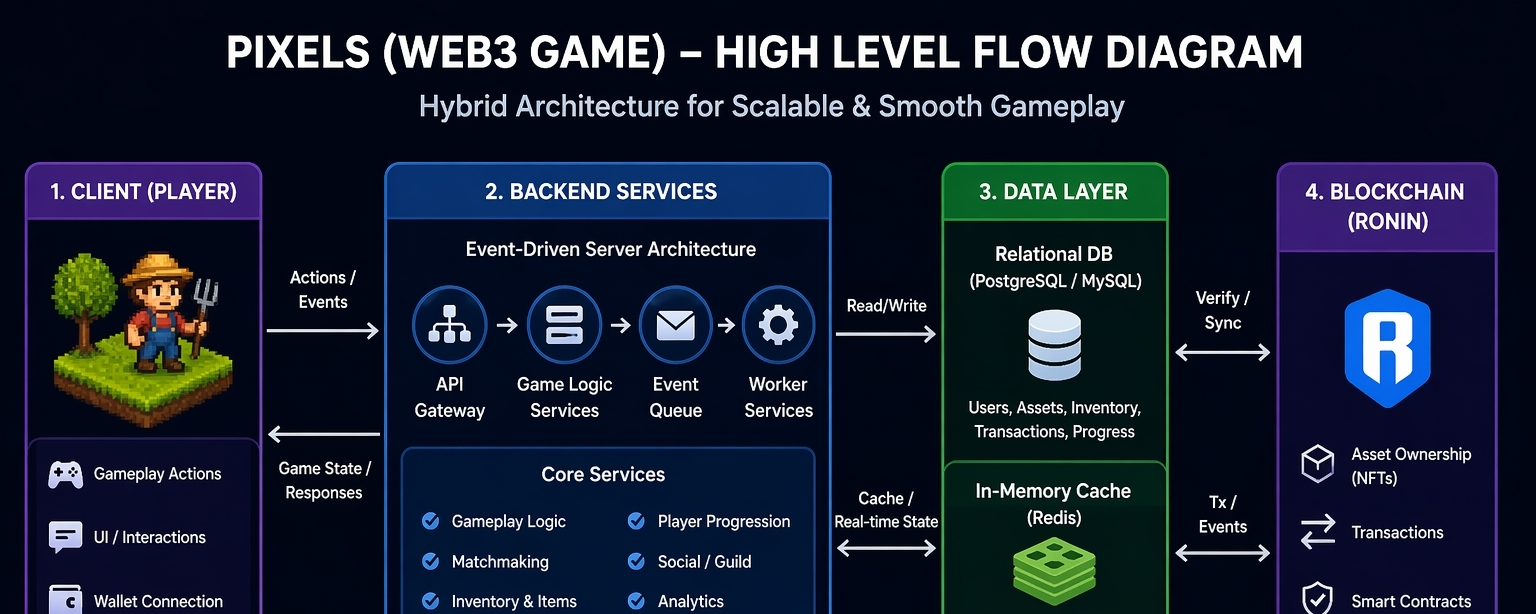
The narrative around Web3 gaming often leans toward a seductive but misleading idea: that these games are fully “on-chain,” governed entirely by smart contracts and immutable ledgers. In reality, most successful Web3 games—including titles like Pixels—rely on a far more pragmatic and nuanced architecture. Beneath their decentralized veneer lies a hybrid backend model that blends traditional game server design with selective blockchain integration.
This hybrid approach isn’t a compromise—it’s a necessity.
The Myth of Fully On-Chain Games
Running an entire game on-chain sounds appealing in theory. Every action is transparent, verifiable, and trustless. But blockchains, even high-performance ones, are not designed for the rapid, high-frequency interactions that define modern games. Imagine recording every player movement, crop harvest, or interaction as a blockchain transaction. The result would be crippling latency, exorbitant fees, and an unplayable experience.
Instead, games like Pixels treat the blockchain as a source of truth for ownership and value, not as the engine of gameplay itself.
Event-Driven Architectures: The Real-Time Backbone
At the core of modern Web3 game infrastructure is an event-driven server architecture. Game clients continuously emit events—movement, actions, interactions—which are processed by backend services in real time. These systems are designed to handle thousands (or millions) of concurrent users, often using message brokers like Kafka or RabbitMQ to ensure scalability and fault tolerance.
This architecture allows developers to decouple systems: gameplay logic, inventory management, matchmaking, and analytics can operate independently while still reacting to shared streams of events. The result is a responsive and resilient backend that feels instantaneous to the player.
Cloud Infrastructure and Horizontal Scalability
Cloud platforms play a crucial role in enabling this responsiveness. Auto-scaling groups, container orchestration (e.g., Kubernetes), and distributed load balancing allow game servers to dynamically adjust to player demand. During peak usage, additional instances spin up seamlessly; during quieter periods, resources scale down to optimize cost.
This elasticity is essential for social casual games like Pixels, where player activity can fluctuate dramatically based on events, updates, or token incentives.
Database Layering: Balancing Consistency and Speed
A key design pattern in these systems is database layering. Structured, persistent data—such as player accounts, inventories, and progression—is typically stored in relational databases like PostgreSQL or MySQL. These systems provide strong consistency and transactional integrity.
However, for real-time gameplay state, relational databases are too slow. This is where in-memory data stores like Redis come in. Redis can handle rapid reads and writes with sub-millisecond latency, making it ideal for tracking live player positions, session data, and temporary game states.
By combining these layers, developers achieve both durability and speed—two requirements that are often at odds.
Latency Optimization: Keeping Gameplay Off-Chain
Perhaps the most critical architectural decision is keeping core gameplay logic off-chain. This minimizes latency and ensures smooth user experiences. Blockchain interactions are reserved for moments where decentralization matters: minting assets, verifying ownership, executing trades, or recording significant milestones.
This selective use of blockchain APIs allows games to maintain performance while still benefiting from decentralization. Players can own their assets and trade them freely, but they aren’t waiting for block confirmations just to harvest virtual crops.
The Trade-Offs: Complexity and Fragility
This hybrid model, however, introduces its own challenges.
First, there’s dependency on external APIs. Blockchain nodes, indexing services, and wallet integrations become critical components. If any of these fail or lag, parts of the game experience can degrade.
Second, there’s the risk of state desynchronization. The off-chain game state and on-chain data must remain consistent, but they operate in fundamentally different environments. Ensuring synchronization requires careful design—event reconciliation, retry mechanisms, and sometimes manual intervention.
Finally, the architecture itself becomes more complex. Developers must manage distributed systems, asynchronous processes, and cross-layer consistency, all while maintaining security and performance.
A Necessary Evolution—or a Temporary Solution?
Hybrid architectures are undeniably effective. They allow Web3 games to scale, perform, and compete with traditional titles while still offering meaningful ownership and decentralization. Without them, most Web3 games would simply not be viable.
But this raises a deeper question.
As these systems grow more complex—layering cloud infrastructure, event pipelines, off-chain logic, and blockchain integrations—are we building a sustainable path forward, or accumulating technical debt that will eventually limit scalability and decentralization?
In other words: is the hybrid model the future of Web3 gaming, or just a transitional phase toward something more fundamentally decentralized?
