
there’s a moment inside Pixels that feels very clear.
you complete a task, finish a loop, and pixels appears as the result. it’s immediate, clean, and easy to understand. action leads to outcome, and the system reflects that outcome without hesitation.
it feels like the end of a process.
the kind of moment that signals completion.
but that feeling starts to change the longer you stay inside the system.
not in a dramatic way, just enough to introduce a small doubt.
is that moment really the end, or is it something else.
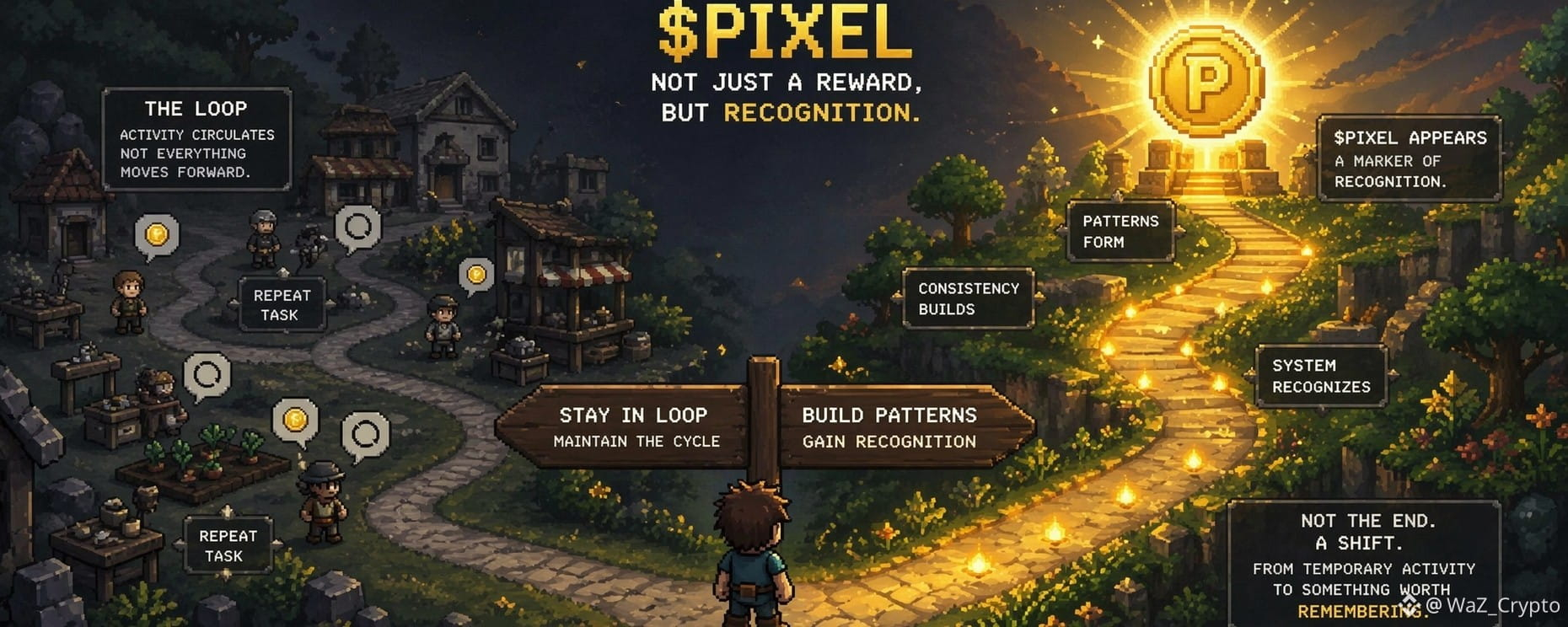
because when you step back and look at how value moves inside $PIXEL , not everything reaches that point.
most activity stays within the internal loop.
Coins circulate, tasks repeat, actions continue without ever producing $PIXEL. and that doesn’t feel like failure. it feels like part of how the system is designed to operate.
not everything is meant to leave that layer.
and that’s what makes the appearance of pixels stand out.
it’s not constant.
it doesn’t emerge from every action.
it feels selective.
and that selectivity changes how the token is perceived.
instead of being a simple reward, it starts to look more like a signal.
not just that something was completed, but that something was recognized by the system as worth moving forward.
that distinction is subtle, but it matters.
a reward implies a direct exchange. you do something, you get something in return. the relationship is immediate and transparent.
recognition implies a filter.
the system evaluates what happened and decides whether it fits into a broader structure.
not everything passes through that filter.
and the criteria for passing are not fully visible.
you don’t see a clear set of rules that determine when pixels will appear. you experience it through patterns, through repetition, through how certain routines seem to connect more consistently than others.
over time, that experience builds into an understanding.
not an explicit one, but something that guides behavior.
players begin to notice which actions tend to lead somewhere and which ones simply maintain the loop. they adjust, not because they are told to, but because they feel the difference between activity that circulates and activity that advances.
and that’s where the role of pixels becomes more complex.
it is still a token, still something that can be measured, transferred, and valued. but within the system, it may also function as a marker.
a way for the system to indicate that certain patterns of behavior have reached a point where they can be acknowledged as part of a larger structure.
that structure is not fully visible.
it doesn’t present itself as a clear hierarchy or a set of levels. instead, it exists through consistency.
through how certain actions begin to stabilize over time.
through how some routines feel like they “hold” while others remain temporary.
when pixels appears, it may be reflecting that stability.
not just the completion of a task, but the alignment of behavior with what the system is able to recognize and reuse.
that idea becomes more noticeable when you compare different sessions.
some feel productive but isolated. actions are completed, rewards are generated, but nothing seems to carry forward.
other sessions feel connected. progress builds, not necessarily faster, but more smoothly.
and those are often the moments where pixels appears more naturally.
not as a spike, but as a continuation.
as if the system is not reacting to a single action, but to a pattern that has already been forming.
that perspective shifts how the entire loop is understood.
instead of focusing on individual tasks, attention moves toward how those tasks fit together over time.
instead of maximizing output in a single moment, players begin to look for patterns that persist.
and in that context, pixels becomes less about immediate reward and more about accumulated recognition.
something that reflects not just what you did, but how consistently you have been doing it.
that doesn’t mean the system is perfectly controlled or intentionally selective at every level.
it could simply be the result of how complex systems behave when they try to balance activity with stability.
but the outcome feels similar either way.
not everything that happens inside Pixels is treated equally.
some of it remains within the loop.
some of it is allowed to move forward.
and the moment where that distinction becomes visible is when pixels appears.
not just as a reward.
but as a quiet confirmation that something within the system has shifted from temporary activity to something the system is willing to acknowledge as part of its structure.
and once that idea takes hold, it becomes difficult to see the token in the same way again.
because it no longer feels like the end of a process.
it feels like the moment where the system decides that what you did is worth remembering....
