

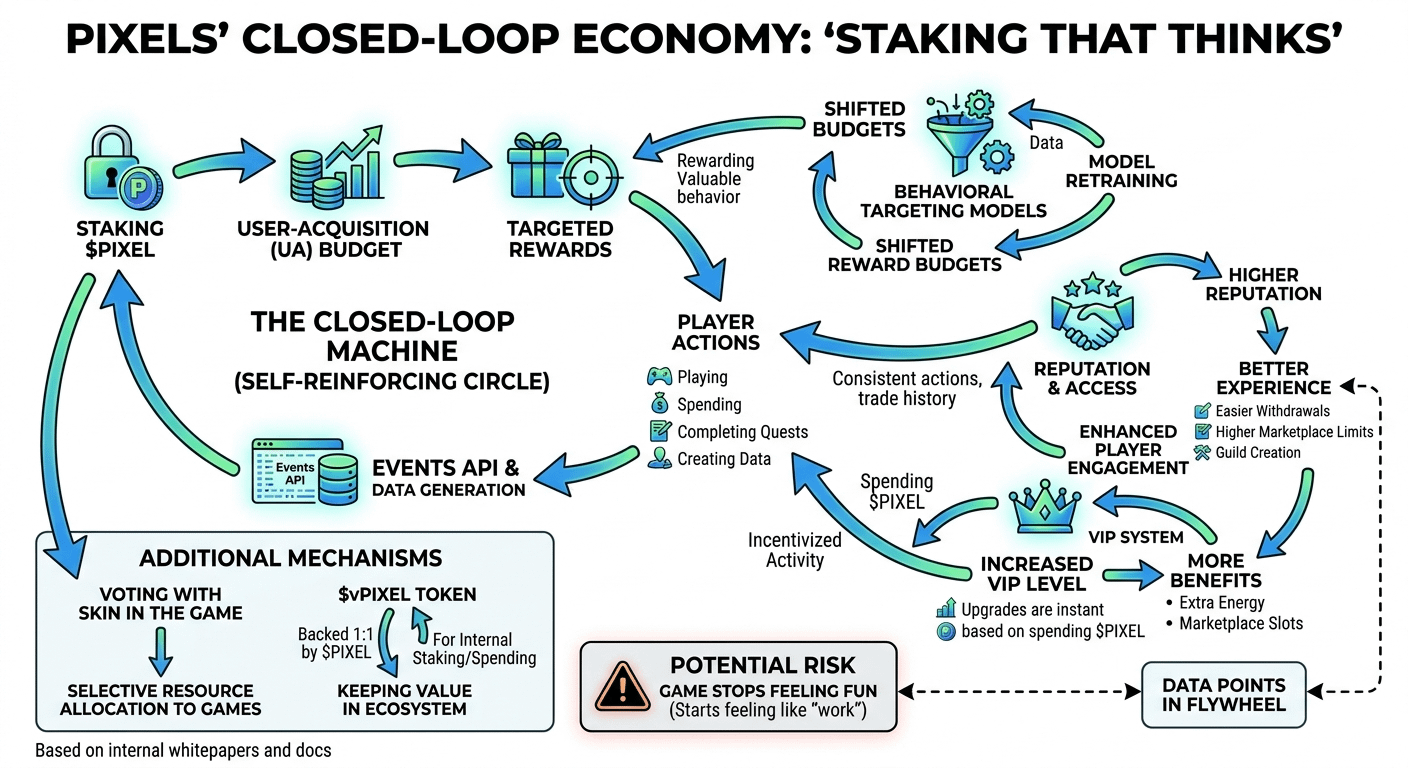
 I used to think staking in Pixels was pretty basic stuff. You lock up your $PIXEL, feel like you’re backing the game, and maybe pick up a few rewards along the way. It just seemed like the usual loyalty play most Web3 projects throw out there.But the more I actually read through their newer whitepaper and docs, the more it started to feel… different. Smarter. Like staking isn’t really the main event anymore—it’s the on-ramp to this whole closed-loop machine that keeps turning player actions into better targeting, better rewards, and honestly, a healthier ecosystem overall. Staking gets turned into real user-acquisition money. That money funds targeted rewards that actually matter. Players play, spend, and create data. The data makes the whole thing smarter next time around. It’s this nice, self-reinforcing circle that most games only dream about.A lot of token economies I’ve seen still trip over the same old problem: they’re really good at handing out rewards, but terrible at knowing who should actually get them and why. So the farmers swoop in, real players get drowned out, and everything slowly leaks value. Pixels feels like it’s trying to fix that by treating every reward almost like a tiny, perfectly tracked ad. The studio only “pays out” when someone does something verifiable that actually helps retention, brings in friends, or gets them spending more. It’s not random drops anymore—it’s intentional.That little shift quietly changes how I see staking. It stops being the flashy headline and turns into the budget boss. You stake $PIXEL straight into specific games, basically voting with your own skin in the game on which projects deserve more love and resources. The bigger the staking pool a game builds, the more on-chain UA budget it gets to spend on in-game incentives. No more wasting cash on outside ads. The game earns its own growth fuel just by being good at keeping people happy and engaged. I love that the token isn’t just sitting there—it’s actively deciding where the next wave of attention and money should go.What really surprised me is how thoughtful the targeting side is. Every little thing you do—buying something, finishing a quest, trading, even withdrawing—gets logged through their Events API. That builds this clean, first-party picture of who’s actually valuable: LTV curves, how long sessions last, who’s likely to stick around or churn, even basic fraud signals. Then the models retrain and shift the reward budgets toward the players and moments that genuinely move the needle. They’re not just rewarding “being online.” They’re rewarding the kind of behavior that actually builds something lasting. That feels refreshing.Reputation slots into all of this in such a natural way. It’s not some pointless badge you show off. It’s built from real stuff—how old your account is, how consistent you are with quests, your trading history—and it quietly decides how smooth your experience is. Higher rep means easier withdrawals, bigger marketplace limits, the ability to start guilds, fewer restrictions. It’s like the system is gently saying, “We see you doing things right, so here’s a little more trust.” I think that’s smart without feeling heavy.And then there’s VIP. On paper it’s just a monthly sub with extra tasks and energy and marketplace slots. But the way they score it is sneaky-clever: your level goes up when you actually spend and use $PIXEL in the ecosystem, upgrades are instant, and it slowly fades if you go quiet. Spending stops feeling like you’re just giving money away—it becomes a signal that helps you level up inside the loop and opens more doors. I didn’t expect that.
Even the $vPIXEL token fits the same vibe. It’s backed 1:1 by regular $PIXEL but you can only spend or stake it inside the games. It’s basically there to keep value hanging around longer instead of everyone rushing to sell the second they can. Less immediate pressure, more time for the loop to do its thing.
At the end of the day, Pixels is quietly moving away from “reward everyone the same” toward something more selective. Not every action is worth the same. Not every player needs the exact same access right away. Some behaviors just matter more, and the system is built to notice and reinforce them. Once you see it that way, staking suddenly makes sense as the thing steering where the attention, the incentives, and the growth actually flow.
I’ll be honest though—my only real hesitation is how human this all stays. When a loop gets too tight and every single click feels measured for “yield,” there’s a risk the game stops feeling fun and starts feeling like work. They keep saying “fun first,” and I really hope they mean it, because no amount of perfect targeting can replace that genuine “I just want to play” feeling. If players ever start sensing they’re just data points in someone else’s flywheel, the magic disappears fast.
Still, I’m rooting for this direction. $PIXEL doesn’t feel like just another reward coin anymore. It’s becoming the quiet intelligence that decides where capital goes, which players get trusted quicker, which games get more room to breathe, and how the whole thing stays balanced and alive. It doesn’t feel closed-off or smaller. It feels more thoughtful.
And in a world full of copy-paste tokenomics, thoughtful is the thing that actually sticks with you.
