
There is a certain kind of system design that does not look important when it first appears.
It does not announce itself as a breakthrough.
It does not feel dramatic on day one.
It does not even look like the center of the product.
and then, slowly, you realize the whole experience is starting to reorganize around it.
that is the kind of feeling Pixels gives me sometimes.
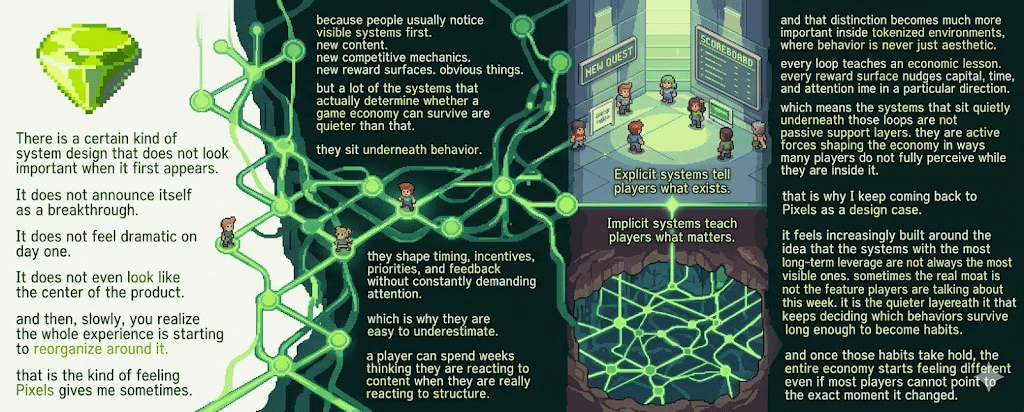
because people usually notice visible systems first. new content. new competitive mechanics. new reward surfaces. obvious things. but a lot of the systems that actually determine whether a game economy can survive are quieter than that. they sit underneath behavior. they shape timing, incentives, priorities, and feedback without constantly demanding attention.
which is why they are easy to underestimate.
a player can spend weeks thinking they are reacting to content when they are really reacting to structure. reacting to what the system chooses to emphasize, what it lets decay, what it amplifies, and what it leaves unrewarded. that invisible guidance is often more important than the explicit features people talk about in public.
because explicit systems tell players what exists.
implicit systems teach players what matters.
and that distinction becomes much more important inside tokenized environments, where behavior is never just aesthetic. every loop teaches an economic lesson. every reward surface nudges capital, time, and attention in a particular direction. which means the systems that sit quietly underneath those loops are not passive support layers. they are active forces shaping the economy in ways many players do not fully perceive while they are inside it.
that is why I keep coming back to Pixels as a design case.
it feels increasingly built around the idea that the systems with the most long-term leverage are not always the most visible ones. sometimes the real moat is not the feature players are talking about this week. it is the quieter layer beneath it that keeps deciding which behaviors survive long enough to become habits.
and once those habits take hold, the entire economy starts feeling different even if most players cannot point to the exact moment it changed.