

When I first started thinking about Pixels, I saw it as just a simple farming-style game. Farming the land, collecting resources, doing daily tasks - everything seemed like an old-fashioned farming game. But after playing for a while or understanding its economy structure, one thing stands out - it's not just the in-game items, your time is being converted into a value.
Pixels is basically a blockchain-based farming game, where players earn rewards through land, resources, tasks, and various in-game activities. From the outside, it's a very simple loop - log in, farm, upgrade, repeat again. But if you look inside, time is being considered as a measurable economic input.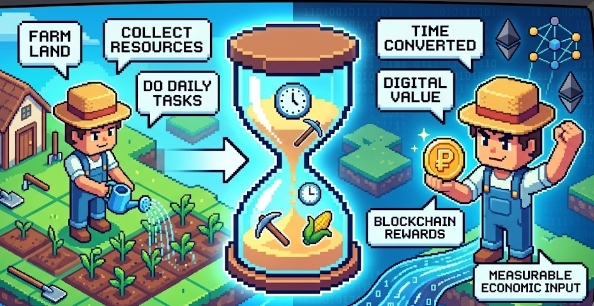
In my opinion, this place is the most interesting and at the same time risky.
Because in traditional games, you play for fun. But here you are playing to maximize the time efficiency. That is, the more optimized you play, the more likely you will get the output. This is very interesting in a way - because the value is being attached to your skill and consistency. But in another way, it creates a pressure system, where every minute has to be thought of as a value.
Let me give a simple example. There's two players. One plays 2 hours a day, the other 5 hours. If it was a simple game, the experience of both would be only enjoyment-based. But in an economy-driven system like Pixels, those 5 hours of players can naturally get more resources, progress or advantage. Here time is not just spent - it is becoming a kind of asset.
This is where the saying "time is an asset" comes into play.
However, there are some risks in this model. First, there is the issue of sustainability. If new players do not come or the reward structure is not balanced, then the economy can gradually become unbalanced. Second, over-pressure. Many players may feel that if they do not optimize continuously, they are falling behind. It can reduce long-term enjoyment.
Another risk is the perception gap. Many people think it is a simple game in the beginning, but later they realize that it is actually a semi-economic system, where time investment is very important. This mismatch can reduce the retention of many players.
Retention is an important issue here. Because games like Pixels will only last when players are engaged for a long time, not just for short-term rewards. But if the gameplay loop becomes too repetitive, or the reward progression becomes predictable, then interest can drop. People will no longer see "pleasure in play" as a "daily chore."
What I personally observe, the biggest challenge of this type of system is to keep the balance - fun vs efficiency. If only efficiency dominates, then there is no game anymore, it becomes a productivity simulator.
But there is an interesting aspect. Pixels show that in the digital world, time is not only a spending unit, it can also be a value creation unit. It can be seen in many more Web3 or gaming ecosystems in the future. Where the players are not only playing, but their time, strategy and engagement are acting as a kind of asset.
But the question remains - will this model match human behaviour in the long run?
Because people end up playing games to relax, not to take stress.
In my opinion, Pixels is an interesting experiment. It shows how there is a shift from traditional gaming to economy-driven gaming. But the more exciting this shift, the more fragile it is.
Pixels is not just a farming game - it's an experiment to convert time into value.
But whether this model will survive or not, it will depend on the balance of enjoyment and economic pressure.
