
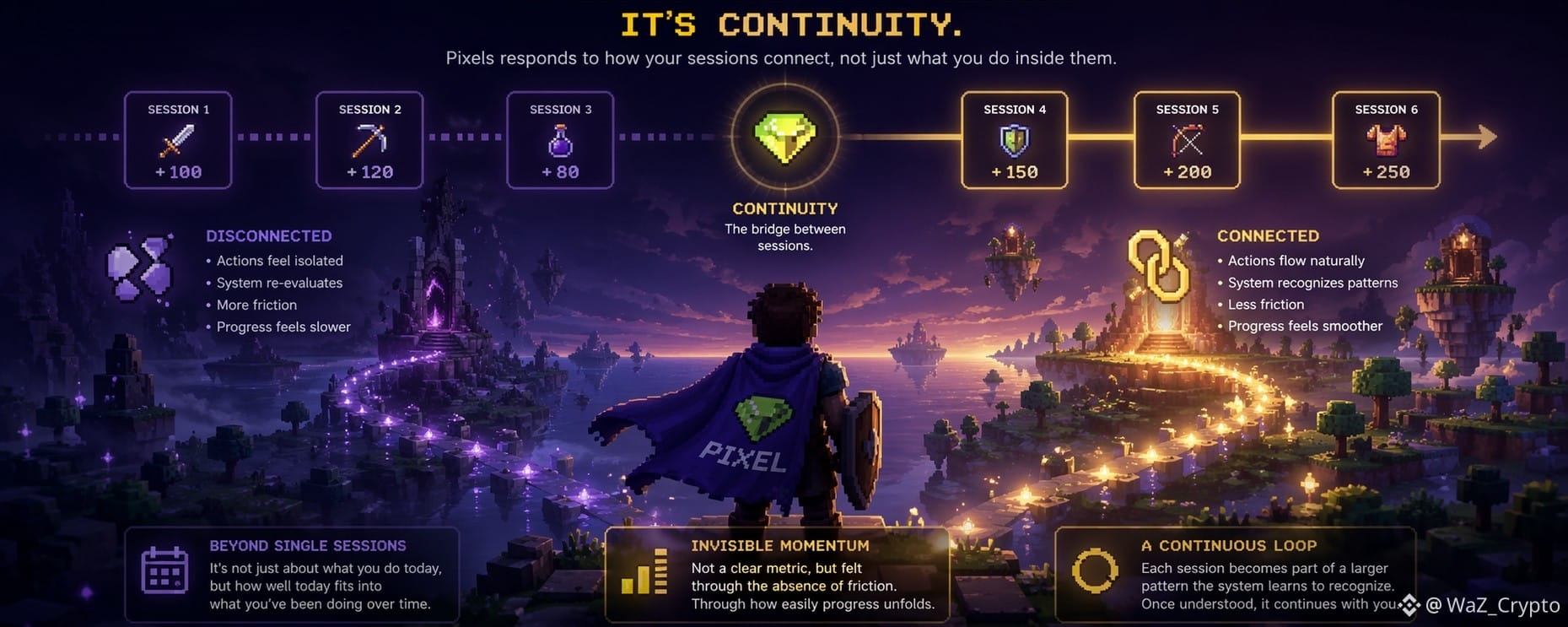
at first, it’s natural to think of progress inside Pixels as something that happens within each session.
you log in, complete tasks, move through routines, and whatever you achieve feels tied to that specific period of time. when you log out, it feels like a pause. when you return, it feels like a fresh start that continues from where you left off.
that model works on the surface.
but over time, it starts to feel less complete.
because the system doesn’t always respond the same way when you return.
sometimes you log back in and everything feels immediately connected. the loop resumes smoothly, tasks align, and the flow feels uninterrupted, almost as if the system was waiting for you to continue.
other times, the same actions feel slightly disconnected.
nothing is broken. everything still functions. but the responsiveness isn’t quite the same. there’s a subtle sense that the system is adjusting to you again rather than continuing seamlessly.
that difference is small, but it builds over time.
and it points to something beyond individual sessions.
it suggests that the system is not only tracking what happens within a session, but how those sessions relate to each other.
continuity begins to matter.
not just activity, but how consistently that activity carries across time.
when sessions connect well, the experience changes.
progress feels smoother, not necessarily faster, but more stable. actions lead into each other without interruption, and the system seems to recognize the pattern without needing to re evaluate it.
that stability feels different from simple efficiency.
it feels like the system is no longer interpreting each session in isolation.
instead, it is building a broader understanding of behavior over time.
that understanding is not visible, but it shows itself through how the loop responds.
less friction, fewer moments where the system seems to hesitate, a general sense that everything is already aligned.
when continuity breaks, the opposite happens.
again, not in a dramatic way.
you can still complete tasks, still earn rewards, still move through the system. but the flow feels less connected. actions feel more isolated, as if they are being evaluated without the context of what came before.
that shift changes how progression feels.
it is no longer just about what you do in a single session.
it becomes about how well each session connects to the next.
and that connection is not guaranteed.
it has to be maintained.
not through explicit rules, but through consistency.
players begin to notice that returning at similar times, repeating familiar routines, and maintaining a steady pattern of activity seems to create a more stable experience.
the system responds more predictably.
not because the actions are new, but because they are consistent.
and consistency is easier for a system to recognize.
that recognition changes the role of $PIXEL again.
instead of reflecting isolated achievements, it begins to feel tied to patterns that extend across sessions.
not just what you did today, but how well today fits into what you have been doing over time.
that perspective shifts how value is perceived.
a single session can still produce results, but those results may not carry the same weight if they are not connected to a broader pattern.
on the other hand, consistent behavior across multiple sessions seems to create a different kind of momentum.
not a visible one, but something that affects how smoothly the system responds.
that momentum is difficult to measure.
it does not appear as a clear metric.
it is experienced through the absence of friction.
through how easily actions connect and how naturally progress unfolds.
and once that idea settles in, the loop begins to feel less like a series of separate sessions and more like a continuous process.
each session is no longer independent.
it becomes part of a larger pattern that the system is gradually learning to recognize.
that recognition may not be perfect.
it may not be intentional in a strict sense.
but the outcome feels consistent enough to influence behavior.
players start thinking less about what to do next and more about how to maintain what is already working.
they avoid breaking patterns that feel stable.
they return in ways that preserve continuity.
not because they are told to, but because they sense that the system responds better when that continuity exists.
and that creates a different kind of loop.
one where progress is not built in isolated moments, but in how those moments connect over time.
not just activity, but continuity.
and that might be where the system holds more influence than it first appears.
not in controlling what happens within a session.
but in shaping how sessions relate to each other.
because once that relationship becomes stable, the experience changes.
not dramatically.
just enough to feel like the system is no longer starting over with you each time.
it is continuing something it already understands.....
