
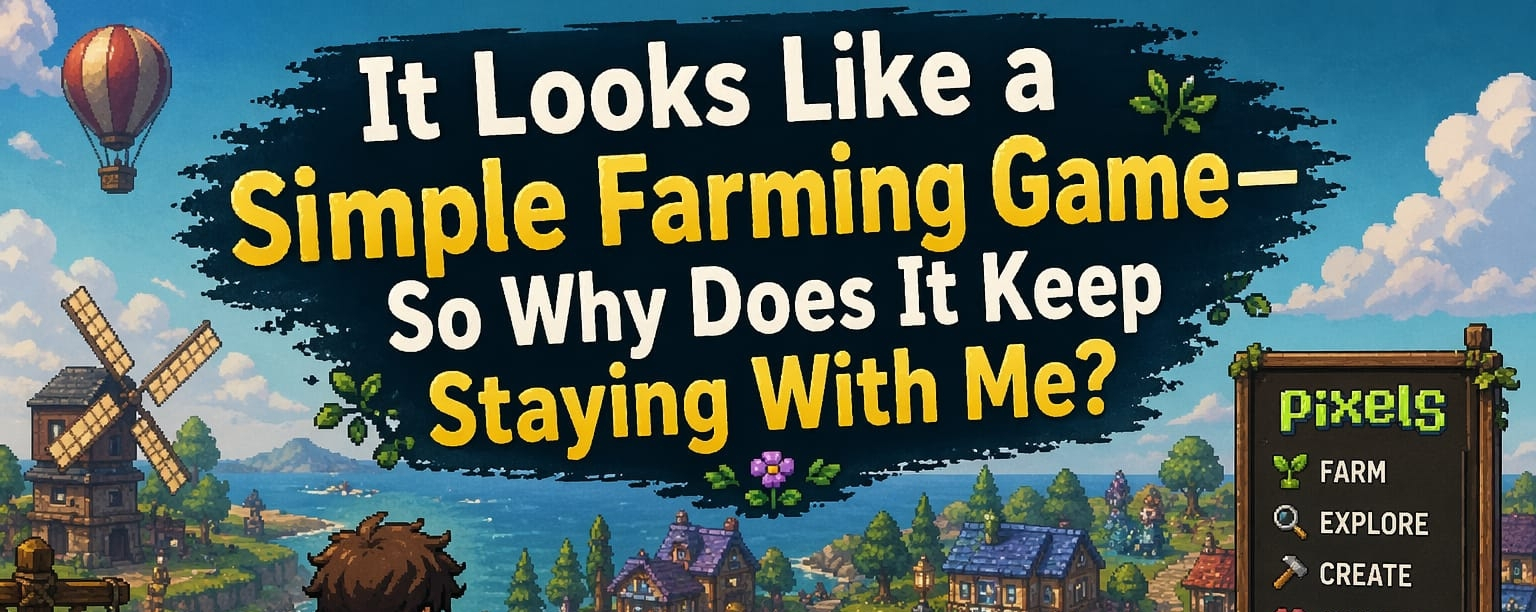
I didn’t expect Pixels to linger in my head this long. At first glance, it feels almost too soft to take seriously. You log in, plant something, walk around, maybe interact with a few people, then leave. There’s no urgency pulling you back, no loud mechanics demanding attention. And usually, that’s exactly the kind of experience I forget about quickly.
But this one didn’t fade the way I thought it would.
The more I looked into it, the more I realized Pixels isn’t really trying to impress in obvious ways. It’s a social, open-world Web3 game built on Ronin, centered around farming, exploration, and creation. That description sounds familiar, almost predictable. We’ve seen versions of this loop before in countless games. So the question isn’t what it does. The question is what it’s trying to feel like.
And I think that’s where things get interesting.
Pixels doesn’t push itself as something revolutionary on the surface. It leans into simplicity. But underneath that, it’s trying to create a sense of continuity—a world that doesn’t just pause when you leave. Your actions, your progress, your place in that space… they’re meant to persist in a way that feels a little more grounded than the usual “session-based” experience most games offer.
Now, the Web3 part is there, of course. Ownership, assets, the idea that what you build or earn has some form of permanence beyond the game itself. But I don’t think that’s the most important piece, at least not in the way people usually talk about it. We’ve seen enough projects by now to know that just adding blockchain doesn’t automatically make something meaningful. Most of the time, it doesn’t change how people actually feel while playing.
What matters more is whether the system makes you care.
And strangely, Pixels seems to understand that in a quiet way. It doesn’t overwhelm you with complexity or pressure. It gives you space. But that space comes with an expectation—that the world continues, with or without you. And that subtle shift changes how you behave. You don’t just “play and leave.” You start thinking about timing, about return, about presence.
That’s not something most casual games manage to do.
I think what people might be missing is that farming isn’t really the point here. It’s just the surface activity. The deeper idea is about whether a digital space can feel inhabited rather than used. Whether it can hold small traces of your time in a way that feels consistent enough to matter.
And that’s not easy to get right.
Because the moment a system like this is put under pressure—more players, more incentives, more expectations—it either holds its shape or it starts to shift. And when it shifts in the wrong ways, people notice. Not all at once, but gradually. Through small inconsistencies. Through changes in pacing, fairness, or balance. That’s usually where trust begins to wear down.
So while Pixels feels calm right now, I don’t think the real test has happened yet.
Outside of crypto narratives, what’s actually at stake here is something more basic. It’s about whether digital spaces can feel stable enough for people to invest time into them without feeling like it’s disposable. Whether “ownership” means anything if the experience itself isn’t strong. Whether a social world can stay intact when it stops being new.
Those questions matter more than any token or feature.
And to be fair, there are risks. The system could become too dependent on incentives and lose its natural feel. It could start to feel like upkeep instead of play. Or it might simply struggle to maintain its identity as more pressure builds over time. We’ve seen all of this happen before in different forms.
So I don’t think Pixels is something to blindly believe in.
But I also don’t think it’s something to dismiss.
What it’s trying to do is actually quite subtle. It’s not chasing intensity. It’s not trying to dominate your attention. It’s trying to exist in a way that feels steady, almost quiet, and still worth returning to.
And that’s a harder problem than it looks.
I’m not sure where it ends up. But I do think it’s asking the right kind of question: what does it take for a digital world to feel like a place, not just a game?
For now, that question feels more important than any answer.