
I didn't think too hard about free-to-play mechanics for a long time. The structure is usually predictable. You enter, things feel generous, momentum builds naturally… and then somewhere down the line, friction appears. Either progress slows to a crawl or rewards start thinning, and suddenly the paid layer makes complete sense. Nobody hides it anymore. The pattern is basically common knowledge.
Pixels doesn't feel like that. Not on the surface, anyway. That's what stopped me.
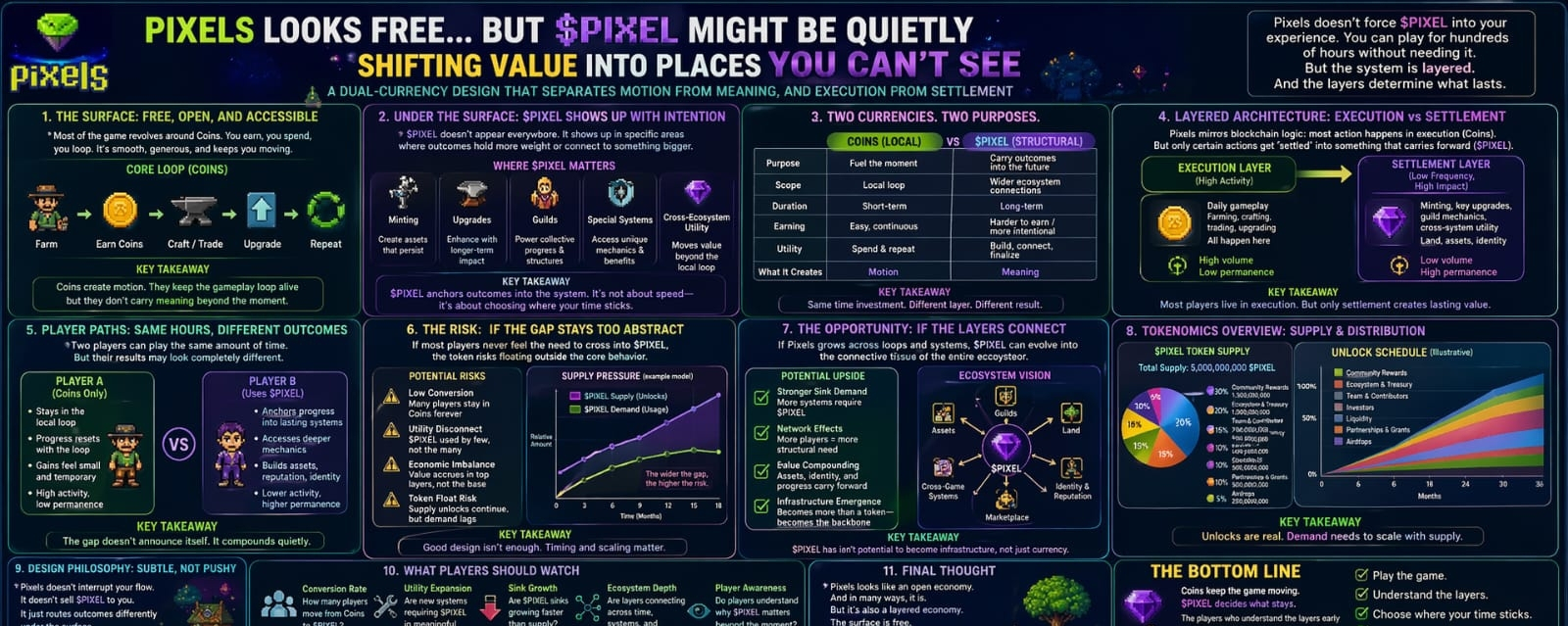
You can sink hours into this game without ever pixel entering the picture. The farming loops hold up, Coins keep moving, and nothing pulls you out of that rhythm by force. It feels contained. Almost comfortable. But after watching the system long enough, I started noticing a quiet mismatch. The energy players put into the game doesn't always translate into something that holds.
That's where things get a little off.
Coins run most of what you see. Earn them, use them, loop back around. Clean and simple. But they don't move far. They don't carry weight beyond the moment they're spent. It's motion, not meaning. I kept coming back to that thought while tracing where pixel actually surfaces. It's not scattered across the experience. If anything, it's conspicuously absent from the spaces where most players spend their time.
Then it shows up in very specific contexts. Minting. Certain upgrades. Guild mechanics. Spaces where something holds its shape a little longer, or connects to a wider structure. It's not louder than anything else. Just positioned with more intention.
I kept thinking, this isn't about buying speed. It's more like choosing where your time actually sticks.
That distinction sounds minor, but it changes how the whole system behaves. Two players can log the same hours. One stays entirely inside the Coin loop, accumulating small gains, staying active, staying busy. The other touches pixel occasionally, not constantly, just enough to anchor what they've built into something that doesn't dissolve as easily.
The difference doesn't announce itself. That's probably deliberate.
It reminds me, loosely, of how some blockchain architectures separate execution from settlement. A lot of activity can be happening at once, but only certain parts of it get finalized in a way that carries forward. Pixels seems to mirror that logic, just in a gentler form. Most of the gameplay is execution. The parts tied to pixel feel closer to settlement.
I didn't clock that immediately. At first glance it just looked like another dual-currency design. But the longer I sat with it, the less it behaved like a standard premium token. It isn't pushed at you. You can go a long time without feeling its absence. Which is unusual, because most systems want you to feel that gap early and often.
Here, the gap drifts in. Gradually. Almost without announcement.
The harder question is whether players actually register that. Most people don't think in layers while they're inside a game. They respond to what's visible. If the distance between Coins and pixel stays too abstract for too long, a significant portion of the player base may never cross that line in any meaningful way.
And if that happens, the token begins to float a little. It exists. It has utility. But it isn't tightly wired to the bulk of behavior inside the game.
There's also the supply side to consider, which doesn't care how thoughtful the design is. Unlocks keep coming. Distribution continues moving. If the parts of the system that consume $PIXEL don't scale at the same rate, pressure starts building somewhere it wasn't intended. I've watched that dynamic unfold in other ecosystems where the logic was sound but the timing wasn't.
Still, what's genuinely interesting here is hard to dismiss.
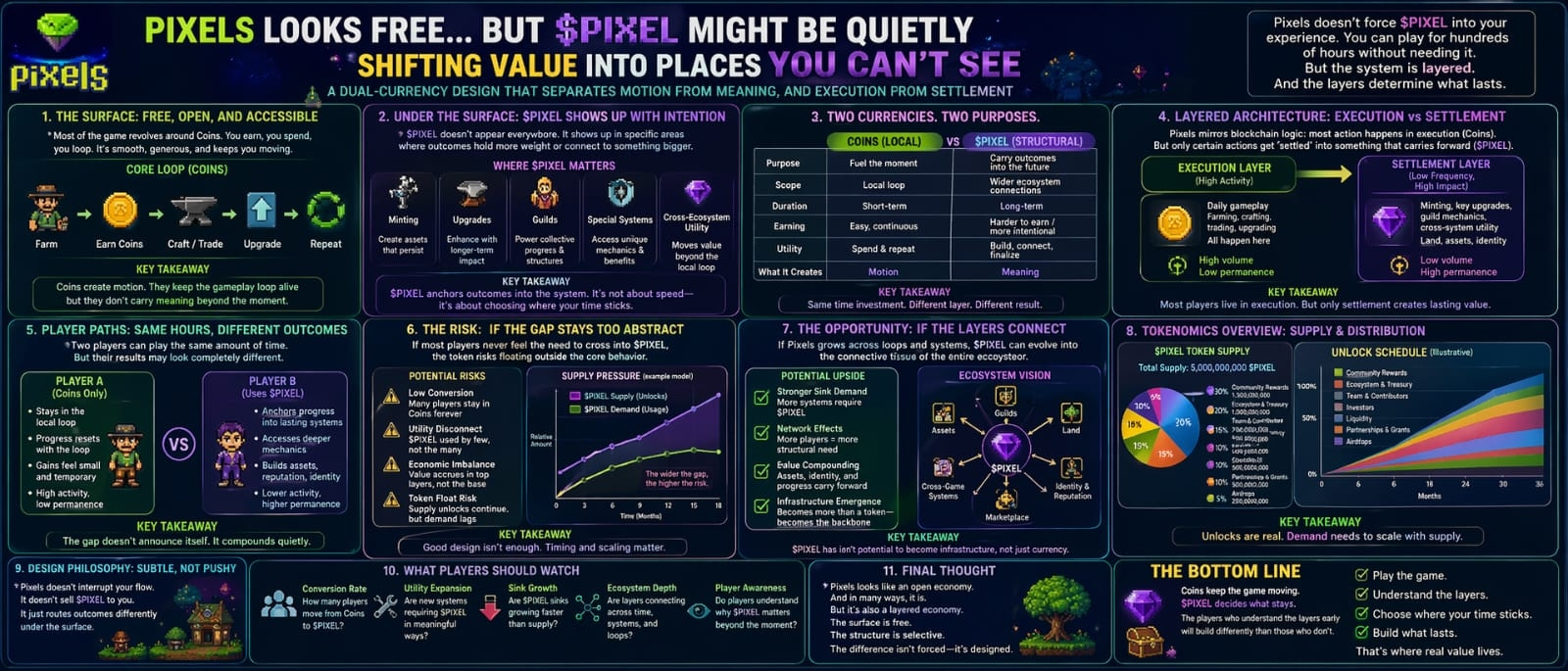
If Pixels keeps growing, especially across more than a single loop, this separation could start to carry real weight. Coins stay local. They serve the present moment. $PIXEL, by contrast, could begin functioning like connective tissue between different parts of the ecosystem. Not just as a currency, but as a mechanism for carrying certain outcomes forward across time.
That's the point where it stops being a game economy and starts resembling infrastructure, even if it doesn't look like it from where most players are standing.
But that framing carries an uncomfortable implication. If the majority of players operate inside the visible loop while value quietly concentrates elsewhere, then the system isn't really neutral. It's selective. Not in an aggressive way, not in the classic paywall sense, but in how it determines what actually persists.
Whether that's a conscious design choice or just something that emerged from the architecture, I genuinely can't say.
What I can say is that Pixels never pushes you to notice any of this. You can play for a long time and never think about it once. And maybe that's exactly why it works. The system doesn't interrupt you. It just routes outcomes differently underneath the surface.
From the outside, it still reads like an open economy.
But after spending real time with it, it doesn't feel entirely open. It feels constructed in layers. And depending on which layer you're actually operating in, the same investment of time and effort might produce very different results.