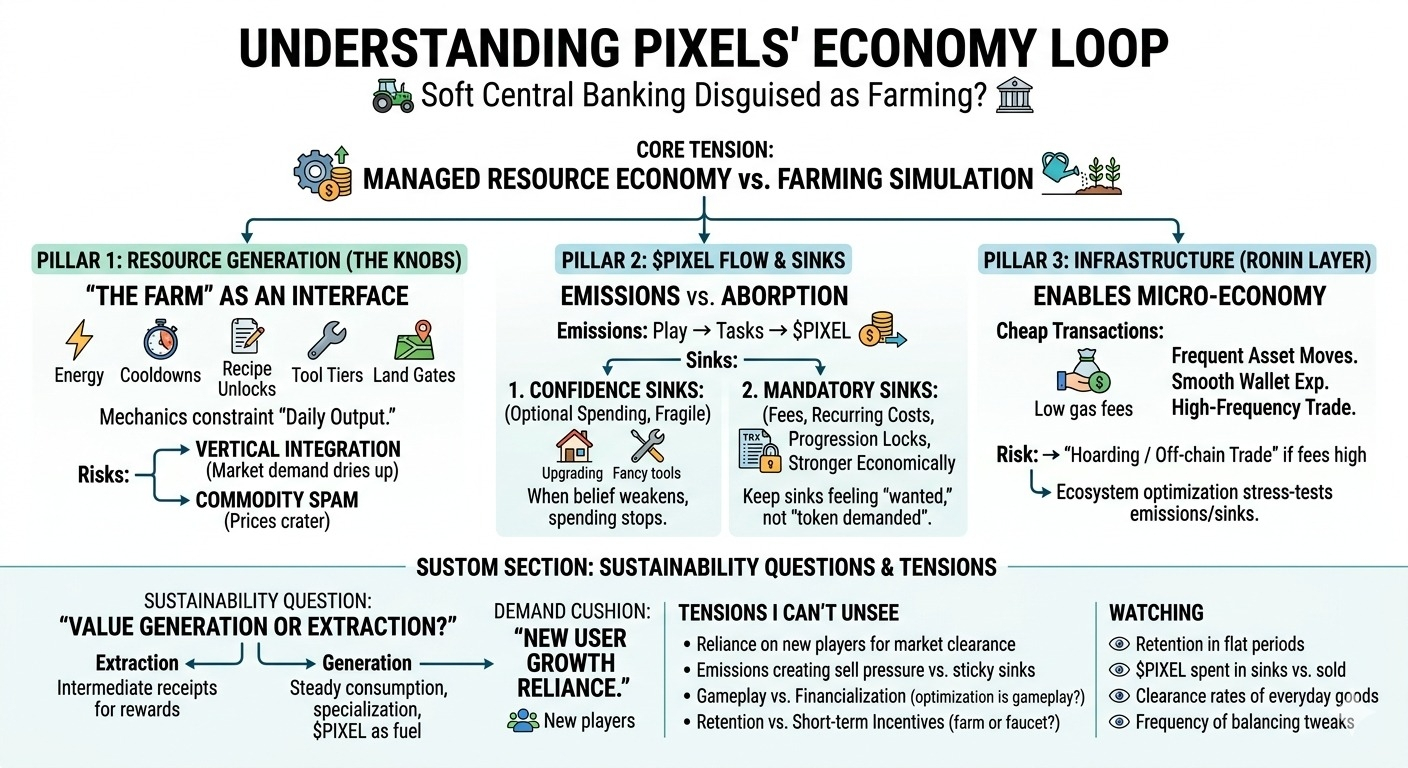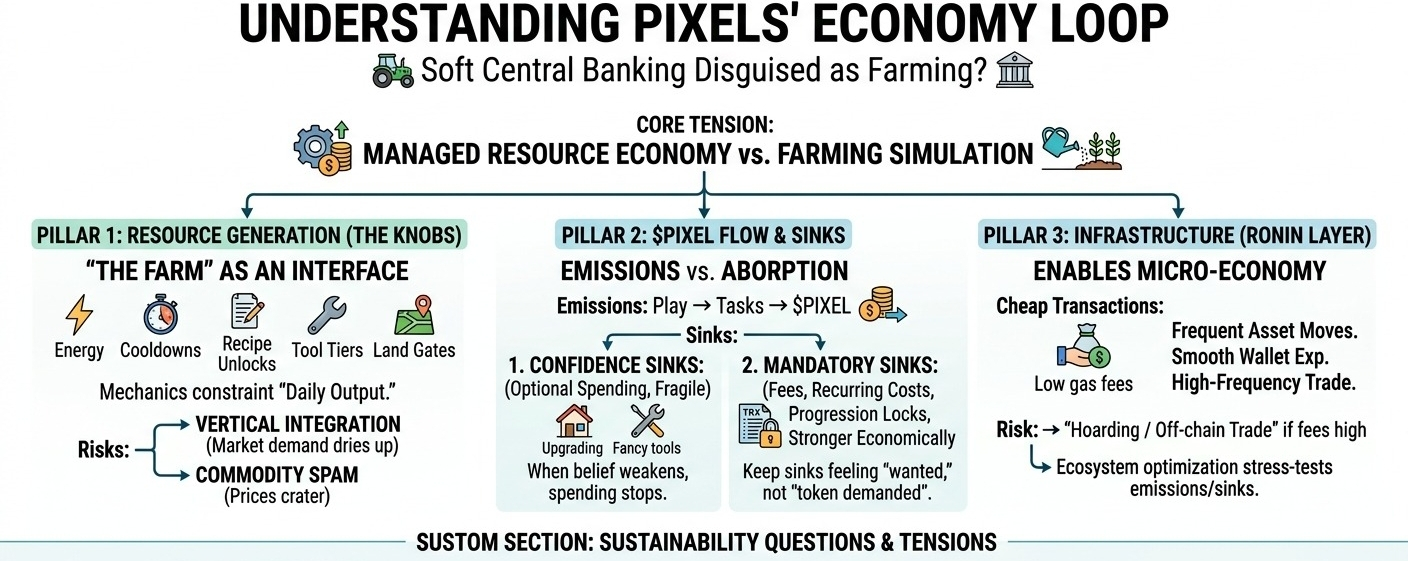
most people still talk about pixels like it’s basically “a cozy farming game on ronin where you can earn $pixels.” and if you only play for a few sessions, that’s exactly what it feels like. but once you start tracking what’s produced, what’s consumed, and what gets sold, the whole thing reads more like a managed resource economy than a farm sim. the farm is just the interface where the knobs don’t look like knobs.
resource generation is the first knob set. farming/gathering/crafting is the headline loop, but the real mechanics are the constraints around it. energy, cooldowns, recipe unlocks, tool tiers, and access gates (land-ish constraints, progression locks, etc.) all decide the system’s “daily output.” a simple chain makes this obvious: harvest a crop → process into an ingredient → craft a consumable → sell it because other players need it for quests or their own crafting. that’s clean. but what stands out is how quickly it becomes either (a) vertical integration (everyone does the whole chain themselves, market demand dries up) or (b) commodity spam (everyone produces the same profitable thing, prices crater). pixels seems to fight both outcomes by constantly shaping what’s efficient, which is kind of the point… but also means the economy is never really allowed to settle.
then $pixels flow. this is where i’m still undecided whether it’s stable or just stable-looking. emissions are the visible incentive layer: play, complete tasks, receive $pixels. the problem is the same as always: emissions introduce inflation pressure unless you have sinks that scale and don’t switch off when sentiment changes. and here’s the part i’m thinking about: a lot of sinks in tokenized games are “confidence sinks.” players spend when they believe spending compounds into better play or better earning. when that belief weakens, optional spending disappears instantly, because holding or selling is always on the table.
so i’m trying to categorize pixels sinks by how mandatory they really are. if sinks are mostly convenience/acceleration, they’re fragile. if sinks become more mandatory (fees, recurring costs, required spend for progression), they’re stronger economically but risk making the game feel like a paywall treadmill. pixels has to keep sinks feeling like “i wanted this anyway” rather than “the token demanded it.” i’m not fully sure it can do that long-term without leaning hard on live events and new content beats.
the infrastructure layer is where ronin matters more than it gets credit for. cheap transactions and a smoother wallet experience make the micro-economy possible: lots of small listings, purchases of ingredients, frequent asset moves. pixels basically needs high-frequency trade for the production chain to feel meaningful. if fees were high, people would hoard, or trading would move offchain, and the “player economy” would thin out fast. ronin also plugs pixels into an ecosystem where players already understand nfts and market behavior, which helps liquidity, but it also sharpens optimization. profitable loops get found and scaled quickly; any imbalance between emissions and sink strength gets stress-tested by the community like it’s a job.
going deeper, the sustainability question for me is: are players generating value or just extracting it efficiently? a sustainable version of pixels looks like steady item consumption (goods getting used up, not just stockpiled), specialization (some players prefer inputs, some prefer crafting, some prefer trading), and $pixels acting mostly as settlement + progression fuel. a less sustainable version looks like items being intermediate receipts on the way to token rewards, with the market primarily serving as a conversion layer from time → liquidity.
what depends on continuous user growth is the “demand cushion.” new players buy starter goods, clear low-tier inventory, and keep the market liquid enough that sellers don’t have to nuke prices to exit. if growth slows, you find out whether the internal consumption loop is real or if demand was mostly onboarding + event scheduling.
tensions i can’t unsee:
- reliance on new players to keep markets clearing
- emissions creating ongoing sell pressure unless sinks stay sticky
- gameplay vs financialization (when optimization becomes the main gameplay)
- retention vs short-term incentives (are people here for the farm or the faucet?)
watching:
- retention in flat periods (no major events, token quiet)
- how much $pixels is spent in recurring sinks vs held/sold
- marketplace clearance rates for everyday crafted goods (not just rare assets)
- frequency of gating/emission tweaks (balancing, or constant leak-plugging)
i’m still figuring out whether pixels has a self-sustaining economy or just a really good short-term loop with smart pacing. if $pixels stayed boring for a few months, would players still buy each other’s output for real utility, or does the whole thing need that constant incentive pulse to stay alive?