
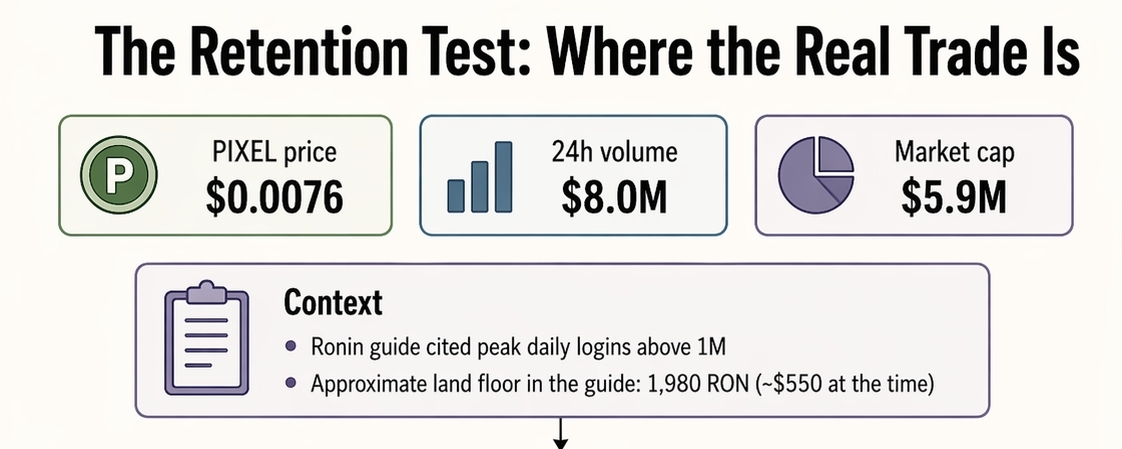

@Pixels i noticed I stopped taking Pixels land seriously the first time I looked at a listing and realized I still couldn’t answer the only question that matters to me as a trader: after four years of upgrades, what does land actually produce besides nostalgia and a sales pitch? That was the frustrating part. The project has had enough time to move past the early “future utility” phase. So I went back to the basics. Today, PIXEL is trading around $0.0076 with roughly $8.0 million in 24 hour volume and a market cap near $5.9 million on CoinGecko. That tells me two things right away. The token is liquid enough to trade, but the market is pricing Pixels like a small, fragile game economy, not like a proven digital property empire.
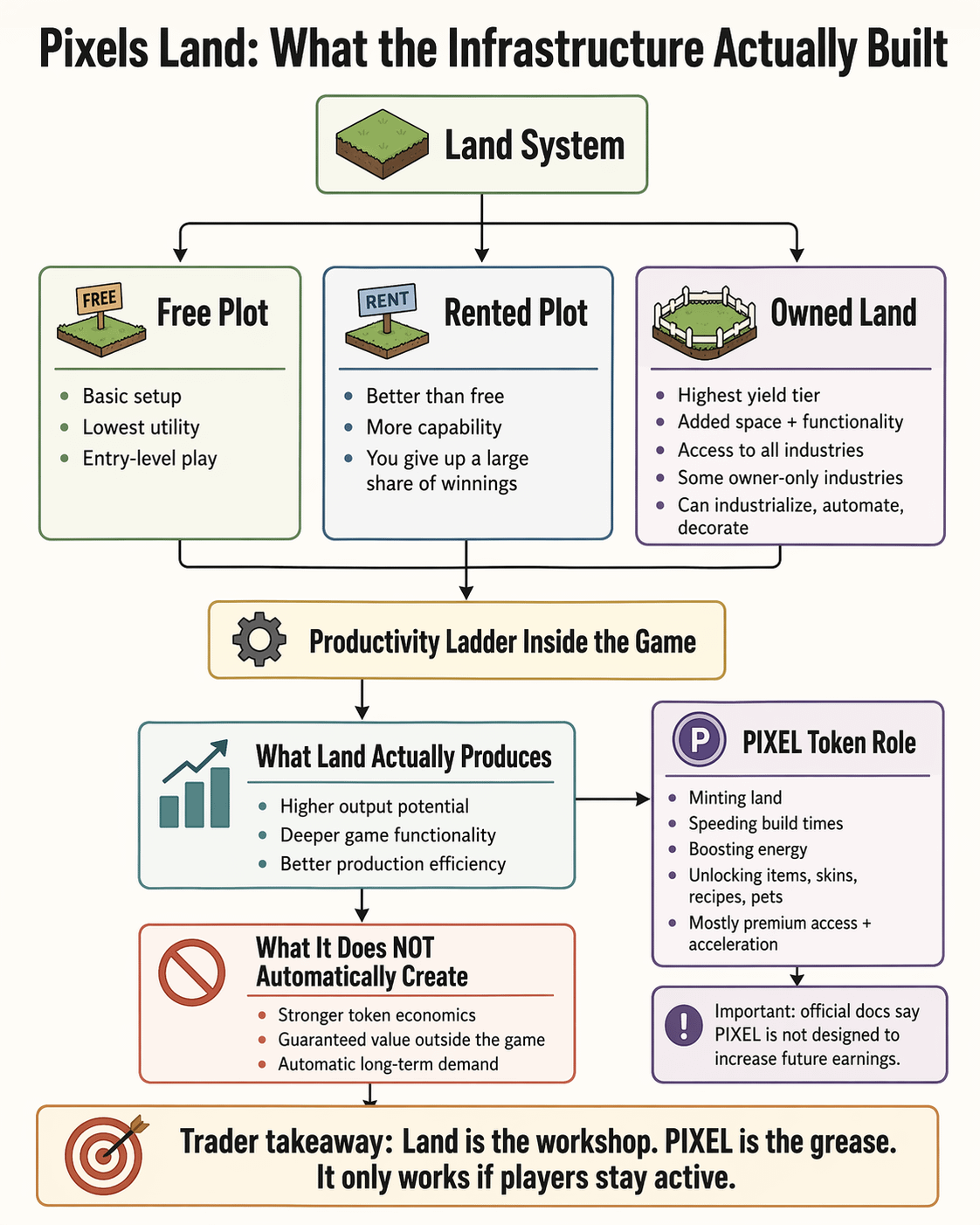
Here’s my read. Land did deliver something real, but not what a lot of people assumed. The official docs have always framed owned land as the highest yield tier with added space, added functionality, access to all industries, and even some owner only industries. Free plots are basic. Rented plots are better, but you give up a large portion of your winnings. Owned land is where the game lets you industrialize, automate, decorate, and push for higher output. So the upgrade path was never just cosmetic. It built a productivity ladder inside the game.
But that still leaves the infrastructure gap. More functionality is not the same thing as stronger token economics. Pixels’ own token docs say PIXEL is mainly for premium uses outside the core gameplay loop, things like minting land, speeding up build times, boosting energy, unlocking items, skins, recipes, pets, and merchandise. The same docs also say the token is not meant to increase future earnings for players. That line matters more than people admit. It means the project itself has long understood the danger of letting land and token ownership turn into a pure extraction machine. From a design perspective, that’s disciplined. From a trader perspective, it’s also a warning. If the token is mostly convenience, status, and acceleration, then sustained demand depends on people continuing to care about the world itself.
That’s where the Retention Problem becomes the whole story for me. Ronin’s own 2025 collector guide says Pixels hit a peak of over 1 million daily logins and that land offers extra in game rewards, with an approximate land floor around 1,980 RON, or about $550 at the time of that guide. Those are not tiny numbers. They tell you the project did succeed at making land feel meaningful enough for players to pay real money for it. But peak usage is not the same as sticky usage. Anyone can get a crowd during reward rich periods. What matters is whether people still log in when the novelty fades, when token price is weak, and when grinding starts to feel like labor. That’s the gap I keep coming back to. Infrastructure only matters if it keeps behavior alive.
The bull case is still there, and I think it’s more realistic than people give it credit for. If PIXEL is sitting near $0.0076 with about $8 million in daily volume, that is a lot of turnover relative to a roughly $5.9 million market cap. Traders are clearly still showing up. Land also has an actual role in the game’s production stack, not some vague promise parked in an old roadmap. Owned plots get the deepest functionality, and PIXEL still plugs into time saving and upgrade behavior across the game. So if Pixels can keep enough players active, the setup exists for land to function like the productivity layer while the token acts like paid acceleration and access. In plain English, land is the workshop, PIXEL is the grease. That combo can work.
Still, I’m cautious for a reason. First, the official token docs are old, and that bothers me. When a live market is trading a token every day, stale token documentation creates avoidable confusion. Second, land utility is clear inside the game, but outside the game it still depends too much on player persistence. If users churn, then extra functionality on owned plots stops feeling like infrastructure and starts feeling like expensive unused capacity. Third, the market is not rewarding the story right now. A token priced this low after years of development tells you investors still question whether the economy can hold attention without constant incentives. That’s not a small criticism. It’s the criticism.
What would change my mind in a stronger direction? Not another lore update. Not another land pitch. I want evidence that better land functionality is translating into repeat activity and real willingness to spend PIXEL on things players don’t regret a week later. I want retention that survives quieter months. I want a cleaner line between infrastructure that improves the game and incentives that just temporarily inflate it.
So yes, Pixels is worth watching right now, but not because four years of land upgrades proved some huge endgame. It’s worth watching because the market has pushed the project into a simple test: can all that land infrastructure finally hold users when price action is no longer doing the marketing for it? Keep your eye there. That’s where the real trade is.