
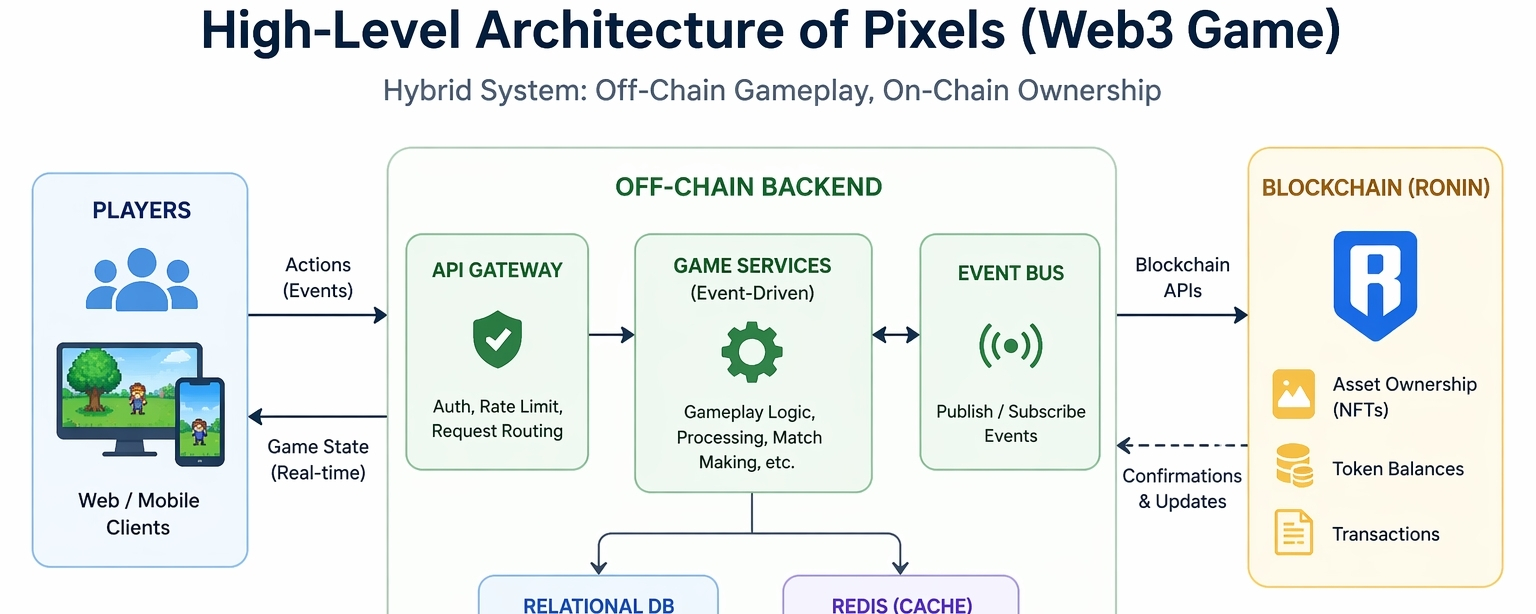
The popular narrative around Web3 games often paints a picture of fully on-chain worlds—self-contained, trustless ecosystems where every action, asset, and interaction lives permanently on a blockchain. It’s an appealing vision, but in practice, it’s largely fiction. Games like Pixels, built on networks such as Ronin, reveal a more pragmatic reality: modern Web3 games are deeply hybrid systems, blending traditional backend engineering with selective blockchain integration.
At the heart of this design lies a simple constraint—blockchains are not optimized for real-time interactivity. High latency, limited throughput, and transaction costs make it impractical to run core gameplay loops directly on-chain. A farming action that takes milliseconds in a traditional game would take seconds—or longer—if it required blockchain confirmation. Multiply that across thousands of concurrent users, and the experience quickly becomes unusable.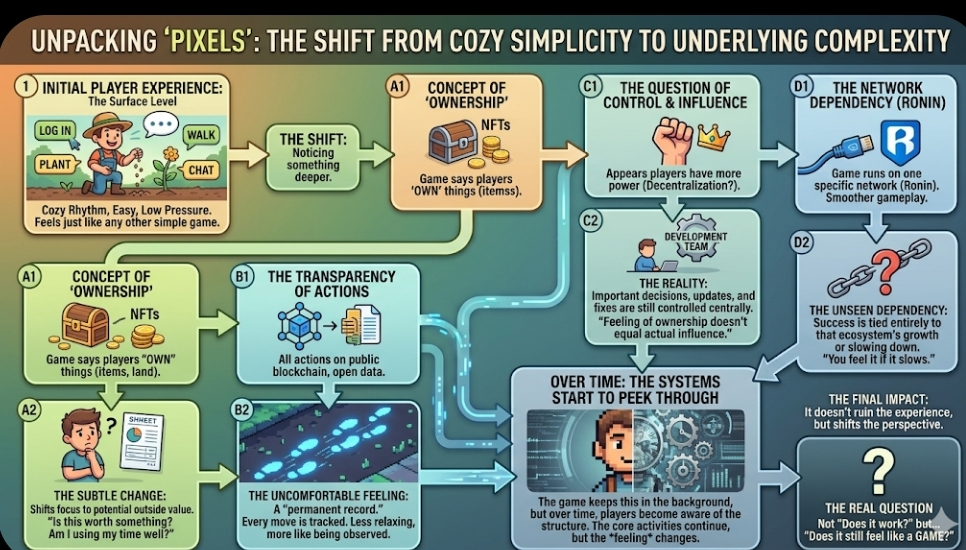
To solve this, Web3 games adopt architectures that look strikingly similar to Web2 multiplayer systems. Event-driven server architectures are a cornerstone. Player actions—harvesting crops, moving across a map, interacting with objects—are processed as events in distributed backend services. These systems are designed to scale horizontally, often running on cloud infrastructure that can dynamically allocate resources based on player load. Technologies like message queues and streaming platforms (e.g., Kafka-like systems) ensure that events are processed reliably and asynchronously, enabling smooth gameplay even under heavy demand.
Data management follows a layered approach. Structured game data—player inventories, progression stats, world states—is typically stored in relational databases for consistency and queryability. Meanwhile, real-time state (such as player positions or temporary interactions) is handled by in-memory systems like Redis. This separation allows developers to balance durability with speed. Redis, for instance, can handle rapid reads and writes with minimal latency, making it ideal for live gameplay synchronization, while relational databases provide a stable backbone for persistent data.
Blockchain integration, then, becomes a selective layer rather than the foundation. Ownership of assets, token balances, and certain high-value transactions are recorded on-chain, accessed through blockchain APIs. This design preserves the core promise of Web3—verifiable ownership and decentralization of assets—without sacrificing performance. A player’s land or rare item might exist as a token on-chain, but the act of planting a seed or walking across that land is handled entirely off-chain.
This hybrid model introduces important trade-offs. On one hand, it enables scalability and responsiveness that purely on-chain systems cannot achieve today. On the other, it creates dependencies on centralized components—cloud servers, databases, and external APIs. If a blockchain API becomes slow or unavailable, asset synchronization can lag behind gameplay. In worst-case scenarios, discrepancies can emerge between off-chain game state and on-chain records, leading to desynchronization issues that are difficult to reconcile.
Latency optimization is another balancing act. By keeping core logic off-chain, developers can deliver near-instant feedback to players. But every interaction that eventually touches the blockchain—such as minting or transferring assets—reintroduces latency and potential friction. To mitigate this, many systems batch transactions or use asynchronous confirmation models, where the game proceeds optimistically while the blockchain catches up in the background. This improves user experience but slightly weakens the immediacy of trust guarantees.
There’s also an architectural complexity cost. Hybrid systems require careful orchestration between multiple layers: game servers, databases, caching systems, and blockchain interfaces. Each layer introduces potential points of failure and increases the operational burden. Debugging issues across these boundaries—especially when timing and state consistency are involved—can be significantly more challenging than in purely centralized systems.
Yet, for now, this compromise is what makes Web3 gaming viable. Fully on-chain games remain constrained by current blockchain limitations, while hybrid architectures offer a practical path forward—delivering performance without abandoning decentralization entirely.
The deeper question, however, lingers beneath the surface: as these hybrid systems grow more complex, are they quietly drifting away from the decentralization ideals they were meant to uphold? And if so, will the very architectures that make Web3 games scalable today become the bottleneck that limits their evolution tomorrow?
