

There was a moment during the recent red market stretch when everything clicked into place for me.
I was watching the Pixels community chat when someone proudly shared that they had just farmed around 240 $PIXEL. The reaction was immediate. People were not impressed. They were telling him to close and sell, questioning why he would hold. At almost the same time, I checked my own rewards and noticed something strange. In just two days, my daily output had dropped from around 220 to 165, even though I had not changed the way I played.
My first instinct was frustration. It felt like the game was quietly cutting rewards without explanation. I have always been skeptical of systems that adjust numbers behind the scenes. It feels unpredictable, almost unfair. But after taking a deeper look into how the system actually works, I realized the issue was not the game acting against me. I was misunderstanding the system entirely.
Pixels does not operate on isolated player outcomes. It reacts to collective behavior.
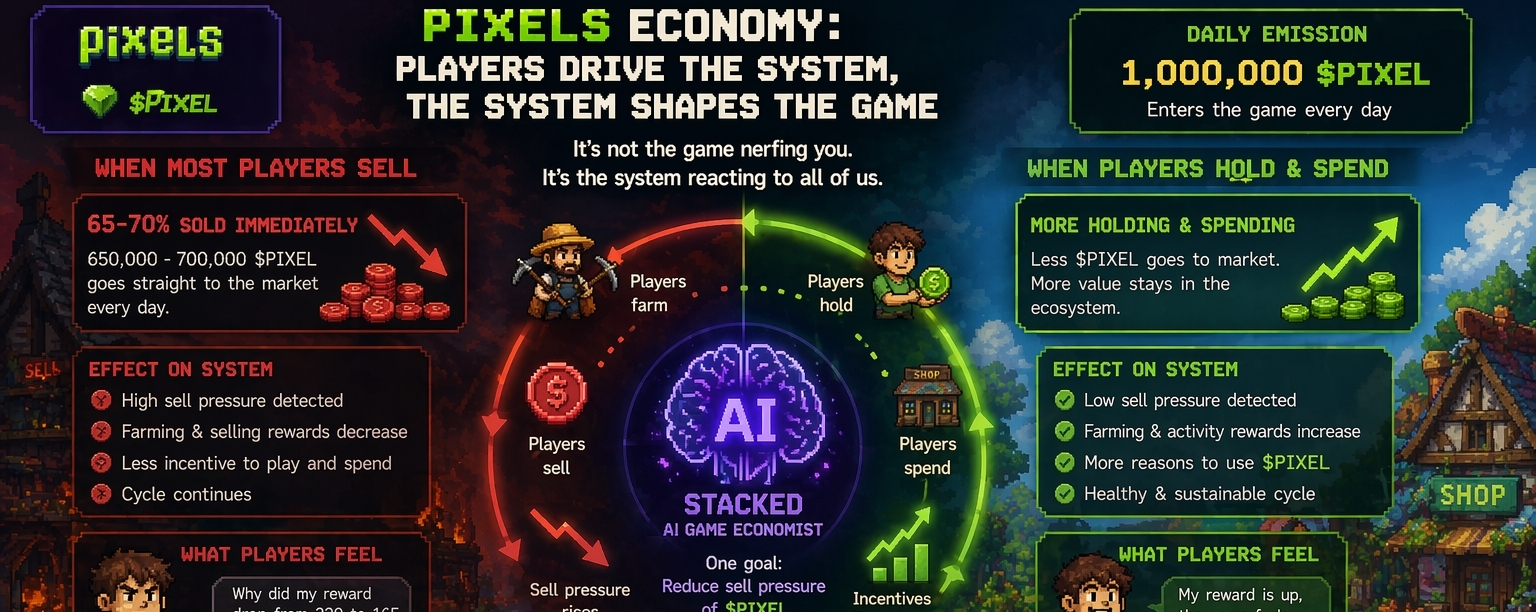
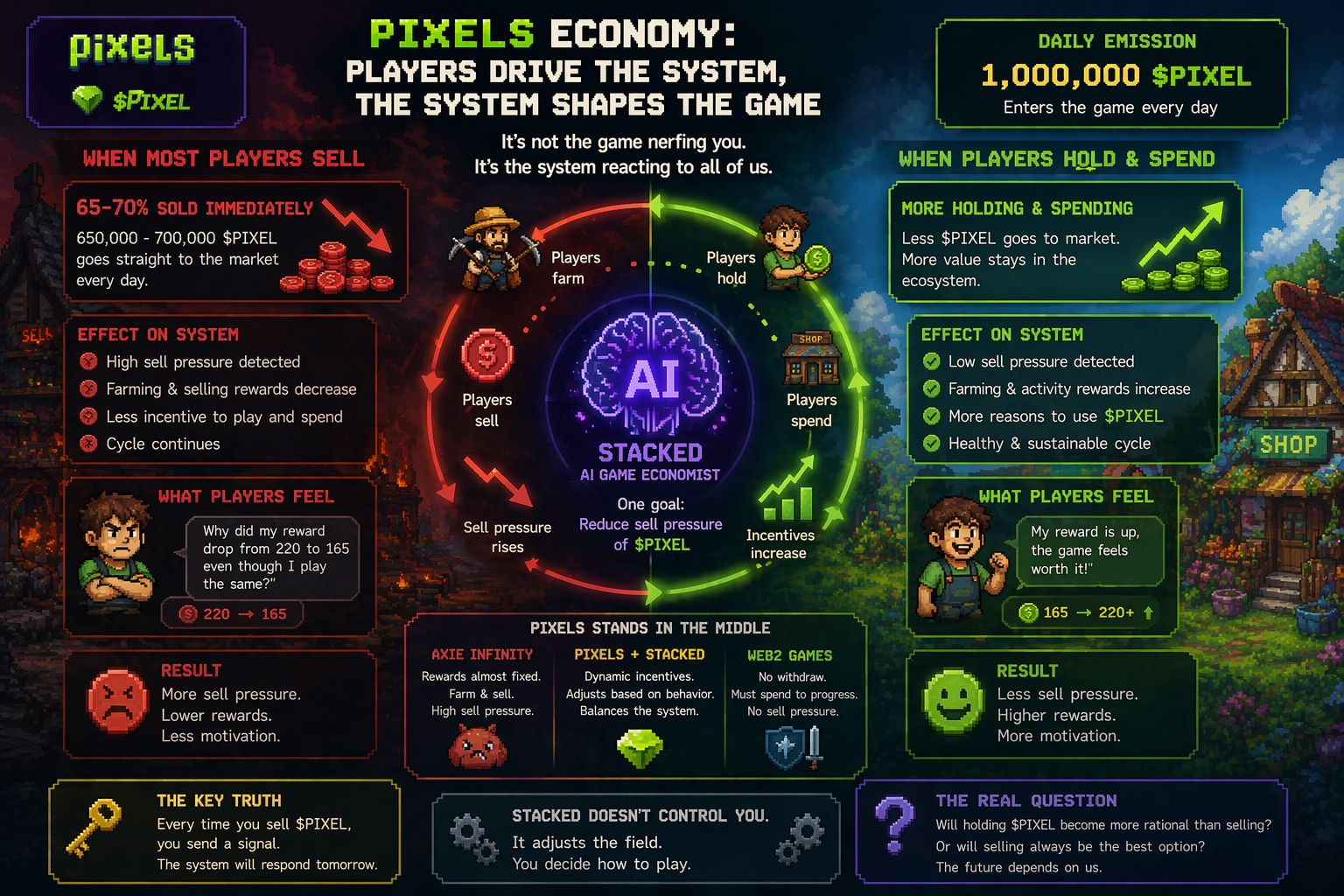
At the center of this design is a feedback loop that connects how players behave with how rewards are distributed. Roughly one million $PIXEL enters circulation each day. If a large percentage of that is instantly sold, the system detects rising sell pressure. When that happens, rewards tied to farming and extraction get reduced. On the other hand, if more players hold or spend their tokens inside the game, incentives shift in that direction.
This is not guesswork. It is a system responding directly to data.
When you look at the numbers, the scale becomes clear. If around seventy percent of daily emissions are sold, that means hundreds of thousands of tokens are entering the market every single day. Over weeks, that becomes millions. The system cannot ignore that. So it adjusts. Quietly, consistently, without emotion.
The easiest way to understand it is to think of it like temperature control. When things get too hot, it cools things down. When activity drops too much, it increases incentives. There is no intention to reward or punish individuals. It is simply trying to keep the overall system stable.
That is where the misunderstanding often begins.
From a personal perspective, nothing feels wrong. You play the same way, invest the same time, and expect similar outcomes. But from a system perspective, you are not alone. You are part of a collective pattern. If most players are farming and selling, then even if your individual behavior feels reasonable, you are contributing to the same pressure the system is trying to reduce.
This leads to a difficult but important realization. The system is not optimizing your experience. It is optimizing the survival of the token.
That may sound harsh, but it explains a lot of what players are feeling.
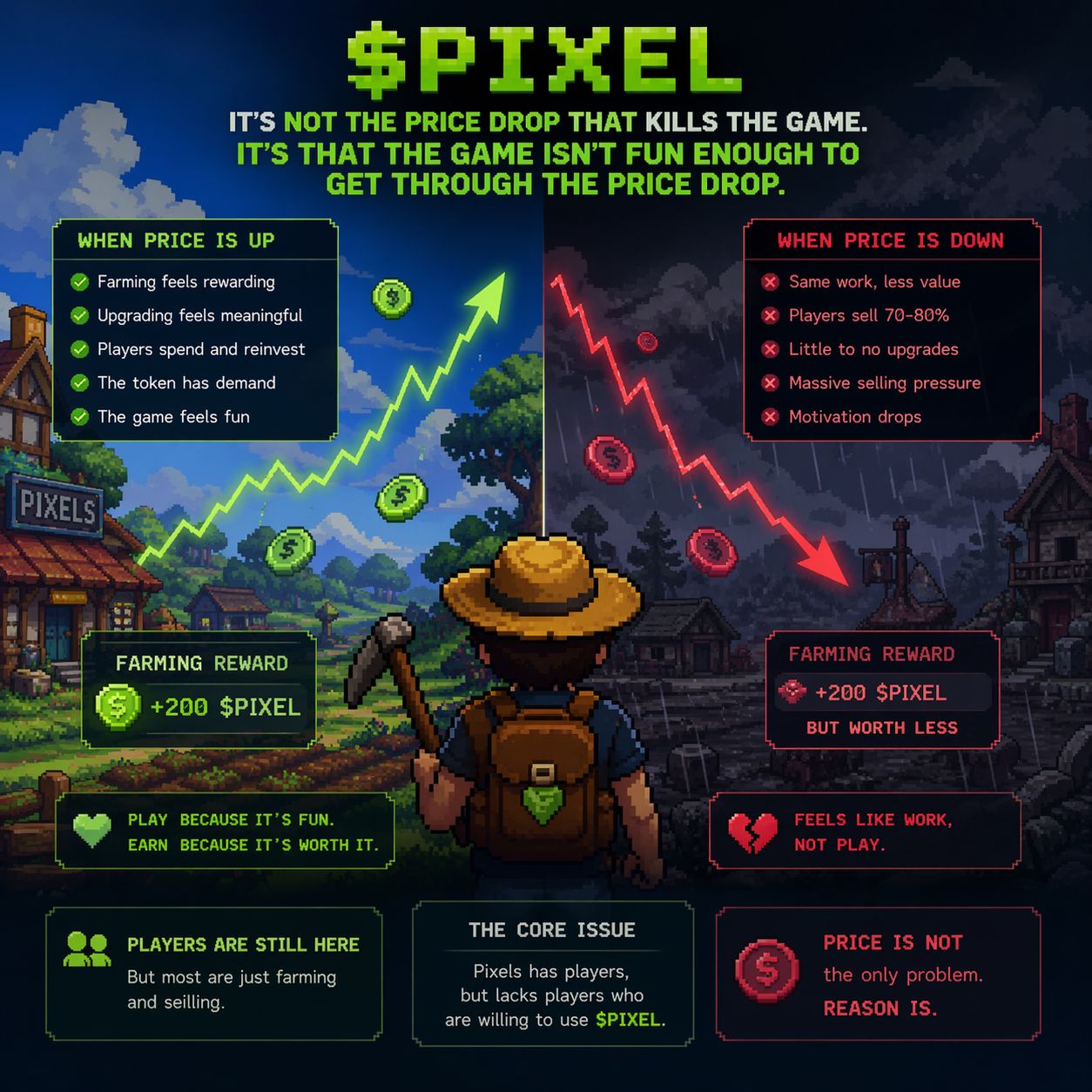
When rewards drop, it feels like progress is being taken away. Motivation decreases. Players become more cautious. Instead of reinvesting into upgrades or long term growth, they shift toward extracting value as quickly as possible. Selling becomes the safest option.
And that behavior feeds directly back into the system.
The more players sell, the more pressure builds. The more pressure builds, the more rewards adjust downward. It becomes a loop where individual rational decisions collectively create an outcome that feels worse for everyone.
This is where Pixels sits in an interesting position compared to other models.
On one side, you have systems where rewards are fixed and predictable. Those tend to attract farming behavior where players extract value continuously without much reason to stay engaged long term. On the other side, you have traditional games where progression depends entirely on spending, with no option to withdraw value at all.
Pixels exists somewhere in between. It allows earning, but also tries to guide how that earning is used.
The challenge is that adjusting numbers alone is not enough to create demand.
Players will only hold or spend tokens if there is a clear reason to do so. Right now, many players continue to farm consistently, but they reduce how much they reinvest into the game. They sell the majority because the gameplay does not strongly require them to do otherwise. Individually, that decision makes sense. But when most players think the same way, the system faces constant pressure.
This is the limitation of any system driven purely by incentives.
It can influence behavior, but it cannot create genuine desire. It can make holding more logical, but it cannot make the game more engaging on its own.
That is where the real opportunity lies.
For the system to truly stabilize, players need reasons beyond short term gains to keep their tokens inside the ecosystem. Progression should feel meaningful enough that spending becomes a natural choice, not a forced one. At the same time, transparency matters. When players understand why rewards change, they are more likely to adapt instead of feeling frustrated.
Right now, many players only see the outcome, not the mechanism behind it.
And that gap creates confusion.
Looking ahead, there are two possible directions. In one scenario, the system successfully shifts behavior. Players begin to hold more, spend more, and engage more deeply with the game. The feedback loop stabilizes, and rewards become more consistent. In the other scenario, players continue optimizing for extraction. They farm, sell, and move on, while the system keeps adjusting without ever fully solving the core issue.
Neither outcome is guaranteed.
What is clear is that every action inside the game sends a signal. Selling is not just an individual decision. It becomes part of the data that shapes tomorrow’s rewards.
Once you understand that, it changes how you see the entire system.
It is no longer about whether the game is being fair or unfair. It becomes a question of how your behavior fits into a larger pattern.
And that is where things get interesting.
Because the system is not forcing you to change. It is adjusting the environment around you, slowly shifting what makes sense.
If holding becomes more rational than selling, players will adapt. If selling remains the better option, they will continue doing it.
The outcome will not be decided by a single update or adjustment. It will be shaped by how thousands of players respond over time.
And that is why this experiment is worth watching.
Not because of short term rewards, but because it is testing whether a system can balance itself through incentives alone.
Every day you play, every time you claim, every time you sell, you are part of that experiment.
And whether people realize it or not, the system is always listening.
