
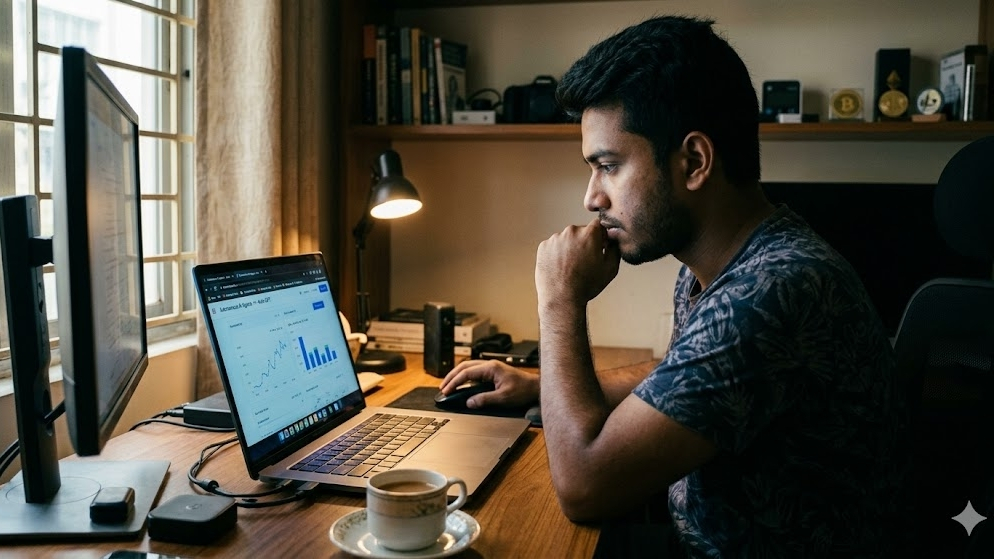
I didn’t set out to explore AI that day. It just sort of happened the way most things do in crypto — one tab opens another, one idea links to the next. I was doing nothing unusual, just scrolling through charts, checking Binance, letting the market drift in the background while I half-focused on it.
Somewhere along the way, I landed on a thread about autonomous AI agents. Things like Auto-GPT. At first glance, it didn’t feel groundbreaking. Just another iteration. Another tool built on top of something we already understand. Faster responses, a bit more automation — nothing that seemed like a real shift.
But then I started paying closer attention to how it actually behaves.
And that’s when it stopped feeling familiar.
What stood out wasn’t intelligence in the usual sense. It wasn’t about better answers or cleaner outputs. It was the way it moved. You don’t guide it step by step. You don’t sit there prompting it every few seconds. You give it a direction, and it starts unfolding the process on its own.
Not in a dramatic way. Quietly.
It sets sub-goals. It decides what to check first. It evaluates whether something worked, then adjusts without asking you. It keeps going, almost like it has its own internal momentum.
Watching it felt different. Not like using software. More like observing a process that’s already in motion.
I remember seeing it handle a simple research task. Instead of jumping straight to an answer, it paused — not literally, but structurally. It mapped out what it needed to do. Then it questioned that structure. Then it refined it. Only after that did it begin gathering information.
It wasn’t just doing the task. It was shaping how the task should be done.
That subtle shift changes everything.
Because once that layer exists, your role becomes less hands-on. You’re no longer directing every move. You’re setting intent. And from there, the system interprets what “progress” looks like.
That’s powerful, no doubt. It makes complex, messy tasks feel more manageable. Things that normally require constant attention suddenly become something you can step away from. There’s a kind of relief in that — letting the system carry the weight.
But there’s also a tradeoff that isn’t immediately obvious.
The decisions don’t disappear. They just move out of sight.
Every step it takes is still a choice. What to prioritize, what to ignore, when something is “good enough” to move forward. And those choices shape the outcome just as much as the final answer does.
The difference is, you’re not watching them happen anymore.
And that’s where it gets interesting.
If something goes clearly wrong, you’ll notice. That part hasn’t changed. But if the process drifts slightly off course while still producing something that looks coherent… that’s harder to catch.
Because on the surface, everything still feels structured. Logical. Step-by-step.
It gives the impression of clarity, even when the underlying path might not be as solid as it seems.
I don’t think that’s a flaw. It’s just a natural result of how these systems operate. They’re built to move forward, to resolve goals, to maintain flow. They interpret what you want and act on that interpretation continuously.
And interpretation, by definition, isn’t perfect.
What stayed with me wasn’t fear or #pixel — it was awareness. The sense that this isn’t just a better tool. It’s a different kind of interaction entirely.
You’re no longer in the loop the same way.
You’re adjacent to it.
Most people probably won’t think too much about that. If the output works, that’s enough. And in many cases, it will be enough.
But it does make me wonder how quickly we’ll get comfortable with this distance. How easily we’ll trust systems that operate just outside our direct visibility, simply because they feel smooth and efficient.
$PIXEL Maybe that’s the direction everything is heading anyway.
Tools that don’t wait. Systems that don’t need constant input. Processes that continue whether you’re watching or not.
There’s something undeniably useful about that.
But there’s also something subtle in the shift — the way control becomes less about action and more about intention.
And once you notice that, it’s hard to unsee.
The real question isn’t whether we’ll use these systems.
It’s whether, over time, we’ll stop thinking @Pixels about how they’re actually making decisions… and just accept the results as if the process never mattered.