@Pixels Here’s a fresh 500-word latest analysis of Pixels (PIXEL) in 2026, written in a clean, post-ready style:
Pixels ($PIXEL ) is quietly becoming one of the most interesting experiments in the GameFi space—not because it promises massive rewards, but because it’s trying to fix what most crypto games got wrong.
At its core, $PIXEL is a Web3 farming game built on the Ronin network, combining simple gameplay loops with real asset ownership and an on-chain economy. What makes it stand out in 2026 is not just the gameplay, but how the economy is structured around utility rather than hype.
Unlike traditional play-to-earn models that collapse under inflation, PIXEL acts more like a premium currency. It’s used for high-value actions—VIP perks, guild participation, NFT minting, and progression advantages—rather than basic gameplay. This design creates a more controlled economy where demand is tied to player ambition, not just speculation.
One of the biggest bullish signals for Pixels right now is user growth. The game has seen a strong increase in activity, with daily users rising significantly in early 2026 and even scaling toward massive adoption levels across the Ronin ecosystem. This matters because GameFi tokens only hold value if players stay—and Pixels is proving it can retain attention.
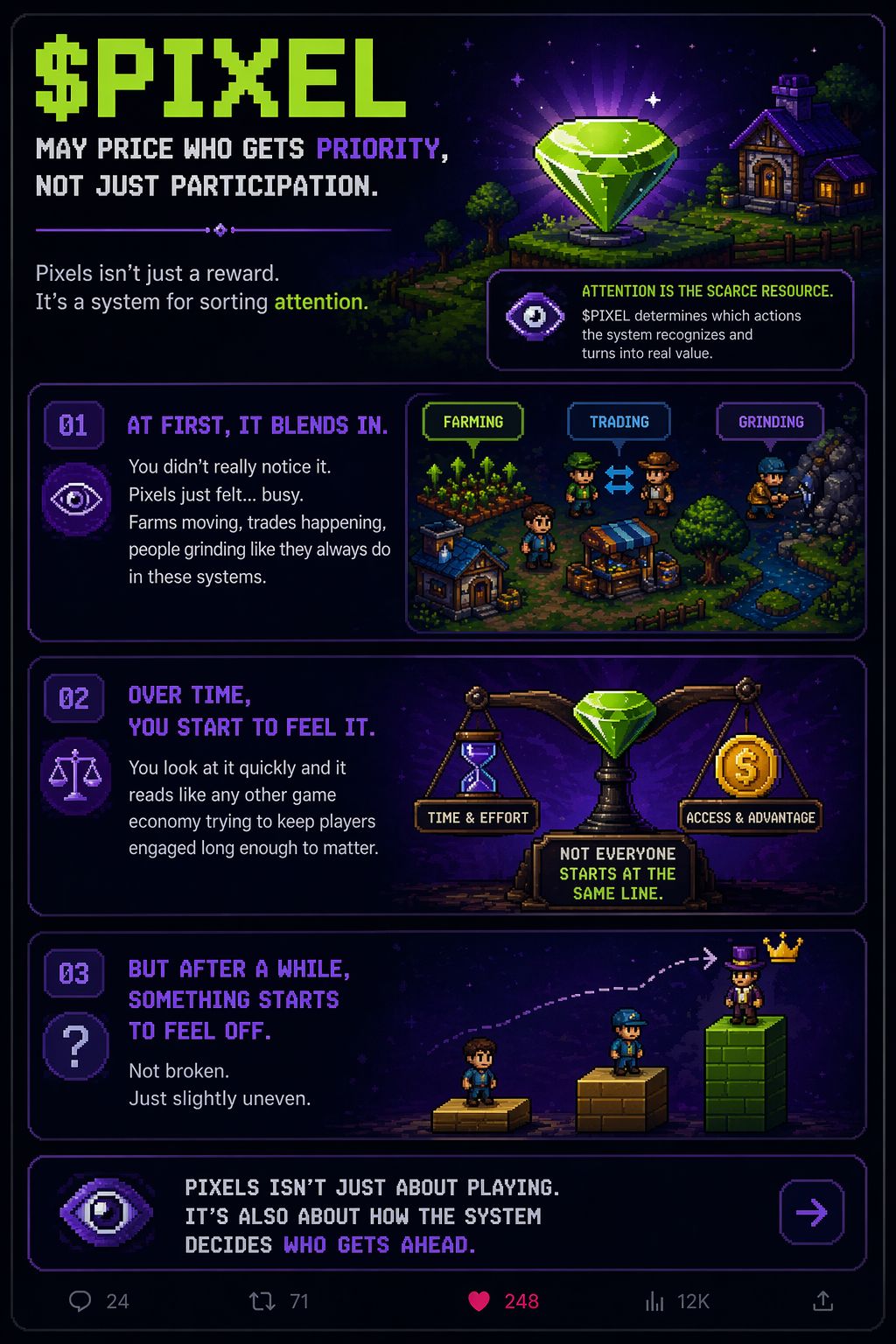
However, the real story isn’t just growth. It’s how attention is being monetized.
Pixels is shifting toward a system where holding or spending PIXEL influences access, efficiency, and visibility inside the game. This creates a subtle hierarchy: players who invest more gain faster progression, better opportunities, and stronger economic positioning. It’s not outright pay-to-win—but it’s not entirely neutral either.
That’s where the market debate begins.
On one side, this model is actually healthier than past GameFi economies. Token sinks, controlled supply, and meaningful utility help reduce inflation and long-term collapse. Around 66% of total supply is already circulating, which lowers dilution pressure and shifts focus toward real demand.
On the other hand, this introduces a new challenge: economic imbalance. If attention and opportunity are increasingly gated by PIXEL, the game risks favoring capital over time investment. This could reshape player behavior—from casual engagement to more competitive, capital-driven gameplay.
From a price perspective, PIXEL has shown volatility typical of gaming tokens. While still far below its all-time highs, recent projections suggest potential upside if adoption continues, with some models placing it in the $0.018–$0.027 range under bullish conditions in 2026. Still, the broader GameFi sector remains under pressure, meaning growth is not guaranteed.
So what’s the real takeaway?
Pixels isn’t just another farming game—it’s an evolving economic system. It’s testing whether a game can balance fun, ownership, and monetization without breaking its