Nowadays, the time we spend online is gradually becoming a value unit rather than just time spent. But the problem is, on most platforms, we don't get any real value against that time. That's where Pixels seems to me to be an interesting experiment - where time, activity and consistency gradually become part of an economic system.
I think of one thing from the beginning - we spend hours every day online, scrolling, playing games, being in the community, but what happens in the end? In most cases only "spent time." But with a system like Pixel, it's a little different. Everyday work, farming, quest completion - everything falls into a structured economy.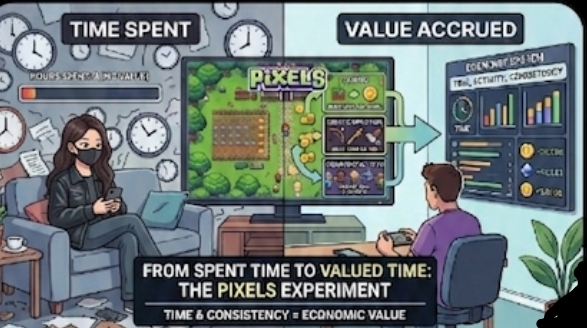
The most interesting part here is "time as participation That is, the more consistent you are, the more you contribute to the ecosystem. This is very different from the traditional gaming model, where there is only skill or pay-to-win. Consistency works as an asset.
But I wouldn't call it perfect. In my opinion, the biggest risk of such systems is retention pressure. At first, there is a lot of hype, new users come, everyone is excited. But over time, when the reward expectation and the actual output mismatch, many people disengage. This is a real challenge for the Pixel economy.
The other thing is speculation versus real engagement. Sometimes it is seen that some people come just for the token price or short-term gain, they do not fully engage with the core gameplay or contribution of the ecosystem. As a result, the balance is lost. I think this is the most sensitive part.
A regular farmer is creating resources with time every day, keeping the ecosystem running. On the other hand, a speculator is looking for short-term profit with early entry. If these two types of behavior are together, the system can survive, but if there is an imbalance, the pressure falls on the real active players.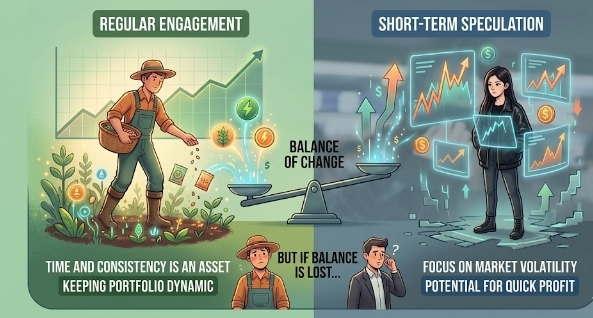
But I see a positive side. Pixels raises an interesting question - Can our online time be just consumption, or value creation? " This is a very big question. Because in the traditional internet economy, the user usually becomes not a product, but a part of the product. But here we are trying to convert the user contribution to a measurable value.
And people bring curiosity in the beginning, but it is difficult to maintain long-term engagement. If the reward structure is not only financial, but also experience-based, progression-based and social value-driven, then it may be more stable.
According to my observation, systems like Pixels actually represent a transition phase. We still do not fully understand how to move from attention economy to participation economy. But it is clear that the future internet will not just stand on scroll and like.
Another important aspect is community behaviour. In an ecosystem like Pixels, the community is not just the audience, but the active layer of the economy. If the community is healthy, the system is sustainable. But if the FOMO-driven entry and exit is high, then the stability is lost.@Pixels
And I don't think the pixels are perfect, but it's a signal. This shows that digital time can be part of a structured value system rather than just consumption. But there will always be risks, volatility, and behavioral imbalances.
In my opinion, Time Online is no longer just entertainment - it's slowly becoming part of the economy, but how fairly that value is distributed is the real question.
Pixels have brought that question to the fore, and the answer is still evolving.$PIXEL
All in all, it seems to me that Pixels may not be redefining our online time completely, but it is definitely changing our way of thinking.#pixel

Articolo

IS PIXELS REDEFINING HOW WE VALUE OUR ONLINE TIM
--
Disclaimer: Include opinioni di terze parti. Non è una consulenza finanziaria. Può includere contenuti sponsorizzati. Consulta i T&C.