
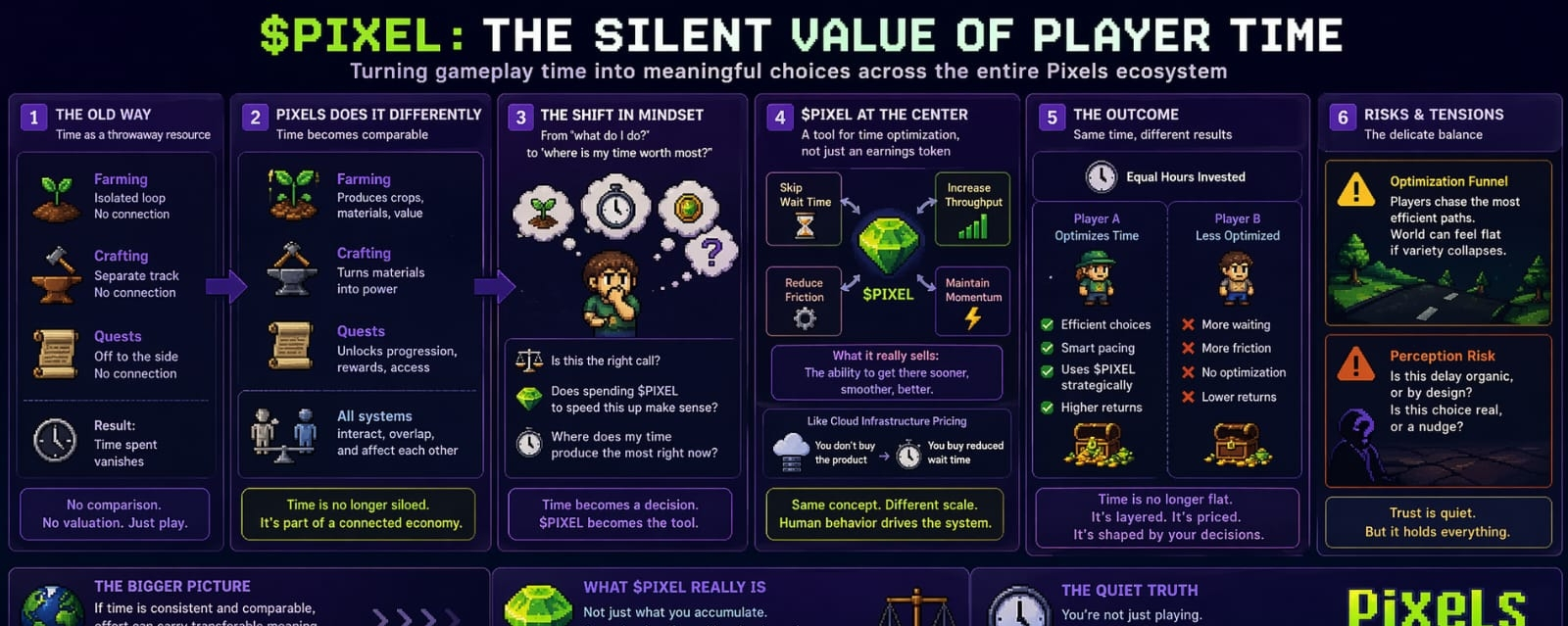
For a long time, I never really thought about time inside games as something with weight. You open the app, run through a few cycles, close it again. Nothing carries over. It's not like a job, where hours translate to income, or a system, where slowdowns carry a real cost. In games, time always felt... throwaway. Until it didn't.
Pixels didn't flip that perspective right away. On the surface, it reads like any other farming sim. Grow something, wait, collect it. I moved through it without reading too deep into it. But gradually, something started pulling at my attention. Nothing loud. Just a low-level feeling that different parts of the game were starting to feel... connected. Like they were being weighed against each other, even without anything explicitly saying so.
That's when my thinking started to move.
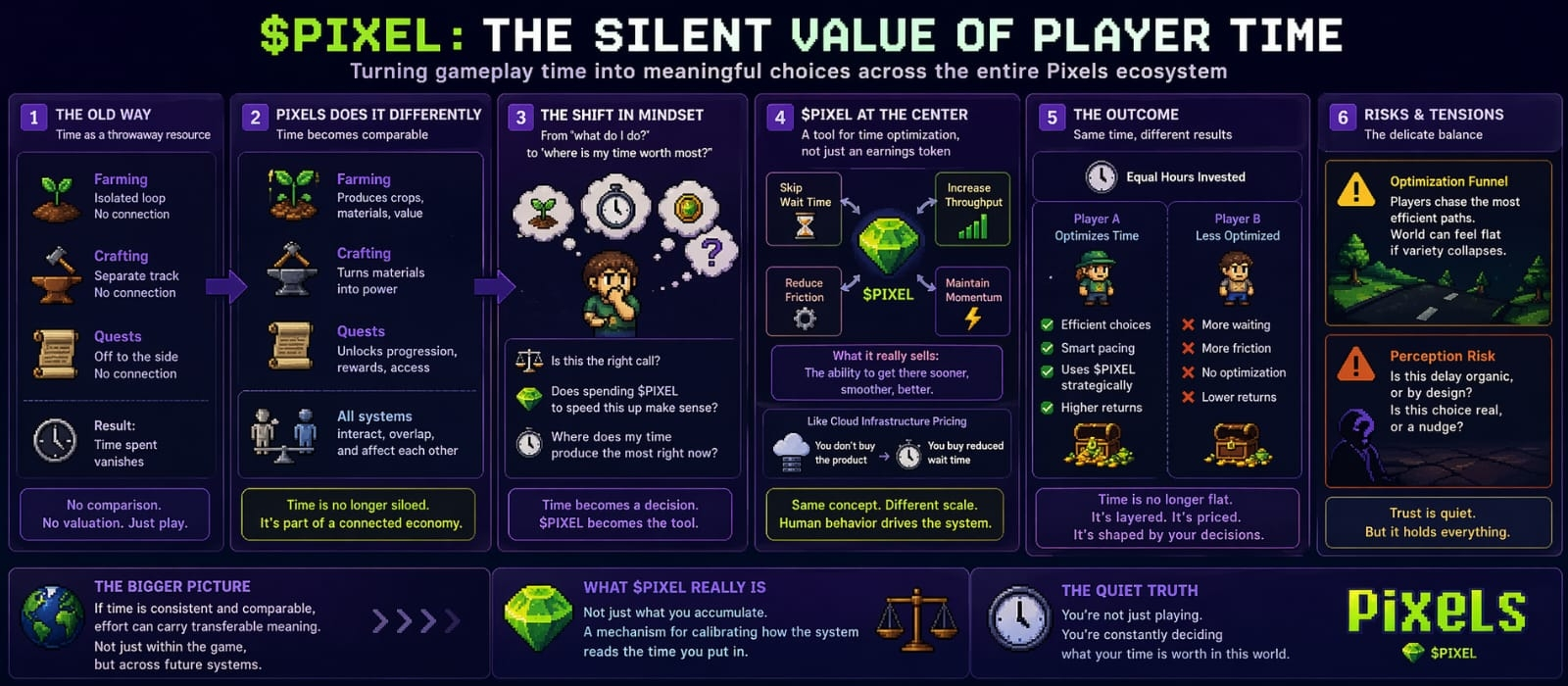
Most games never even attempt this. Farming loops stay siloed. Crafting runs on its own track. Questing exists somewhere off to the side. None of it maps onto the rest in any coherent way. The system just hands out different rewards per activity and counts on players not running the comparison.
Pixels feels like it's reaching for something different, just without announcing it. There's no banner that reads "this is a time economy." It simply builds enough scaffolding that time starts acting like one.
And the moment that happens, pixel shifts. It's no longer just something you earn. It starts functioning more like a tool that interprets what your time is actually worth.
I didn't catch it consciously at first. I only noticed because I found myself running quiet little calculations automatically. Is sitting here the right call? Does spending pixel to cut this down make sense? And it wasn't isolated to one activity. It was spreading across the whole experience. Farming, crafting, progression walls... all of them started collapsing into variations of the same kind of decision.
That's not normal.
Because the question stopped being "what do I feel like doing now?" and quietly became "where does my time produce the most right now?"
That's a different kind of design. Not about keeping content fresh. About making you constantly evaluate how you're allocating yourself.
And the token lives right at the center of that calculation.
What stands out is how soft the friction is. It never pushes. You're never cornered into spending. But there are enough pauses, enough small gaps in momentum, that they start accumulating in the background. Each one is forgivable on its own. Together they create a low, steady pressure.
You can let time pass... or you can reshape the pace.
That reshaping is exactly where $PIXEL enters.
It reminds me less of other game economies and more of how cloud infrastructure gets priced. You're not buying a product directly. You're buying reduced wait time. Faster throughput, shorter gaps, smoother execution. The platform doesn't sell you the result. It sells you the ability to get there sooner.
Pixels is running a softer version of that same logic. Same concept, smaller scale, different context.
The distinction is that here, it's human behavior driving the system. Not servers. Not pipelines. People making decisions.
Which creates a strange outcome. Two players can invest identical hours and land in completely different places, purely based on how efficiently they let the system price their time through their choices.
So time stops being a flat resource. It becomes something layered.
That layering is where the design gets genuinely interesting... and also where it becomes a little unstable.
Because once optimization kicks in, players don't pull back from it. They chase the most productive loops. The highest yield per minute. The path with the least drag and the most return. Every system drifts that way eventually. It's just what happens.
If enough players funnel into the same efficient routes, the whole texture of the game can flatten. What felt like an open world starts feeling like a set of well-worn tracks. You see this pattern everywhere, not just in games.
Then there's the perception layer.
Even when a system is structurally sound, it can start feeling designed against you. That's the quiet risk. Once players recognize that time is being actively shaped, doubt creeps in. Is this delay organic, or was it placed here deliberately? Is this a real choice, or just a push in a direction?
Those questions don't collapse a system immediately. But they don't disappear either.
I'm not sure Pixels has a clean answer to that. Maybe it isn't looking for one.
What it does seem to be doing, whether by design or just by how things evolved, is making time behave consistently across the whole experience. Not identically, but comparably. And that alone changes how the economy underneath it all moves.
If that consistency holds up, it points somewhere interesting. Not just within this one game, but toward a broader kind of framework. One where effort, not just items or assets, starts carrying some form of transferable meaning.
That's still speculative. Maybe too speculative to state firmly.
But I keep landing on the same quiet observation. I don't think $PIXEL is primarily about what you accumulate. It feels more like a mechanism for calibrating how the system reads the time you put in.
That's a small shift. Easy to walk past.
Until you realize you haven't just been playing for a while. You've been constantly deciding what your time is worth inside this thing.