
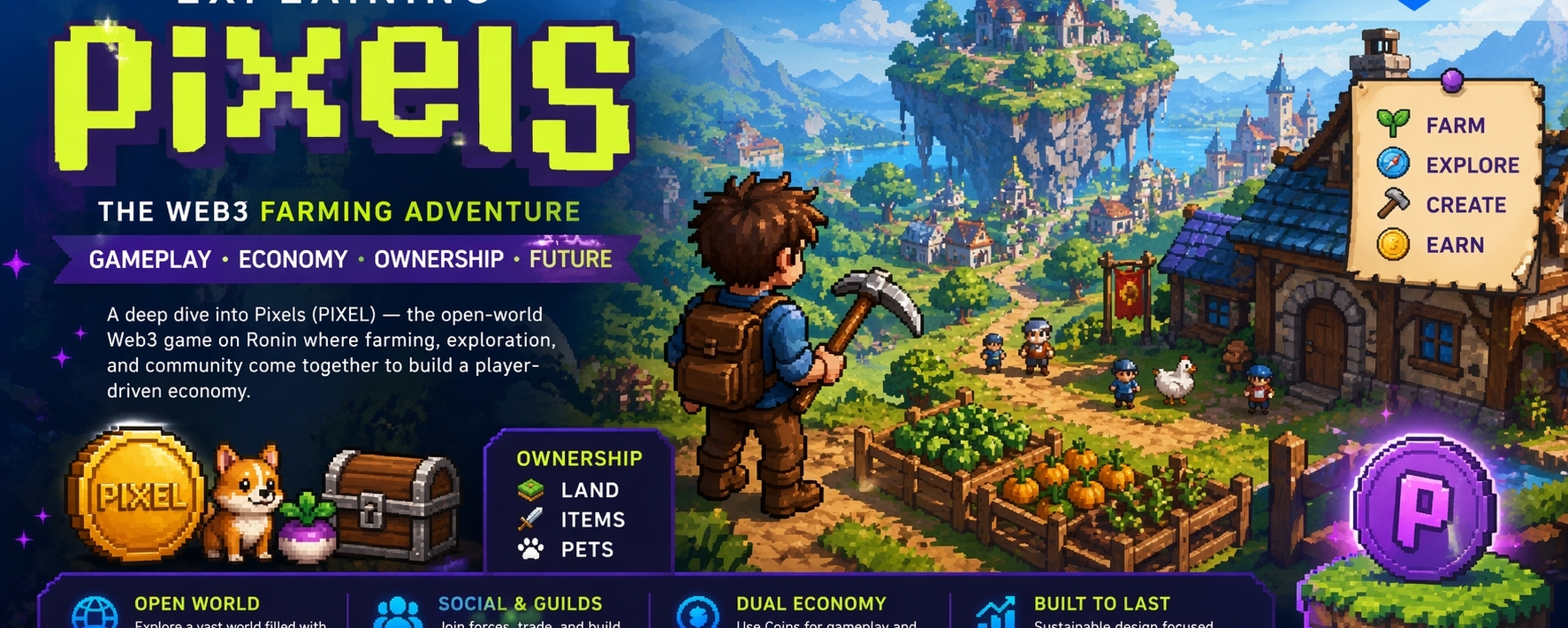

Most projects in this space sound like they were written by the same voice. Big promises. Familiar words. Just enough storytelling to feel exciting, but not enough to feel real. Pixels can easily be mistaken for one of those. A Web3 farming game, open world, social features. It sounds predictable at first. But if you sit with it a little longer, something quieter starts to emerge. Something more human.
At the beginning, Pixels feels gentle. You plant crops, walk through a soft world, collect things, build slowly. There is no pressure, no rush. It feels like a place you can disappear into for a while. The kind of rhythm that lets your mind settle. That feeling is not accidental. It pulls you in without asking too much from you.
But underneath that calm surface, there is another layer. One you don’t notice immediately. Every small action carries weight. Time spent starts to feel like something measurable. Your routine begins to shape outcomes. And slowly, without announcing itself, the game starts to blur into something else. Not just play. Something closer to effort. To value. To quiet calculation.
That shift is subtle, and that’s what makes it powerful. You don’t wake up one day and decide to optimize everything. It happens gradually. You start thinking about efficiency. About what gives more in return. About how to do things better. And before you realize it, a peaceful farming loop begins to feel like a system you are trying to understand, maybe even master.
A big reason Pixels reached so many people is because it removed friction. It doesn’t feel like you are dealing with complicated systems or technical barriers. You just log in and play. Everything else fades into the background. That simplicity makes it easy to stay. And once you stay, the system has time to unfold around you.
There is also something deeper happening with how value is handled. Not everything you earn feels the same. Some things come easily, almost endlessly. Others feel distant, harder to reach, more meaningful. This creates a quiet tension. You start choosing where to focus, what matters more, what is worth your time. The game doesn’t tell you what to care about. It lets you discover it yourself.
Ownership is where things start to feel more complicated. You can own land, items, pieces of the world. That idea feels empowering at first. Like you have a place that is truly yours. But the longer you think about it, the more questions begin to form. How much control do you really have. What happens when the world changes. What does ownership mean when the rules can shift without you.
There is also a quiet imbalance that grows over time. Those who arrived earlier often stand in stronger positions. They have space, resources, advantages that others don’t. New players step into a world that is already shaped. They don’t just build. They adapt. They fit into systems that were created before them. It starts to feel less like a blank canvas and more like a living economy with its own gravity.
Pixels avoids calling itself a play to earn game, and that choice feels intentional. Because once earning becomes the focus, something fragile begins to crack. The joy fades. Curiosity turns into calculation. People stop exploring and start chasing outcomes. The system becomes heavier. And slowly, play starts to feel like work.
Pixels tries to hold onto that balance. It leans into calm, into routine, into small moments that feel satisfying on their own. But the tension never fully disappears. It just stays beneath the surface, shaping how people behave without forcing them to see it.
The social side adds another layer of meaning. You are not alone in this world. People gather, collaborate, share systems, build together. Progress is not always individual. Sometimes it depends on others. Sometimes it grows through connection. And that changes how the game feels. It becomes less about what you do and more about how you exist alongside others.
Visually, it stays simple. No overwhelming graphics, no need to impress. And somehow, that makes it feel more honest. It doesn’t try to distract you. It gives you space to focus on what you are doing and why you are doing it.
What makes Pixels stand out is not what it promises, but what it quietly reveals about people. About how easily we adapt to systems. About how quickly we start measuring our time. About how something that begins as play can slowly carry the weight of purpose.
