
Following
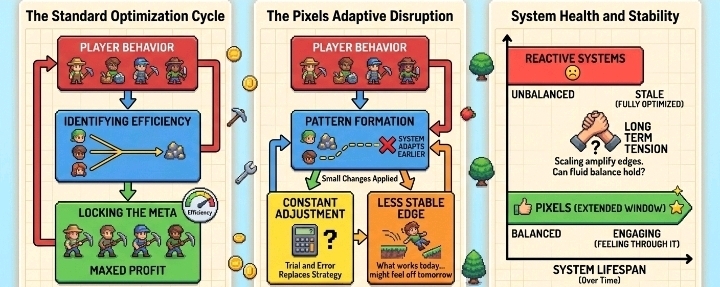
I’ve been thinking about how most systems handle optimization. Usually, it’s reactive. Players find the most efficient path, the system adjusts, and then the cycle repeats. It’s almost expected at this point.
With Pixels, I’m not sure it’s playing the same game.
It doesn’t feel like it’s waiting for behavior to fully form before responding. There’s this sense that it’s adjusting earlier, while patterns are still developing. Not perfectly, but enough to make optimization feel… less stable than usual.
That’s the part I keep coming back to.
Because if a system can adapt quickly enough, it doesn’t just respond to optimization it disrupts it before it fully settles. Players might still find edges, but those edges don’t stay fixed for long. What works today might feel slightly off tomorrow & that changes how people approach the system.
Instead of locking into one efficient loop, you end up in a constant state of adjustment. Testing small variations, watching outcomes, shifting focus. Not because you want to, but because the system doesn’t stay still long enough to allow full optimization.
At least from where I’m standing, that creates a different kind of environment.
Less predictable, but also less exploitable & maybe that’s the goal.
Because most Web3 systems don’t fail immediately. They fail once behavior becomes too optimized. Once everyone converges on the same strategy, the economy flattens, and the system loses its flexibility.
If @Pixelscan stay ahead of that curve, even slightly, it might extend that window where things still feel balanced.
But that introduces its own tension.
Because if the system keeps adapting, players never fully understand it. And when people don’t understand the rules, they rely on patterns instead of clarity. Trial and error replaces strategy. You’re not solving the system, you’re feeling your way through it.
That can be engaging for some, but frustrating for others.
There’s also the question of how long that balance can hold. Adaptive systems work well early on, when behavior is still diverse. But as more players enter and patterns become clearer, the pressure to optimize increases.
And at scale, even small edges get amplified.
I’m not sure if any system can stay ahead of that indefinitely.
But $PIXEL seems to be testing that boundary. Not eliminating optimization, just making it harder to lock in. Keeping things slightly fluid, slightly uncertain & that alone makes it feel different from most systems I’ve seen.
Not because it solves the problem…But because it tries to stay ahead of it. I’m not convinced it works long term.
But I’m also not seeing it break in the usual way.
And for now, that’s enough to keep watching.
#pixel #Pixel @Pixels $PIXEL
PIXELUSDT
Perp
0.00754
-0.42%