
Spend enough time in online games and you start to notice something interesting. People invest real effort into digital spaces. They build farms, collect rare items, trade resources, and slowly shape a world that exists only on a screen. Yet when a game disappears or a developer changes its rules, everything players built can vanish overnight.
That quiet contradiction has always been part of gaming: players create value, but they rarely own it.
This tension is exactly where blockchain technology began to spark curiosity within gaming communities. If digital ownership could exist in a verifiable way, perhaps virtual worlds could start behaving more like real economies. Instead of temporary progress tied to a company’s database, players might have assets that exist independently of the game’s internal system.
That broader idea is part of what makes projects like Pixels interesting to examine.
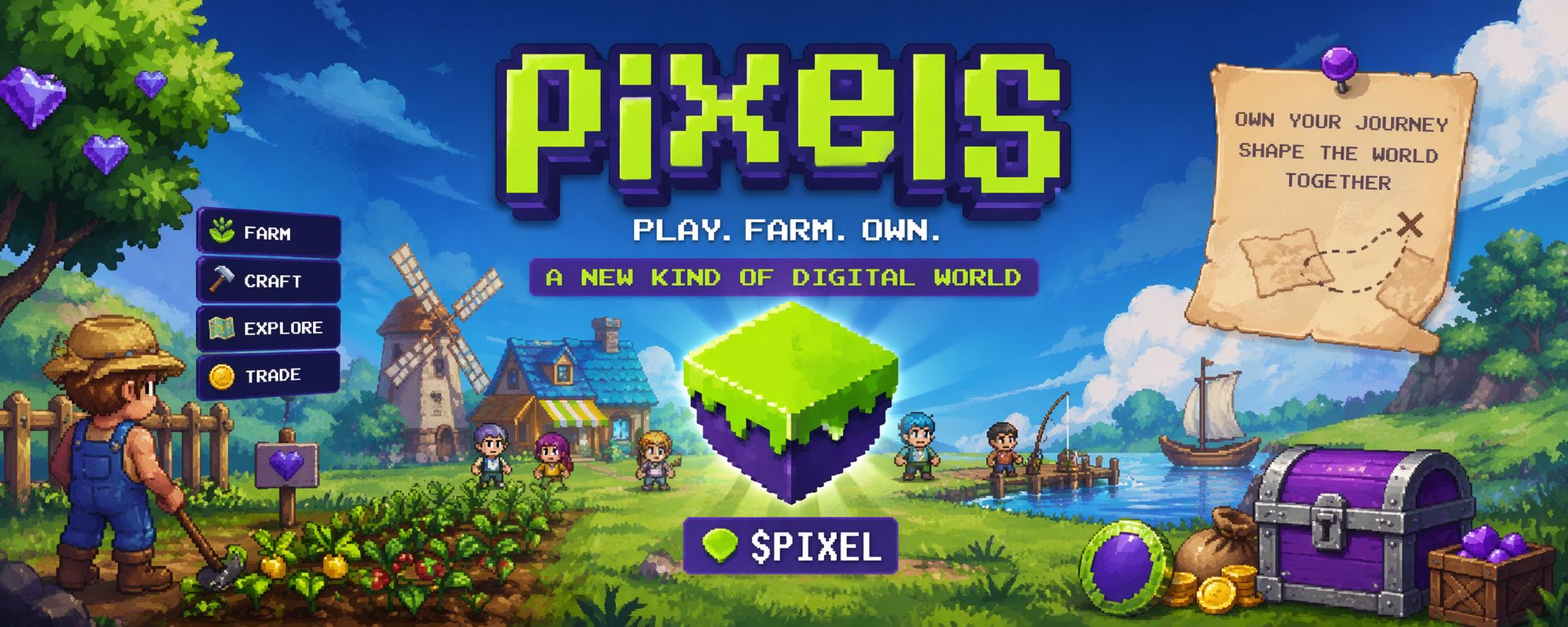
At first glance, Pixels feels familiar. The game revolves around farming, gathering resources, crafting items, and interacting with other players in a shared environment. Anyone who has played classic farming or social simulation games will recognize the rhythm: plant crops, harvest resources, upgrade land, and gradually expand what you can produce.
But behind this simple gameplay loop sits a different technological layer.
Pixels integrates blockchain infrastructure in a way that attempts to extend the life and meaning of in-game activity. Items, land, and other elements can exist beyond a single centralized database. The intention is not just to create another farming game, but to experiment with how player participation might shape a persistent digital economy.
One interesting aspect of Pixels is that the project doesn’t present itself as a highly technical blockchain product. In fact, its design appears deliberately accessible. The visual style is simple, the mechanics are easy to understand, and the entry barrier is relatively low compared with many Web3 platforms.
This design choice may be intentional. For years, blockchain gaming struggled because the technology often came before the gameplay. Many early experiments emphasized financial incentives without building experiences players genuinely enjoyed.
Pixels seems to take a slightly different route: build a world that feels approachable first, then allow blockchain tools to quietly support the underlying economy.
The ecosystem also includes the native token $PIXEL, which plays a role in connecting various activities inside the environment. Rather than existing purely as a speculative instrument, the token is intended to interact with the game’s broader system — from economic participation to community-driven structures.
Another important piece of the puzzle is the infrastructure the game runs on. Pixels operates within the ecosystem of Ronin Network, a blockchain environment developed by Sky Mavis to support large-scale gaming applications. This network originally gained attention through its association with Axie Infinity, one of the earliest experiments in blockchain-powered game economies.
By building on Ronin, Pixels positions itself within a growing ecosystem of games that share technical infrastructure. This reflects a broader shift happening in Web3 gaming: instead of isolated projects, developers are gradually forming networks of interconnected worlds and economies.
Still, the long-term direction of blockchain gaming remains uncertain. Questions about sustainability, player motivation, and economic balance continue to shape the discussion. A digital economy inside a game can be fascinating, but it also requires careful design to avoid becoming overly financialized or unstable.
Projects like Pixels therefore sit at an interesting intersection. On one side, they represent the familiar joy of building and interacting in a shared virtual world. On the other, they explore the idea that digital spaces might evolve into something more persistent — places where ownership, collaboration, and economic activity extend beyond the boundaries of a single game.
Whether Pixels ultimately becomes a defining example of this model or simply part of the experimentation phase is difficult to say. But the project contributes to a conversation that is becoming increasingly relevant: how should value, ownership, and participation work in online worlds?
As gaming and blockchain technologies continue to develop, the answer may not come from one project alone. Instead, it will likely emerge through many experiments — each exploring a slightly different version of the same underlying question.
And perhaps that question is simpler than it first appears:
If people spend years building digital worlds, shouldn’t they have some real stake in them?