
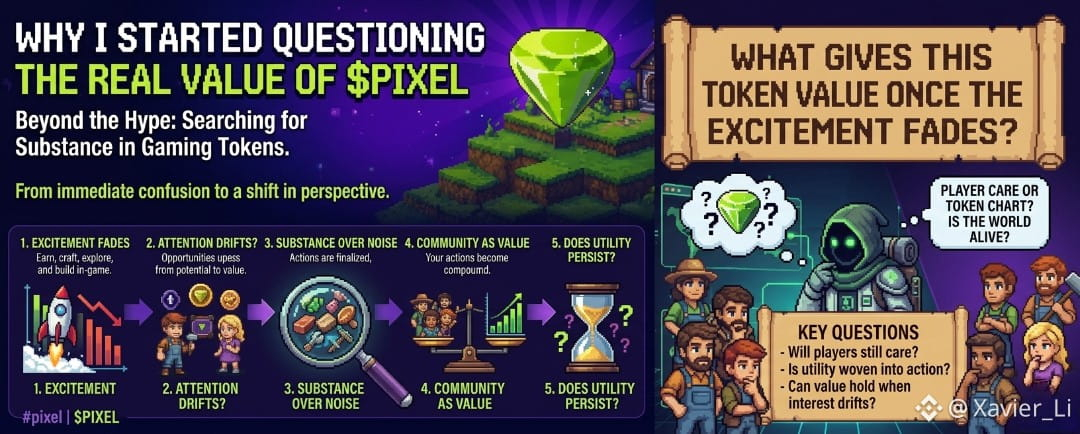
I wasn’t out searching for another token when $PIXEL first showed up in front of me.
Honestly, I had already reached that point where most gaming tokens started feeling the same. You see one launch, then another, then another, and after a while they all blur together. Same excitement in the beginning, same confident posts everywhere, same feeling that this one is supposed to be different. Then a few weeks later people get quiet and move on like none of it happened.
After seeing that enough times, I stopped reacting the way I used to.
So when I first noticed people talking about $PIXEL, I didn’t feel interested right away. My first reaction was more like, here we go again. I’ve learned that when a project starts getting too much attention too quickly, it usually makes sense to slow down instead of jumping in.
That was where my head was.
At first I thought people were probably doing what people usually do in crypto — getting attached to the token before really caring about what sits behind it.
That happens more than people like to admit.
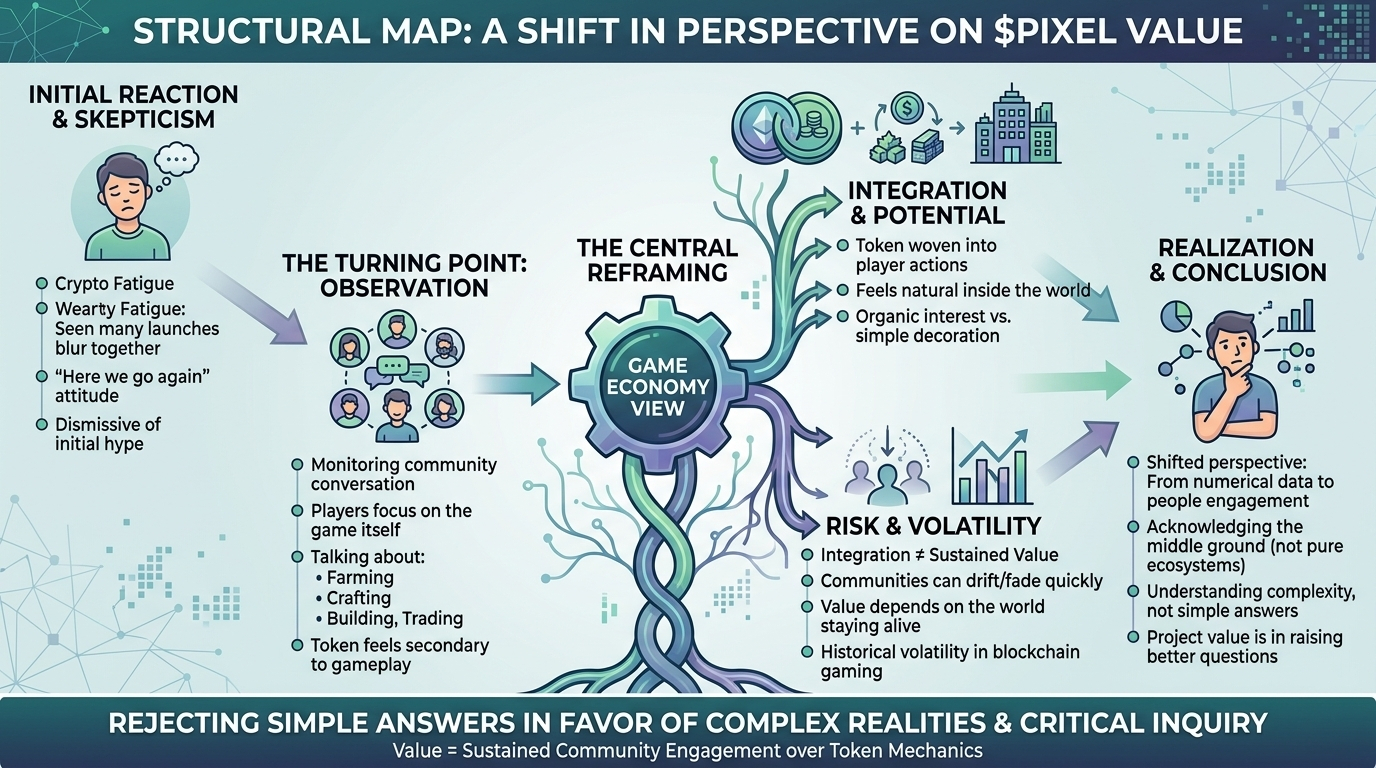
But after watching the conversations around Pixels for a bit, something felt slightly different. I kept seeing people talk about the game itself more than I expected. Not just the token. They were talking about farming, collecting materials, building things, trading with other players, and spending time in the world because they seemed to actually enjoy being there.
That stood out to me.
Most of the time with blockchain games, the token becomes the main character and the game feels like background decoration. Here it felt like the game was getting genuine attention on its own, and the token was just part of that bigger picture.
That was enough to make me stop brushing it off.
Still, being curious about something and believing in it are not the same thing.
The more I looked at $PIXEL, the more one question kept sitting in the back of my mind.
What gives this token value once the excitement fades?
That was the part I couldn’t shake.
Crypto can make it really easy to confuse noise with substance. A project can have a lot of people talking about it, a lot of posts, a lot of activity, and still not have much underneath all that attention. Sometimes people become convinced by momentum before they even understand what they’re holding.
I know that because I’ve done that before myself.
That was probably why I approached this one differently.
I wasn’t trying to decide if the token could pump. I was trying to figure out whether it actually made sense inside the world it belonged to. And the strange part was that the deeper I looked, the less black-and-white it became.
I wanted a simple answer.
Either it mattered or it didn’t.
Either it was real or it was hype.
Either it deserved attention or it didn’t.
But it didn’t feel that simple.
What changed for me was when I stopped looking at $PIXEL like a regular crypto asset and started looking at it as part of a game economy instead.
That made a difference.
Inside Pixels, the token doesn’t feel completely disconnected from what players are doing. People are already farming, crafting, trading, and moving through the world, and the token seems woven into those actions instead of sitting outside them. Compared to a lot of gaming tokens I’ve seen, that felt more natural.
And I can admit that.
But even while noticing that, I kept coming back to the uncomfortable side of it too.
Just because a token fits into a game doesn’t automatically mean the value holds.
That part matters.
I’ve seen projects with decent ideas slowly lose momentum because players stopped caring. I’ve seen communities that looked strong suddenly feel empty. In blockchain gaming, people can be deeply interested one month and completely gone the next.
And when the players drift away, the token usually feels it right after.
That was when I started questioning it more seriously.
Not because I thought Pixels was fake.
Not because I thought the project was meaningless.
It was more because I started realizing that with gaming tokens, value often depends less on the token itself and more on whether the world around it stays alive.
That’s harder to measure than most people admit.
You can study supply.
You can study charts.
You can study token distribution.
But trying to understand whether people will still care later is a completely different kind of question.
And with $PIXEL, that became the real question for me.
I stopped asking whether it had utility.
I started asking whether that utility would still matter over time.
That small change in perspective shifted everything for me.
For a long time I thought the smartest way to judge any crypto project was through numbers. Price felt clear. Market cap felt logical. Charts felt objective. But the longer I’ve been around this space, the more I’ve noticed that some projects only make sense when you pay attention to the people around them.
That ended up being true here too.
I found myself watching the players more than the token.
Some people looked genuinely attached to the world.
Some clearly cared more about the market.
Some probably cared about both.
And weirdly, that made the project feel more real to me.
Because most ecosystems aren’t pure.
They usually exist somewhere in the middle.
Pixels felt like that.
That didn’t make me less cautious.
If anything, it made me more careful.
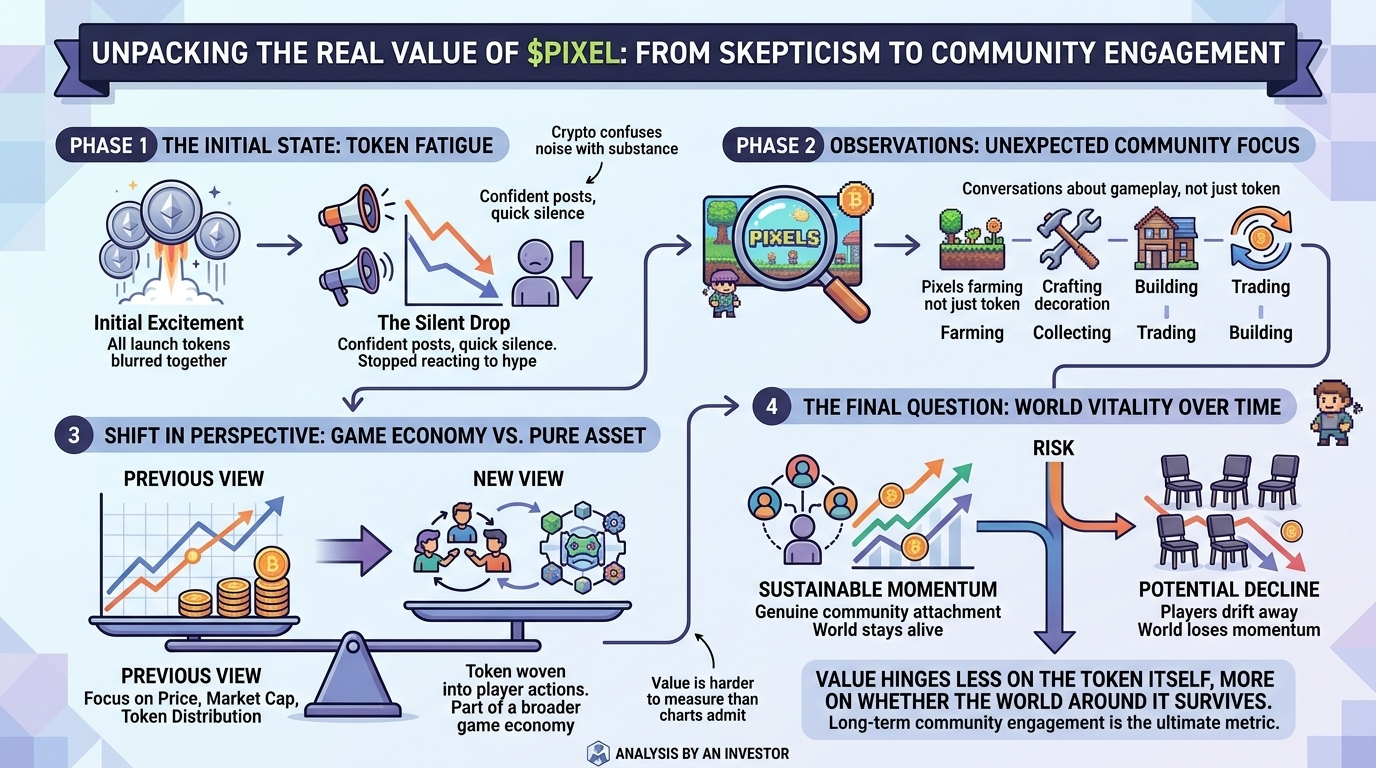
Because once I understood where the token fit, I could also see what might weaken it. If player interest slows down, if the world loses momentum, or if people simply move on, the token could easily feel very different later.
That possibility never really leaves.
And pretending it does would feel dishonest.
But maybe that’s exactly why PIXEL stayed in my mind longer than I expected.
Because it didn’t give me an easy answer.
It made me ask better questions instead.
And sometimes that tells me more than immediate confidence ever does.
