
I kept thinking about where to start, but over the past few days one name kept popping up Pixels. And honestly, that’s not unusual. This space moves fast. New ideas, new narratives, new hype cycles… almost daily. But here’s the thing not every narrative deserves your trust. That’s exactly why I wanted to slow down and look at this one properly. Not just the surface, not just the excitement but what’s actually underneath.
At first glance, Pixels looks like a simple Web3 farming game. You plant, you explore, you build nothing too complicated. But the more you think about it, the more you realize it’s asking a bigger question. When digital systems stop being just entertainment and start handling ownership, rewards, and coordination… what exactly are we trusting?
That’s where things get interesting.
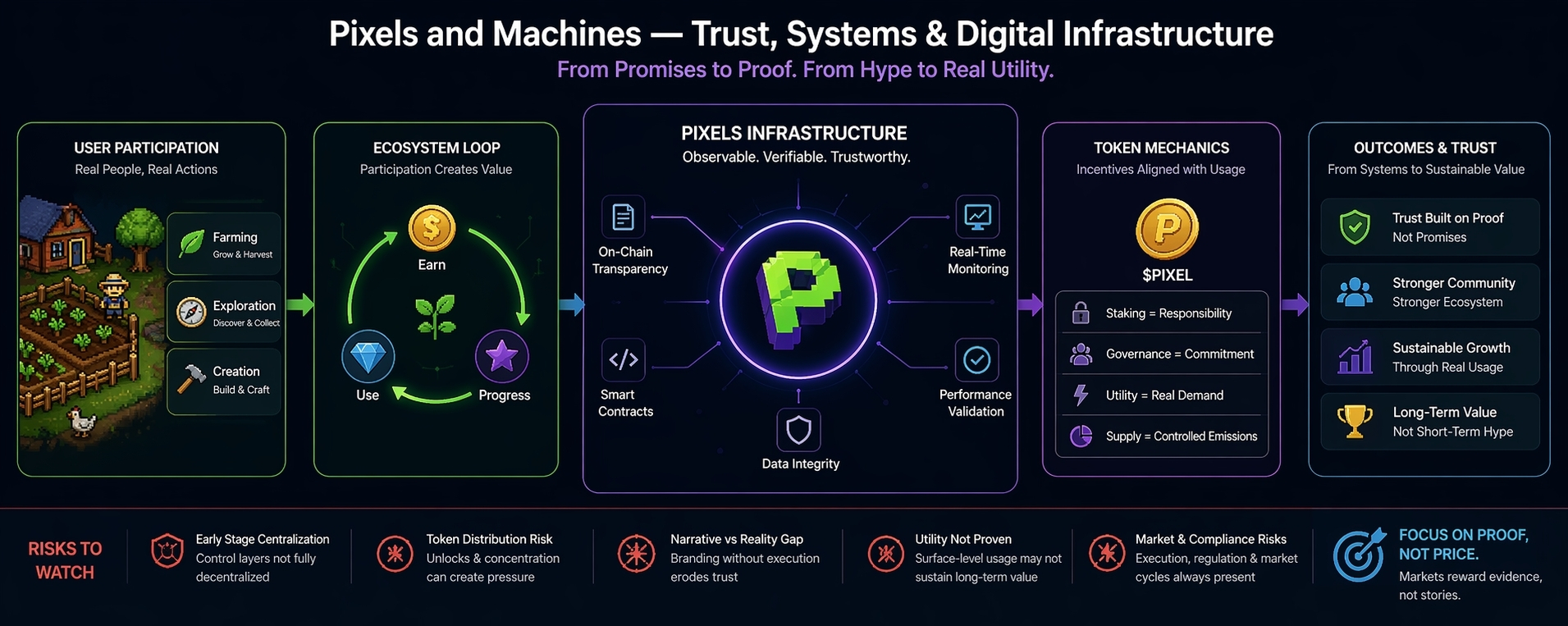
What stood out to me is that Pixels doesn’t just rely on a “token story.” It tries to connect participation, progress, and ownership into one loop. The $PIXEL token fits into that system as a tool, not just something to trade. But let’s be real for a second there’s a big difference between having utility and proving it. Markets usually react to the idea of utility long before it’s actually tested.
And that’s where most projects either level up… or quietly fade out.
Because verifying transactions on a blockchain? That part is already figured out. But verifying behavior — especially in real-time systems or future autonomous environments that’s a completely different challenge. If tomorrow these ecosystems start running with AI agents or self-operating economies, how do you actually trust what’s happening inside them?
Pixels seems to be leaning into that problem. The idea is simple: make actions visible, make outcomes traceable. Don’t just tell people things are working show them. Move from promises to proof. It sounds straightforward, but in practice, it’s one of the hardest things to get right.
At the same time, it’s important not to ignore the risks.
Early-stage systems are rarely as decentralized as they claim to be. There’s almost always some level of control sitting behind the scenes. That gap between branding and reality? It matters. If it stays too wide for too long, people notice. And when trust starts slipping, it doesn’t slowly fade it drops fast.
Token dynamics add another layer to this. In any ecosystem, the way tokens are distributed and used directly shapes how people behave. If the system rewards quick wins instead of long-term participation, things can get unstable pretty quickly. Pixels looks like it’s aiming for a more participation-driven model, but the real test won’t come during hype phases it’ll come when the market cools down and only genuine users remain.
Zooming out a bit, the bigger picture becomes clearer. Digital economies are evolving fast. Gaming, social interaction, and finance are starting to blend together. Infrastructure like Ronin Network is built to support exactly that kind of future fast, scalable, and accessible. Pixels fits into this shift, but it’s not alone. There are plenty of projects trying to solve similar problems, and that competition isn’t slowing down.
So what’s the realistic outlook?
If Pixels manages to grow its user base, keep people engaged, and actually deliver meaningful utility, then yes it has room to evolve into something bigger than just a game. But that only happens through execution. Not announcements, not branding real, consistent usage.
On the flip side, if the utility stays surface-level or the token economy loses balance, it could easily fall into the same pattern we’ve seen before strong narrative, short-lived momentum. Crypto has seen that story play out more than enough times.
At the end of the day, Pixels isn’t just a product it’s a test. A test of whether digital systems can actually build trust at scale, not just talk about it.
And trust isn’t something that slowly fades away. It holds… until it doesn’t.
That’s why the focus shouldn’t be on price it should be on proof. Because in the long run, markets don’t reward good stories. They reward what actually works.