
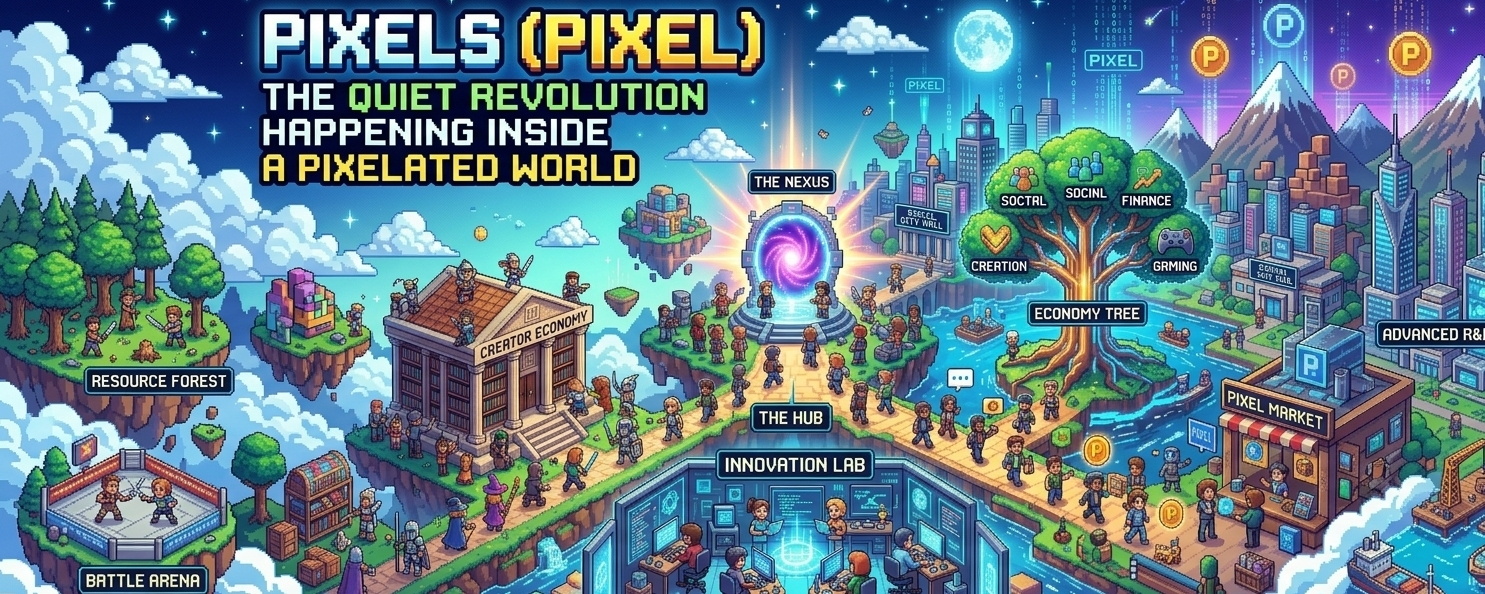
At first glance, Pixels looks deceptively simple — a charming, retro-style farming game where players plant crops, explore landscapes, and trade resources. It feels familiar, almost nostalgic. You might even mistake it for something you’ve played before.
But stay a little longer, and something interesting starts to unfold.
Beneath the pixel art and relaxed gameplay sits an entirely different kind of ecosystem — one where time, effort, and creativity can translate into real ownership. Not just points on a leaderboard, not just virtual coins that vanish when you log out — but assets that exist beyond the game itself.
That’s where Pixels (PIXEL) separates itself from the noise.
A World That Doesn’t Reset When You Log Off
Traditional games have always followed the same unspoken rule: you don’t truly own anything. Your progress, your items, even your achievements — they all live inside someone else’s system.
Pixels quietly breaks that rule.
Built on the Ronin Network, the game introduces a model where players hold real ownership over in-game assets. Land, items, and currencies aren’t just database entries — they’re tied to blockchain-based systems that persist independently of the game client.
This changes how players behave.
Instead of rushing through content or grinding mindlessly, many players treat their in-game actions more like investments of time and strategy. Farming isn’t just about harvesting crops — it’s about managing resources efficiently, understanding market demand, and building something that lasts.
Farming, But With Stakes
At its core, Pixels is still a farming game. You plant seeds, water crops, gather resources, and expand your land. It sounds simple, and in many ways, it is.
But the simplicity is intentional.
Because the real depth comes from how those systems connect.
Crops can be traded
Resources can be crafted into higher-value items
Land can be upgraded or optimized
Time becomes a measurable asset
Players quickly realize that efficiency matters. If you log in for 20 minutes, what should you prioritize? Watering? Harvesting? Crafting? Trading?
These small decisions add up.
It starts to feel less like a casual pastime and more like managing a tiny digital economy.
The Role of the PIXEL Token
Every ecosystem needs a heartbeat, and in Pixels, that role is played by the PIXEL token.
This token acts as the primary currency within the game’s economy, but it’s not just a reward mechanism. It’s woven into the structure of gameplay:
Used for upgrades and crafting
Earned through in-game activities
Traded between players
Connected to broader crypto markets
What makes it interesting is how it aligns incentives. Players who understand the game mechanics — who plan, optimize, and adapt — can potentially earn more.
But there’s a subtle balance here. The game doesn’t throw rewards at you instantly. It nudges you to think long-term.
And that’s where many Web3 games fail — but Pixels doesn’t rush you. It lets the system breathe.
Why the Ronin Network Matters More Than You Think
A lot of people overlook infrastructure, but in this case, it’s crucial.
The Ronin Network was originally built to support large-scale blockchain games without the usual problems — high fees, slow transactions, and clunky user experiences.
In simpler terms, it makes everything feel smooth.
You’re not waiting forever for actions to process. You’re not paying absurd fees just to move assets. The experience feels closer to a normal game — and that’s exactly the point.
Because if blockchain gets in the way, players leave.
Pixels understands this. It hides the complexity while keeping the benefits.
A Social Game That Actually Feels Social
Many games claim to be “social,” but interactions often feel forced — quick chats, guild invites, or leaderboard comparisons.
In Pixels, the social layer emerges naturally.
Players:
Trade with each other
Visit each other’s land
Collaborate on resource strategies
Share tips and discoveries
There’s something oddly satisfying about walking through another player’s farm and seeing how they’ve arranged everything. It feels personal — like visiting someone’s creative space.
And because there’s real value tied to assets, these interactions carry more weight. You’re not just chatting — you’re participating in a shared economy.
The Psychology of Ownership
Here’s where things get interesting.
When players feel ownership, their behavior changes dramatically.
They become:
More patient
More strategic
More emotionally invested
In traditional games, losing items or progress is frustrating. In Pixels, it can feel personal — because what you own has meaning beyond the game.
But that also creates a deeper sense of satisfaction.
Planting a crop, harvesting it, crafting something useful, and then trading it — the loop feels rewarding in a way that’s hard to explain until you experience it.
It’s not just gameplay. It’s participation.
Not Without Challenges
Let’s be honest — no Web3 game is perfect.
Pixels still faces some hurdles:
The learning curve for new players unfamiliar with crypto
Market fluctuations affecting in-game economies
Balancing fun vs. financial incentive
There’s always a risk that players focus too much on earning and forget to enjoy the game itself.
But Pixels seems aware of this tension. It leans heavily into casual gameplay to keep things grounded.
And that might be its biggest strength.
A Glimpse Into the Future of Gaming
What Pixels represents isn’t just a single game — it’s a shift in how games can work.
Imagine:
Games where your time has transferable value
Worlds that persist beyond developers’ control
Communities that co-own the ecosystem
We’re not fully there yet, but Pixels is one of the clearer steps in that direction.
It doesn’t try to overwhelm players with complexity. It starts small — farming, crafting, exploring — and builds outward.
Final Thoughts: Why Pixels Feels Different
There’s something quietly compelling about Pixels.
It doesn’t scream innovation. It doesn’t bombard you with features. Instead, it invites you in with something simple… and then slowly reveals its depth.
That’s rare.
In a space filled with overpromises and half-built ideas, Pixels feels grounded. Playable. Thoughtful.
It respects your time — and more importantly, it gives that time meaning.
And maybe that’s the real shift here.
Not just playing a game…
but being part of something that continues to exist, grow, and evolve — whether you’re logged in or not.