
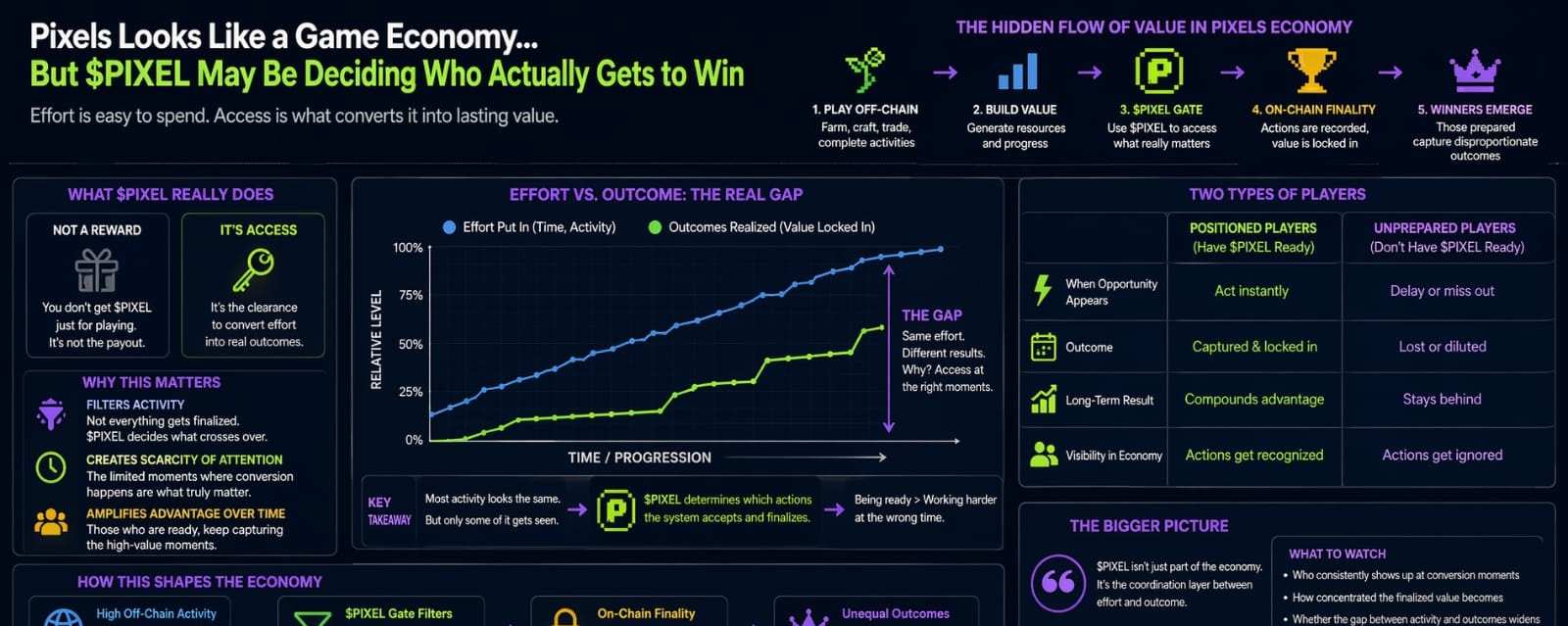
I didn't catch it immediately. Pixels just seemed active. Farms running, trades flowing, players grinding through the same loops the way they always do in these kinds of systems. A quick glance and it looks like any other on-chain economy trying to hold attention long enough to build something real.
But after enough time watching, something starts to feel unbalanced. Not broken. Just quietly skewed.
You can put in the same hours as everyone around you, follow the same paths, stay just as consistent — and still end up in a different position when it counts. Some players keep landing better outcomes. Not more talented, not more active. Just better placed at the right moments. I assumed it was variance. Maybe timing. But neither explanation held up.
That's when I started looking at pixel differently.
The basic design is straightforward. You play off-chain, earn through normal activity, then bring $PIXEL in when something actually matters — upgrading assets, securing land, accessing the deeper economic layer. Clean separation between lightweight activity and meaningful finality. Plenty of projects build this way.
But the distance between those two layers feels larger than it should.
Most of the time, players are just moving through a frictionless loop. Farming, crafting, managing resources. Nothing forces a real decision. Then something limited shows up — a scarce asset, a timed opportunity, a meaningful upgrade — and the whole energy shifts. Suddenly activity doesn't matter. What matters is who can move without hesitating.
That's where $PIXEL quietly becomes something else.
Not a reward. More like clearance.
Have it ready and you move. Don't have it and you stall, or you miss the window completely. On its own, each instance feels minor. But it compounds. The same players keep appearing at exactly the points where value gets locked in. Not because they outworked everyone in that moment. Because they were already set up to convert when it counted.
This pattern exists outside of games too.
In financial markets, positioning beats effort almost every time. Traders with deeper liquidity don't just execute more — they execute the trades that actually matter. They're there when windows open for seconds. Everyone else is technically in the market, but not really competing for the same outcomes.
Pixels is starting to feel like that.
The strange part is the system doesn't present itself this way. It still reads as open. Anyone can enter, anyone can earn, anyone can participate. And that's technically accurate. But when you watch long enough, you start to see that not all actions carry the same weight. Some just circulate. Others get pulled toward finality and become something real.
Pixels sits right at that boundary.
It doesn't shape what you do. It determines whether what you did actually registered.
That's an uncomfortable distinction, because it changes how you think about fairness inside the economy. If outcomes mapped cleanly onto effort, the system would eventually level out — everyone optimizing the same loops, returns compressing, nothing separating players over time. But if the system is filtering which actions get recognized and locked into value, then scarcity relocates.
Not into resources. Into attention.
Not the social kind. Economic attention. Which actions the system actually sees, processes, and converts into something permanent.
I'm not convinced this was all intentional. It might just be what emerges naturally when you combine off-chain scale with on-chain constraints. You need a mechanism to decide what crosses over. You can't finalize everything — too costly, too cluttered, too unstable.
So a gate forms. And once a gate exists, something has to price access to it.
That's where pixel starts behaving less like a typical game token.
It's not really about how much you earn. It's about when you're permitted to matter.
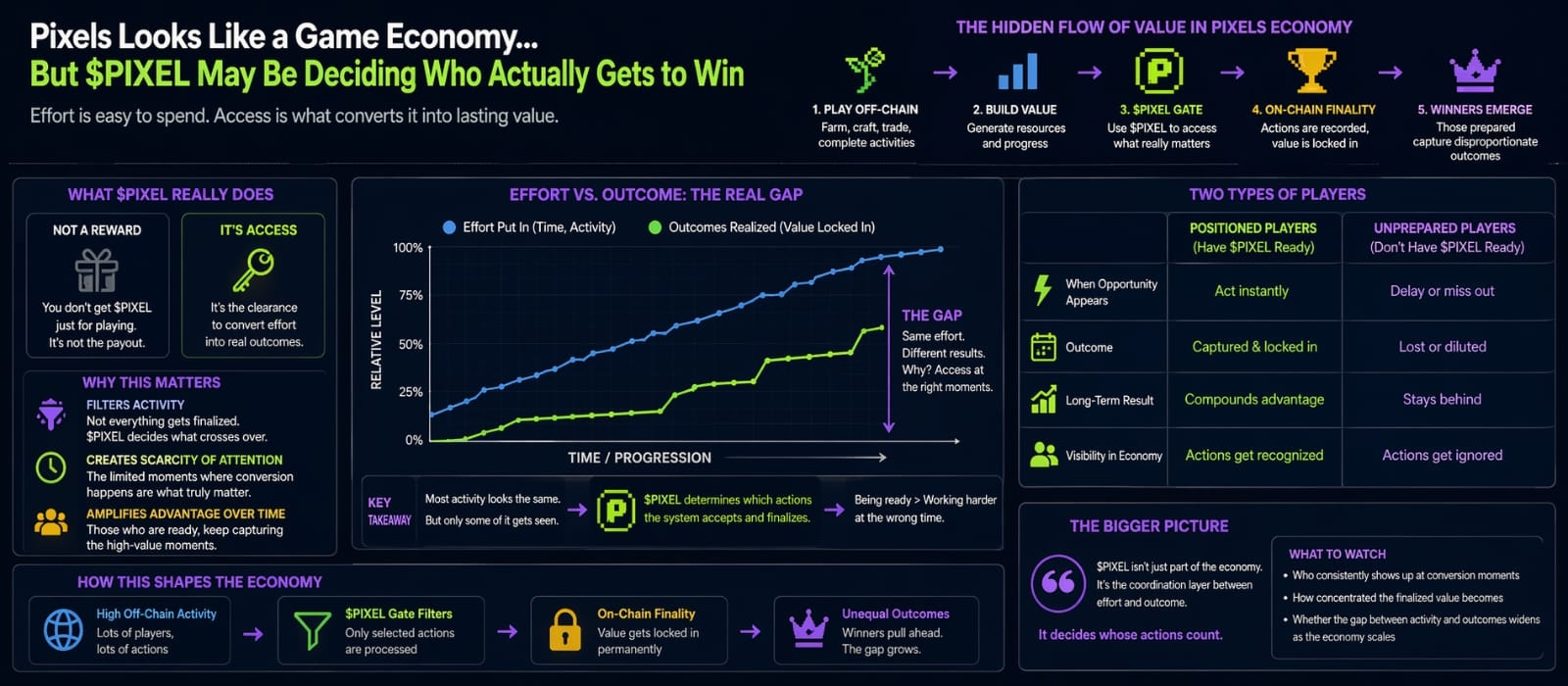
There's a function to this. It keeps the economy from being overwhelmed by its own volume. Not every action needs to settle on-chain. Not every player needs to convert simultaneously. It creates rhythm, structure, pacing that wouldn't otherwise exist.
But it also creates separation.
Players adapt. They always do. Once it becomes obvious that conversion points are where real economic outcomes live, behavior reorganizes around them. Less exploration, more targeting. Less casual play, more checkpoint optimization.
That's where the system becomes fragile.
If enough players converge on the same moments, the value of being early and prepared amplifies. Those already holding $PIXEL, or those who understand when to deploy it, begin building quiet advantages. Not dramatically. Just consistently. Over time.
New players still come in. Still generate activity. Still feel like they're part of something. But their actions don't always reach the layer where economic outcomes are decided. They're inside the system — just not inside the part that counts.
That gap is nearly invisible if you're only tracking surface-level metrics.
Player numbers grow. Activity stays high. The world looks alive. But the moments where value actually crystallizes stay selective — and potentially more selective as the system matures.
That's why calling pixel a reward token doesn't feel right anymore. It functions more like a coordination layer. Something positioned between effort and outcome, filtering which actions pass through and which stay in the background indefinitely.
I don't think that's fully reflected in how the market values it yet. The dominant narrative is still about growth, engagement, user counts. Standard framing. But if this system keeps developing in this direction, those metrics won't tell the real story.
The actual signal will be harder to read.
Who keeps showing up at exactly the moment the system converts activity into value — and who stays one step behind it.