
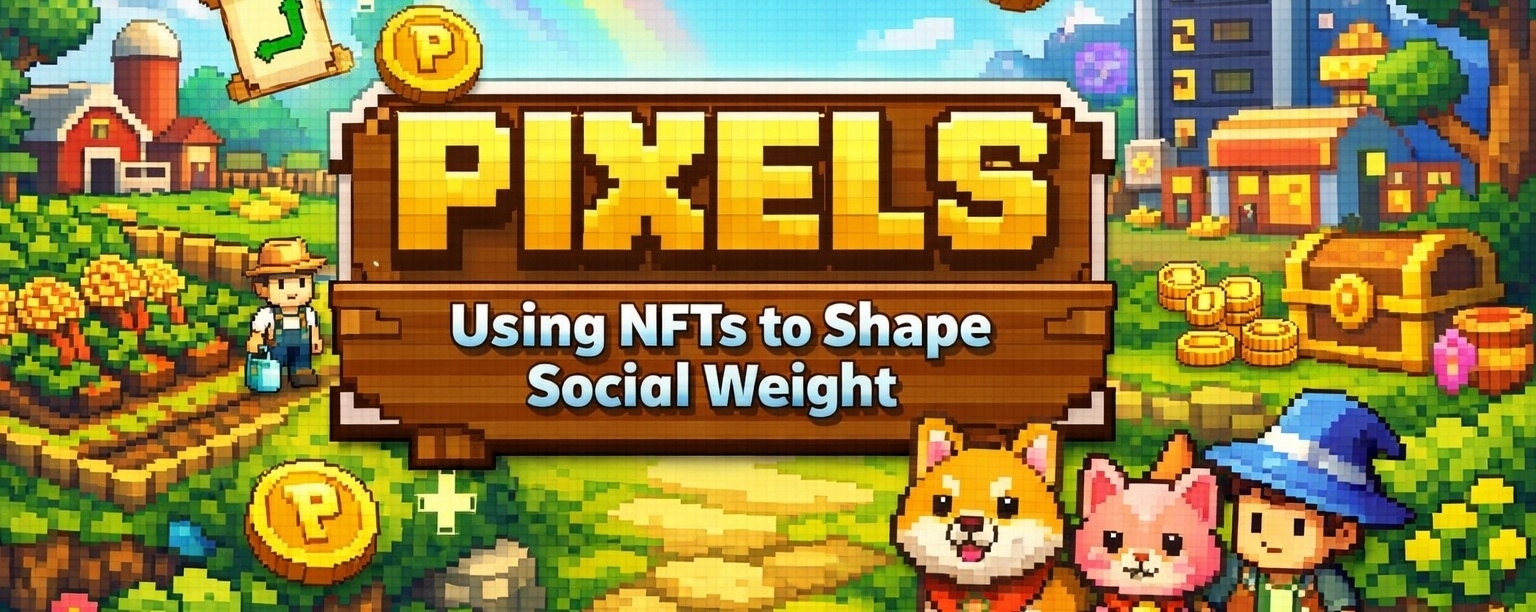
I didn’t understand Pixels (PIXEL) the first time I stepped into it. It felt like another soft, casual farming game—something familiar, almost predictable. I planted crops, gathered wood, completed small tasks, and moved on. But the longer I stayed, the more I started to notice that the experience wasn’t as simple as it looked. It wasn’t just a game loop repeating itself—it felt like I was participating in something that had structure, intention, and quiet depth beneath the surface.
I see Pixels as more than a game. To me, it feels like a system that is slowly learning how to behave like an economy. It lives on the Ronin Network, and that matters because Ronin already carries the DNA of Web3 gaming—ownership, scale, and a player-first asset structure. When I interact with Pixels, I don’t feel like I’m just progressing through levels. I feel like I’m stepping into a world where time, effort, and digital assets are constantly being measured and translated into something larger.
What pulls me in is how the game hides its complexity. On the surface, I’m just farming, mining, cooking, or exploring. But underneath, every action feels connected to a broader system. When I plant crops, I’m not just waiting for them to grow—I’m engaging with timing, resource cycles, and energy constraints. It’s subtle, but over time I start to feel how the system shapes my behavior. I don’t just play randomly anymore; I begin to optimize, to think ahead, to manage my actions like they actually matter.
The world doesn’t feel isolated either. I’m not alone in Pixels. I see other players moving around, building, trading, interacting. It creates this quiet sense that I’m part of something shared. And when I started to understand land ownership, the experience shifted even more. Land isn’t just decoration—it’s power, access, and opportunity. Some players own land, others use it, and suddenly there’s a relationship forming between players that feels closer to an economy than a traditional game.
That’s when I began to notice the deeper structure. Resources flow into items, items create value, and value connects back to tokens. It’s not forced—it just exists beneath everything I do. The PIXEL token sits at the center of this system, not as a loud feature, but as a layer that ties everything together. When I earn it, it doesn’t feel like a random reward. It feels like a result of participation, like the system is recognizing my time and translating it into something measurable.
What’s interesting is how this doesn’t feel aggressive. Pixels doesn’t push me to think about money or profit every second. It lets me exist in the game naturally. But over time, I realize that my actions have weight. My time isn’t just disappearing into gameplay—it’s contributing to something persistent. That realization changes how I approach the game. I become more intentional, more aware of how I spend my energy and what I choose to do.
I also notice how the system isn’t static. It feels like it’s still evolving, still trying to figure itself out. New mechanics appear, guild structures start to matter, and the economy slowly becomes more layered. I don’t feel like I’m playing a finished game—I feel like I’m inside something that is still forming, still adjusting its balance between fun and function.
And maybe that’s what keeps me interested. Pixels doesn’t try to overwhelm me with complexity upfront. It lets me discover it gradually. It starts as a calm farming experience, but over time it reveals itself as something deeper—a space where gameplay and economy are blending together in a way that feels natural rather than forced.