
I’m waitingI’m watchingI’m lookingI’ve noticedI focus on the small loops that repeat without announcing themselves, the way a patch of land is revisited not out of urgency but habit, the way hands return to the same motions as if the soil remembers them before the player does, and I can’t quite tell when attention turns into pattern or when pattern begins to feel like something the world expects.
There is a softness to how things unfold in Pixels, something that resists the sharp edges of competition. Movement doesn’t demand precision so much as it invites continuation. A field is planted, harvested, replanted. Paths are walked again, not because they are the shortest, but because they are known. At first it feels open, almost indifferent to what anyone chooses to do. But over time, the openness begins to narrow in ways that aren’t immediately visible.
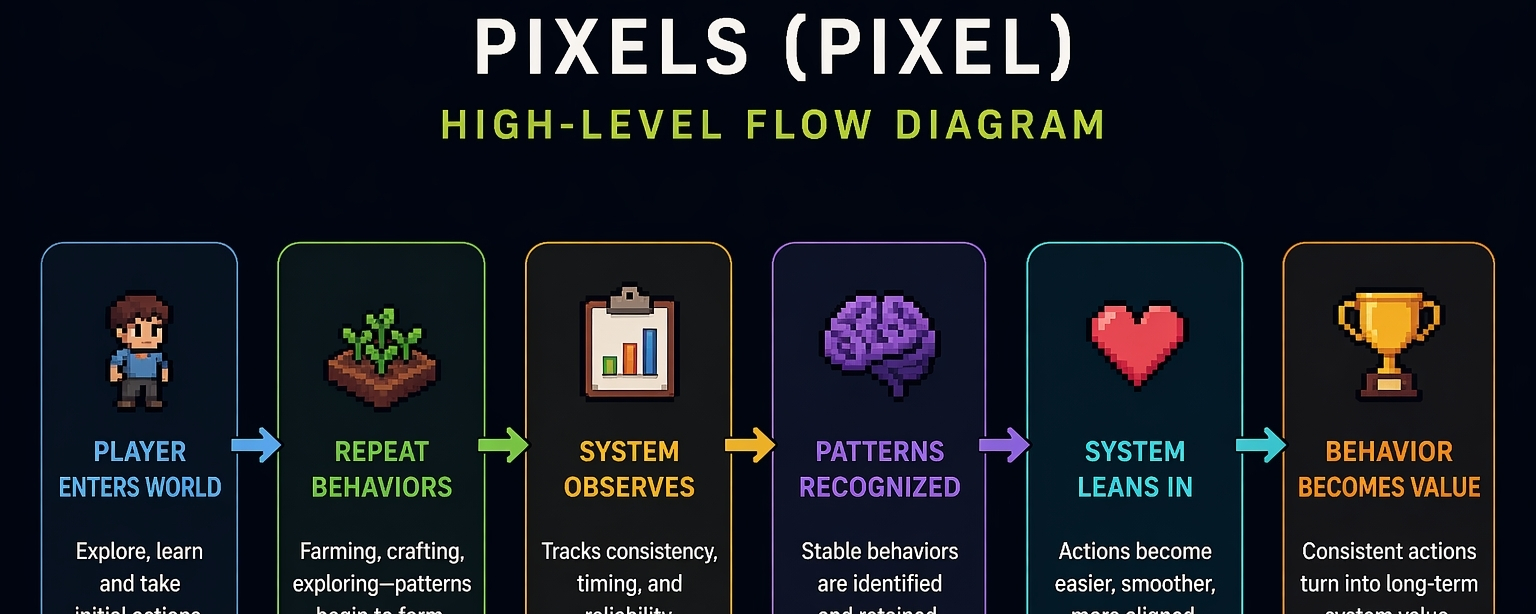
I’ve noticed that not all repetitions carry the same weight. Some loops feel lighter, as if they pass through the system without friction. Others seem to hesitate, like they’re being measured against something that isn’t quite stated. It isn’t about speed or efficiency in any obvious sense. There are players who move more slowly, who take longer routes, who linger, and yet their presence seems to settle more easily into the world. Their actions don’t stand out, but they don’t fade either. They persist.
It’s difficult to say when this difference begins. There’s no clear threshold, no moment where the system signals a shift. But gradually, certain behaviors seem to carry forward. Not in the sense of progress alone, but in the way they are received. A planted crop grows as expected, but the act of planting begins to feel less like a decision and more like a continuation of something already recognized. The system doesn’t react; it accommodates.
Others move through the same spaces and perform the same actions, but something doesn’t quite align. Their efforts register, but they don’t seem to accumulate in the same way. It’s as if each action is evaluated independently, without the benefit of memory. There’s no visible penalty, no obvious loss, just a quiet absence of continuity. The loop resets more completely.
I find myself wondering if effort is even the right measure here. Effort suggests intensity, intention, a kind of visible striving. But what seems to matter is not how much is done, but how consistently it resembles what has already been done before. Repetition alone isn’t enough; it has to stabilize. It has to settle into a shape that the system can recognize without needing to reconsider it each time.
And once it reaches that point, something changes. The behavior no longer feels like effort at all. It becomes easier, but not in the sense of reduced difficulty. It becomes expected. The system begins to lean toward it, not overtly, but in small, almost imperceptible ways. Outcomes align more smoothly. Transitions feel less interrupted. There’s a sense that the world is no longer just responding, but anticipating.
This is where the boundaries start to blur. Growth doesn’t expand outward as much as it refines inward. Players begin to adjust, not necessarily consciously, but through small corrections. A route is shortened here, a timing is altered there, not because it’s faster, but because it feels more stable. The variability that once defined exploration starts to compress into narrower patterns.
It’s subtle, this narrowing. Nothing is taken away. The world remains open, the options still visible. But the difference between what is possible and what is carried forward becomes more pronounced. Over time, the distance between those two begins to matter less than it seems.
I’ve watched players who don’t resist this shift, who allow their actions to settle into these patterns without questioning them. They don’t appear constrained. If anything, they seem more at ease, moving with a kind of quiet alignment. Their presence feels continuous, as if each action is connected to the last in a way that doesn’t need to be reestablished.
Others hold onto variation, testing the edges, changing rhythms, introducing small disruptions. Their experience doesn’t collapse, but it doesn’t accumulate in quite the same way either. There’s a kind of reset that follows them, a lightness that never quite anchors.
It makes me wonder what the system is actually holding onto. Not outcomes, not rewards in the usual sense, but patterns that prove themselves stable enough to be reused. Behavior that no longer needs to be evaluated each time it appears. Once something reaches that point, it stops being an action and becomes something closer to infrastructure.
And maybe that’s where the quiet tension sits. The more a player aligns with these patterns, the less visible their effort becomes. It dissolves into the system, indistinguishable from the processes that support it. There’s a kind of comfort in that, a reduction of friction, a sense of belonging. But it also raises the question of what is being shaped in return.
I’m still watching, still trying to see where the boundary is between adapting to the system and becoming part of its logic. It doesn’t feel like a decision that happens all at once. It’s slower than that, more gradual, like a drift that only becomes noticeable when you look back.
And the longer I stay with it, the less it feels like a game responding to players, and more like a space that quietly learns which versions of them are easiest to keep.
