

@Pixels i remember checking PIXEL after one of those tiny green candles and feeling annoyed more than excited. The price was moving, volume was there, people were talking again, but the question in my head wasn’t “can this pump?” It was “can Pixels actually afford the behavior it’s rewarding?” That’s where this whole RORS idea changes the way I look at the trade.
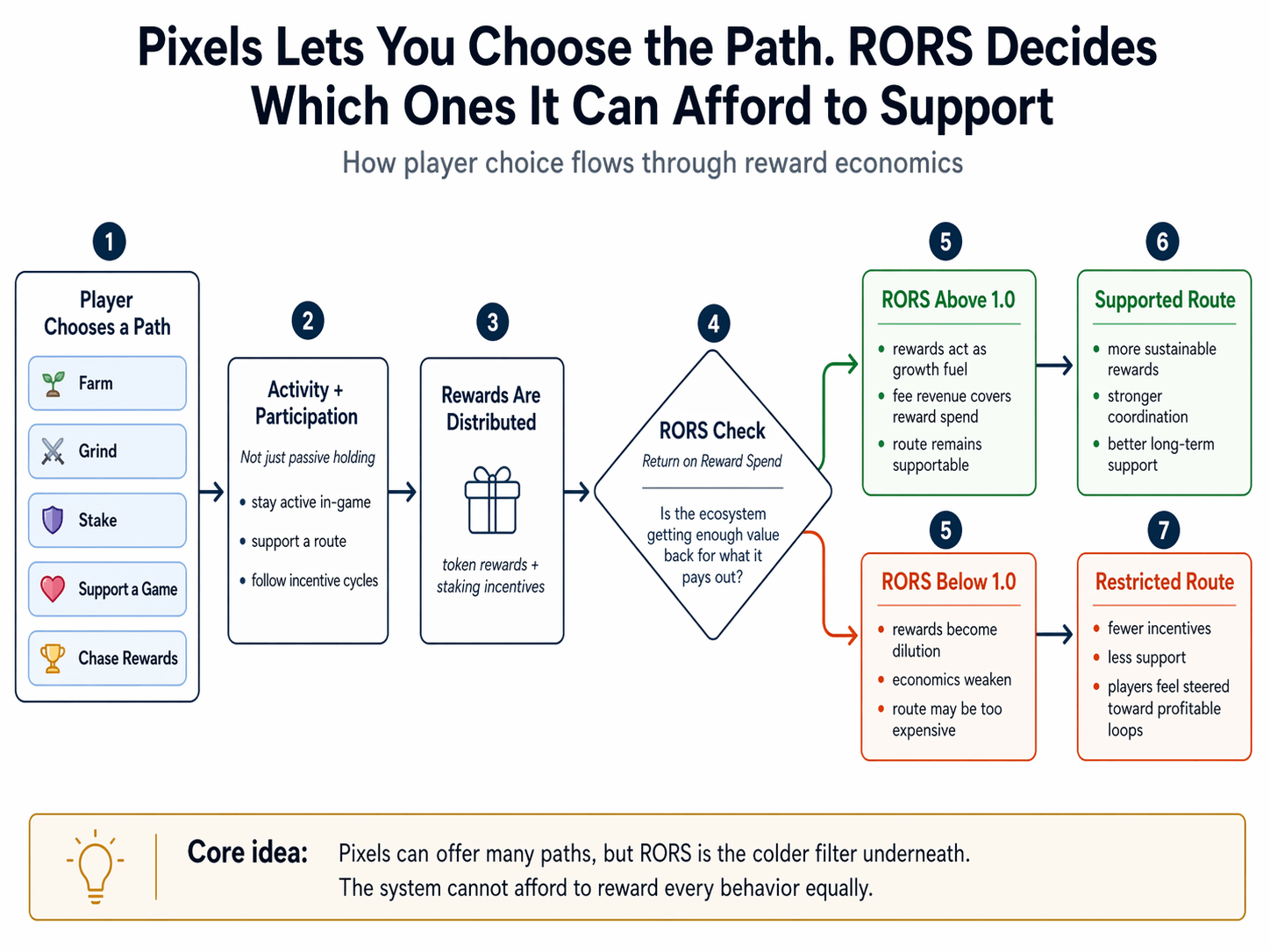
Pixels lets you choose the path. You can farm, grind, stake, support a game, chase rewards, or sit around waiting for the next incentive cycle. But RORS, or Return on Reward Spend, is the colder layer underneath. It basically asks whether the system gets enough value back for what it pays out. One public explainer describes Pixels’ RORS target as above 1.0, meaning the ecosystem should generate more than one dollar in fee revenue for every dollar equivalent of token rewards distributed. That’s not a cute design detail. That’s the difference between rewards as growth fuel and rewards as slow dilution.
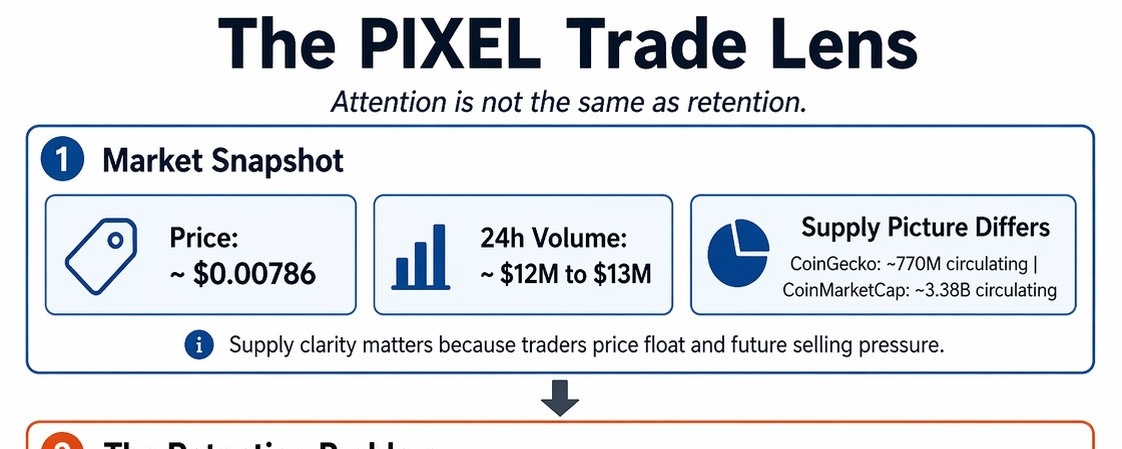
Today’s market still looks cautious. CoinGecko shows PIXEL around $0.00786, with about $12.17 million in 24 hour volume, down 3.8% over seven days, and a market cap near $6.06 million based on roughly 770 million circulating PIXEL. CoinMarketCap shows a very different supply picture, with about 3.38 billion circulating, a market cap near $26.5 million, and 24 hour volume around $13.1 million. That supply difference matters because traders aren’t just pricing the chart. They’re pricing how much float is actually out there and how much future selling pressure the market may need to absorb.
Now here’s the thing. A low price doesn’t automatically mean cheap. High volume doesn’t automatically mean conviction either. When a token is doing almost half its market cap in daily volume on some trackers, it can mean attention is alive, but it can also mean holders are rotating fast. That’s the Retention Problem. Are players and stakers staying because the system creates repeat reasons to participate, or are they just showing up when rewards are attractive?
Pixels’ staking docs make this more interesting because in-game staking rewards aren’t just about holding a minimum balance. Users need to remain active in-game, and inactive accounts may not be eligible for rewards. That tells me Pixels is trying to tie capital support to actual behavior, not just passive parking. The staking FAQ also tells users to choose games based on gameplay preference, activity, reward potential, and long-term outlook, which fits the idea that the route you choose matters, but the system still decides what kind of route deserves support.
The bull case is pretty simple, but it needs discipline. If PIXEL can keep daily volume around the $10 million to $13 million range while improving retention, and if reward routes keep getting tied to activity instead of blind emissions, then the token starts looking less like a normal GameFi farm coin and more like a coordination asset for player behavior. At a CoinMarketCap-style valuation near $26 million, even modest proof that RORS is working could change how traders value the project. Not because the chart “deserves” it, but because sustainable rewards are rare in Web3 gaming.
But I’m not fully comfortable. The bear case is still right there. PIXEL is far below its old highs, supply data varies across platforms, and the market is clearly not giving the project a clean premium yet. If players only stay while rewards are attractive, RORS becomes a restriction, not a growth engine. The system may support fewer paths than users want, and that can feel frustrating. In real life, it’s like a food delivery app giving promos only on routes where it knows the economics work. Smart for the company. Annoying for the driver who wanted freedom.
That’s the tradeoff I’m watching. Pixels can’t reward everything. It shouldn’t. But if RORS becomes too tight, players may feel like the game is pretending to offer choice while quietly steering them toward only the profitable loops.
So watch the boring stuff. Activity. Reward rules. Volume quality. Supply clarity. Whether Stacked and staking create repeat participation after the reward excitement fades. Don’t just ask where PIXEL can go next. Ask which player paths Pixels can afford to keep paying for, because that’s where the real signal is hiding.